
Goal.com
+18 | Commercial Content | T&C's Apply | Play Responsibly | Publishing Principles
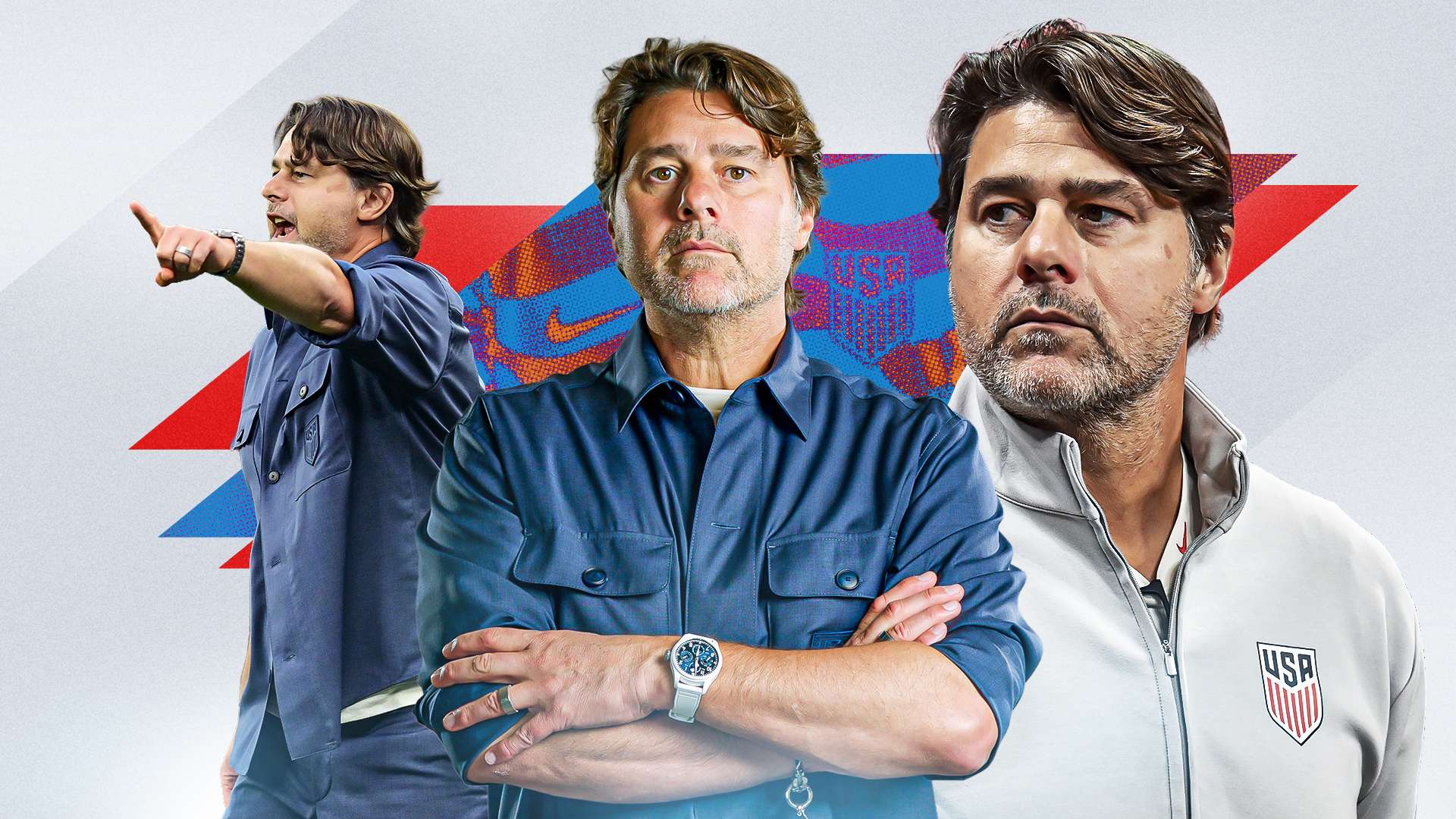
Mauricio Pochettino GFXGOAL

'Why not us?' - Inside Mauricio Pochettino's USMNT World Cup dream, the American lessons driving his belief and the legacy he wants to build

IRVINE, Calif. -- Mauricio Pochettino's office is located on the lower floors of the U.S. Men's National Team's World Cup hotel. The first thing you notice about it is the view. A quick glance onto the balcony and beyond offers a breathtaking perspective of the Pacific Ocean. It's a sight that, even a few weeks into this whole thing, still amazes the manager who is calling that office home.

"Twenty-four hours, you see people there doing their surfing," Pochettino says as he stares out into the sun just starting to set over the ocean. "It's a little bit boring, no? They're waiting for the perfect wave, and it never arrives."

That reflection there offers a glimpse into the mindset of the USMNT head coach, a man who isn't content to simply sit, wait, and hope for that perfect wave. More glimpses into Pochettino's psychology are scribbled all over the wall behind him. Each one in his own handwriting, he says, and no one else's. There are quotes, mantras, tributes, and reflections. Above them all, though, sit six giant letters.

Why not?

Those two words, Pochettino tells the group of reporters gathered in his office, are at the center of everything. They're the reason he took this job, and the reason he was able to navigate the moments where it got hardest. They're the words that he tells himself daily. He says them often to his players, too. In fact, he remembers the first time he said it and the spontaneity of it all. Perhaps that's why they matter so much: because they came at a moment in time when he and his players needed to hear them.

That moment came back in November, and it came in what was a seemingly routine team meeting. The USMNT entered that room expecting to hear a team talk; they left with an ideal.

"I never prepare for the meetings," Pochettino says. "Of course, I prepare in my mental way, but in the end, it's more intuition, feelings, or emotion. In this moment, I said, 'Come on guys! You are listening to me, and we need to believe. Why not us? What? Why not? We can beat these guys that are right there, even when no one believes.'

"It's because it's true. It's true."

Pochettino, at his core, does believe that. So, too, do the players. They've spent all summer saying it. They've spent all summer wondering aloud about their place at this home World Cup. They've spent their summer, to put it bluntly, asking "why not?"

Through their first two World Cup performances, they've lived by those words. A 4-1 win over Paraguay opened proceedings, and then a 2-0 win over Australia followed. Now, the questions aren't just being asked inside the USMNT's meeting room; they're being asked by onlookers all over the world. Why can't this team win at this World Cup? And, man, what would happen if they did?

Ultimately, only one team can lift that trophy. The odds say it won't be the USMNT. But it could be, and people are starting to believe that fact. In some ways, that means that Pochettino has already done his job, the one he set out to do less than two years ago. He arrived on American soil and found a country that needed something to believe in. That country might just have found what they were looking for in a coach and a team that is now looking to create their own perfect wave.

"It's being part of something that can create a legacy," he says. "For me, that is the most important legacy: the connection between the national team and the fans. That is, for me, the legacy. It's not to win the World Cup, and of course, we do want to win, but that is the legacy that we need."

The construction of Pochettino's legacy will happen over the next few weeks, and with a spot in the knockout rounds already secure, there's much writing left to do. So far, though, everything is just about going to plan. It didn't always feel that way, and the quotes written behind Pochettino's desk reflect that. They're not all relentlessly positive or optimistic; some are there as reminders for the coach, his players, and anyone with a reason to reflect on how this all came together.

  • United States v Mexico - Gold Cup 2025: FinalGetty Images Sport

    'It was so painful'

    Pochettino can admit it now: he cried his eyes out after the Gold Cup final loss to Mexico. It wasn't about the loss, though, because he's felt plenty of those. It wasn't about the performance or the opportunity squandered. No, on that day, in front of his players, tears flowed down Pochettino's face because of what he just saw and, more importantly, what he just heard.

    On that day in Houston, the U.S. fell to El Tri in front of a crowd filled with green, white and red. It didn't feel fair, Pochettino said, and all he could do was cry and wonder about what it would take to get his players to feel that type of support. He knew it was possible, having seen it himself at his first college football game between Ohio State and Texas. On that day, though, like so many others before it, the USMNT were the away team in their own country. They weren't necessarily a team lacking support, but they were a team that wasn't feeling it in stadiums.

    "I felt so sad for all the American people," he says, "for the players, for the staff. We play in our own place, our own country, and there are 70,000 Mexican people, singing 'Cry and cry', 'Llorar y Llorar' in your own country. I cannot accept that. It was so painful, so painful."

    Fast forward less than a year later, and Pochettino is on the field in Seattle after the win over Australia, hugging everyone in sight. "Country Roads" is blasting through the stadium as thousands of Americans sing their own song and celebrate their own moment. That, he says, is culture. That, he says, is what he was fighting for since the beginning.

    The culture was always there, he believes.

    "My question was, 'why not?'," he says, again using that same phrase. "If the fans are very passionate, why are they not with us, with soccer? They will be showing that same passion is massive. It's so powerful for the players, and now we achieve that. I think it's amazing, and that may change, a little bit, the game, because to be part of, to help, to evolve in a very good direction, this sport that we really love. We feel the passion. If the American people start to show passion in our sport too, not only in other sports, why not be here and be part of something?"

    He adds, "Being here is an amazing challenge, and then that football is very dynamic and changes after the connection. The team starts to feel that with the fans in Charlotte, in Chicago, in Los Angeles, and in Seattle. It's completely different than all the games before."

    That didn't happen overnight. World Cup wins help, for sure, but there's no denying all of the growing pains that led Pochettino and his players to them. Losses, criticism, questions - those all piled up during the middle part of his tenure once that new-coach shine wore off. Even that, though, Pochettino says, was expected, although even he can admit that, for a while there, it got worse than he anticipated.

  • Advertisement
  • FBL-WC-2026-MATCH04-USA-PARAFP

    The punch and the process

    Pochettino knew it was coming and, in hindsight, he was glad it happened when it did. When the USMNT was embarrassed at the CONCACAF Nations League in March of 2025, Pochettino wasn't the least bit surprised. His team deserved it. They needed it, too.

    "We received that big, bang, punch, and we were not knocked out for a while," Pochettino can admit with a laugh now, adding that he and his team might have been a bit "naive" about how complacent the USMNT had gotten when they arrived. "We say, 'What the f***? We were so excited about [the job] because we say, 'Oh, it's so close, the World Cup, so I think the people are desperate to help, to be involved, to come to the national team'. No, it was the opposite.

    "That punch, we expected. I think it was more of a plan to have this punch that was painful, but was necessary for the people to realize in which place we were. Even for the players to realize that, in this way, it's impossible. It was impossible to arrive in good condition for the World Cup."

    In the year and change since, much has been written about the process of fixing it. It began with a Gold Cup of hungry up-and-comers. It continued with a gradual rebuild of both the squad and the culture in the fall. It included one more setback in the spring and then two confidence-boosting friendlies before the World Cup kicked off. It hasn't been linear and it hasn't always been pretty. Throughout it all, Pochettino just asked for trust.

    Through two games of this World Cup, at least, he's shown he might just have been onto something.

    "It's difficult to analyze the process," he says, reflecting on the path here. "The process is like when you put the seed in the soil. It's, at first, a seed. You don't see nothing, no? Then you start to grow the tree. It was difficult to explain the plan because it's not easy."

    The goal of that plan, ultimately, was for this team to peak at the World Cup and, in the process, build a sustainable culture like many Pochettino has encountered in his career. During that process, though, Pochettino embraced something that might not have been fully in his plans: he embraced being an American, and all the quirks that come with it.

  • FIFA World Cup 2026 PreviewsGetty Images Sport

    From Teddy Swims to Chick-fil-A

    Pochettino is quick to rattle off the music he's been listening to. It's a lot more country than before, he can admit. Lainey Wilson has been on the playlist lately. So, too, has Ella Langley. Teddy Swims, of course, remains a favorite. Pochettino went to that concert in New York in December.

    He arrived in America well aware of the misconceptions, he says. He knew all about American food, but was blown away by the sheer number of options. There's your healthy organic, but also your good old American grease, and you can get all of it and more at any Whole Foods. He enjoys Chick-fil-A, too. "It's amazing," he says, drawing a laugh.

    It's not just the music, the food, or even the chicken sandwiches that Pochettino has fallen for, but rather the spirit. Since taking over as USMNT boss in October 2024, Pochettino has coached his team in 20 different American cities. As a result, he's seen a lot of America.

    "When you come here, you can wear something like this," he says, pointing to his USMNT tracksuit, "and go to a restaurant, or you can wear a suit and tie. People are very approachable and make you feel comfortable. It's very welcoming. You can go to, I don't know, some place like Nashville, go to a bar, and if you're alone, you can make friends so quickly. You can look like you belong in a few minutes and feel like you belong in that place.

    "When you go around America, that for me was a massive surprise, and every state is all different, but you have the same sense of human being. You always want to welcome people. You make people feel that they belong quickly in that place... I know that the country is massive, and the people are so good. I think we learn a lot. I think we are much better people now, knowing the country and the culture of the people here."

    The world has gotten a taste of that this summer. Pochettino, admittedly, hasn't followed much of the fan culture outside of the USMNT bubble, but he has seen glimpses. Algeria becoming one with Kansas, Scotland taking over Boston, Norway rowing their way through Times Square - the world has arrived stateside for the World Cup, and many are learning lessons Pochettino has learned for the last 20 months.

    "When people come, they start to realize that sometimes you have a wrong idea about the people here in this country," he says. "Maybe the different countries reflect different visions about the USA. The reality is different."

    It's why, even now, he's not totally closing the door on staying past his contract's expiration this summer. No guarantees, he says, and the World Cup is, of course, the priority. The decision to stay would obviously be a big one, one that would require him to commit four long years to the program while waiting for another World Cup.

    Again, the question: why not? It's not out of the question.

    "It's difficult to describe or know your future," he says. "But, when you are here, I think it's difficult now to see yourself living in another place, because for sure, we will miss it if one day we don't stay here in this country or don't have the possibility to come back."

    Those discussions are for another time, though. For now, there's a World Cup to compete for.

  • ENJOYED THIS STORY?

    Add GOAL.com as a preferred source on Google to see more of our reporting

  • USA v Paraguay: Group D - FIFA World Cup 2026Getty Images Sport

    No more nerves

    Even now, 24 years later, Pochettino remembers the night before his World Cup debut. That night, in the hours before Argentina were set to face Nigeria in Japan, he was a wreck. He hardly slept.

    "It was so difficult," he says.

    Weirdly enough, that wasn't his experience this time around. The day before the USMNT's opener against Paraguay, his first World Cup game as a coach, Pochettino spoke at a press conference and said that the work had been done. There would be no grand motivational speech necessary to fire his players up because they were ready. He left that press conference, went back to the hotel and slept like a baby. The next day, the USMNT came out and showed why.

    "I feel so confident in the players," he says."They're going to perform. We were talking, and we are so relaxed, because when you feel that the energy is good, it's right, everything is perfect, there is no doubt that they are going to perform. When you are convinced, there is this feeling that it's now easy. You don't need to motivate, you don't need to talk, you don't need to do nothing, because they know what they need to do.

    "I think that is why I sleep so well: we were so relaxed. I like that feeling, to be relaxed, because, in the end, they are the protagonist."

    It was the same against Australia. The USMNT, on that day, were relaxed and composed. All that was left to do was to turn up the intensity, execute the gameplan and watch it all work out. There were months, years, lifetimes of buildup to those two games and, by doing the work worthy of the occasion, the USMNT earned the ability to relax with confidence.

    That work doesn't change, of course. Up next is Turkey, a new but unique challenge considering the stakes, or lack thereof. The USMNT is through to the knockouts, so the game doesn't mean anything in the grand scheme of things. It does mean something to Pochettino, though, because there's a bigger picture at play.

  • USA v Paraguay: Group D - FIFA World Cup 2026Getty Images Sport

    Philosophy of Pochettino

    Believe-Work-Compete.

    Pochettino points to the board behind him and, specifically, one section of it. That section shows those three words in the center of a circle, and that circle is formed by those three words written over and over again. It's multiple layers of those three words side by side, forming endless 360-degree links alongside one another.

    "Without one of these, it's a disaster," Pochettino says. "If you believe, but don't work? If you compete, but don't believe? It's not good. You won't compete. This means something, in this moment especially."

    It's one of many drawings and messages. Each, Pochettino says, carries meaning. All of them, ultimately, lead to the same point: you have to do things the right way. That applies on the soccer field, he says. It applies in real life, too. It applies to interactions with the team chef, to discussions with players, and, yes, he says, even in reporting about the team he covers. If you do things the right way, you won't often be let down and, if you are, you won't be let down with regrets.

    Generally, he says, the world rewards those who take the steps towards seizing those rewards. The steps aren't always particularly clear, but you can give yourself something to aim at by sticking to the values that got you there. From there, who knows?

    "When you are relaxed, and you are doing your job, that's when the inspiration hits," he says. "When you feel inspired, you can give your best... Always, we grow in a culture of, if you want to get something, you need to be so serious, so responsible, so focused, so concentrated, no pain, no gain.

    "In football, it's not like this. Football doesn't [always] reward good people; football rewards talent."

    It remains to be seen how football will reward, or punish, Pochettino and the USMNT this summer. It's a cruel game, one that can turn on you in an instant if you aren't careful. In one moment, in one kick of the ball, it can all fall apart.

    It can also all go right, too. One swing of your leg can change your career. One decision to coach a national team in a foreign country can change your perspective on life. One handwritten quote on a wall can change a mindset, and one change of mindset could be what ensures everything else around you changes for good.

    So, as Pochettino says, why not? Why not bank on things changing for the better? Why not be excited about things that make you excited? Why not write down that quote that means something to you in the moment? And why not have the courage and belief to create your own perfect wave?

    "I think every single quote represents our journey from day one to today," Pochettino says, taking a slight pause before finishing his thought: "And beyond."