
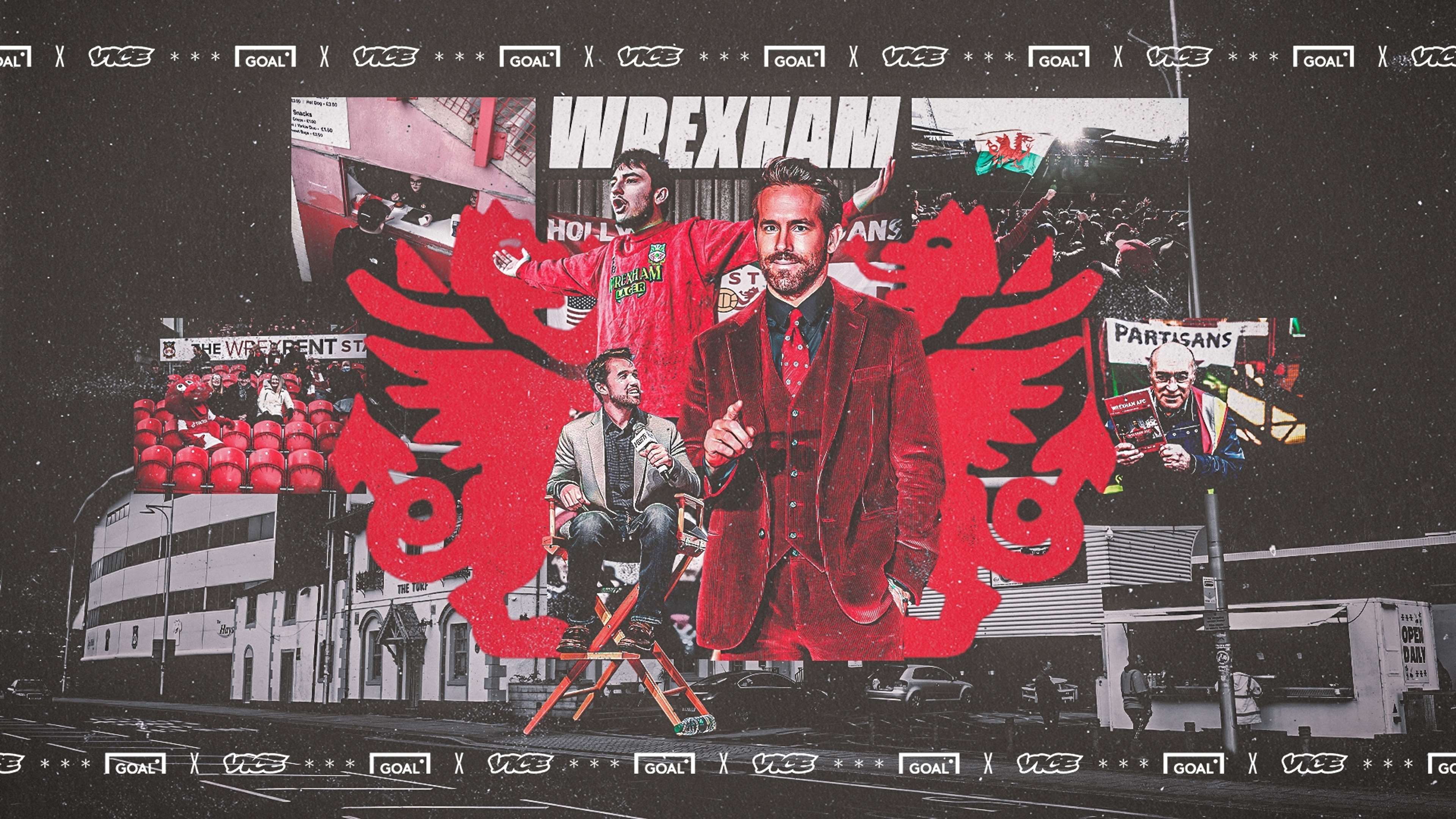
2022 marks the year of the UEFA Women's Euro and the FIFA Men’s World Cup. All this week, VICE and GOAL will be collaborating to publish insightful, interesting stories from the world of football and fan culture, introducing VICE fans to GOAL and GOAL fans to VICE.
In north-east Wales, a football team was on the brink of financial ruin. For its community, for Welsh football, and with no exaggeration, for the game of football worldwide, this would have been one of the biggest losses imaginable.
Wrexham Association Football Club is a small team with a huge history. It is the third-oldest professional club in the world and the oldest in Wales.
Based in a town of 65,000 people, they once knocked Arsenal out of the FA Cup and scored a first-leg victory over then-Portuguese Cup champions Porto in the Cup Winners Cup. At the time, the club was in the equivalent of League Two.
And there’s the stadium; The Racecourse and its iconic and imposing floodlights. “The oldest stadium in the world still hosting national football matches,” is announced on the public address system each time it hosts a game.


The breaking point had come after two decades of neglect and at the hands of a man most Wrexham fans despise; chairman Alex Hamilton.
A property developer by trade, he took over the club in 2004 and attempted to get the club evicted from their stadium in order to develop and sell the land it was built on. That could not happen.
Fans rallied together; savings were raided, houses remortgaged and eventually the Wrexham Supporters Trust took control of their club.
Wrexham AFC – and The Racecourse – were, by the skin of their teeth, going to avoid being taken all the way to the footballing graveyard. It cost the community a six-figure sum and the struggle was unrelenting.
 Chris Bethell
Wrexham were playing against teams that had financial backing beyond piggy banks like Brentford and Peterborough United. This could not last and, in 2007-08, they were relegated from League Two.
Exiting the Football League for the first time in 87 years, things remained stagnant from that point onwards. The Dragons were not dead, but they were barely alive and at their lowest low.
Then, at the back end of the Covid-19 pandemic, there was light – a takeover worth around £2 million ($2.5m). And then there was the trailer.
“Our new show on FX is called Welcome to Wrexham, a docu-series centered in Wrexham. A working-class town in north Wales, in the United Kingdom," Rob McElhenney, of It’s Always Sunny in Philadelphia fame, says.
He’s stood next to his co-owner, and an even more famous actor, Ryan Reynlods. There’s big spotlights behind them. To their left is Maxine, a Welsh translator.
The announcement reveals there will be two seasons of the documentary, housed on Disney’s FX platform and coming to Disney+ internationally. It’ll be fly-on-the-wall, following the owners from Hollywood to Wales, following the players and staff home and away, and the fans from the pub to the stands.
To this point, the new owners (RR McReynolds Company LLC) have been met with the closest thing possible to universal acclaim. Since signing the ownership contracts, which 98.2 percent of the Supporters Trust allowed them to do, a lot has happened.
The first women’s team in Wrexham’s history has been founded, along with a Powerchair team. The men’s team has been added back onto the FIFA franchise for the first time since FIFA 07 and a new shirt sponsorship deal with TikTok has been secured.
 Chris Bethell
Meanwhile, 19 new players have been signed, many from higher leagues, including record arrival Ollie Palmer from AFC Wimbledon, and the Kop stand is being rebuilt.
Perhaps most crucially, the club is in talks to buy the freehold for the Racecourse, ensuring it stays as the football team’s home indefinitely. Fans want to see that dream become a reality.
“It’s always in the back of my mind – will this ground become a new supermarket?” asks Phillip Lynch, 66.
“Will they move the Racecourse elsewhere? It wouldn’t be the same, this place has history, I want it secured.”
Beyond that, he just wants the potential windfall spent ‘wisely’. Although official figures haven’t yet been reported, people in Wrexham seem to have the consensus that the documentary will net the club somewhere around £200,000 ($250,000) per episode. That’s a hell of a lot of money when you consider Palmer came in for £322,000 ($400,000).
Naturally, money has been a big talking point since the takeover. A cash injection was needed, and it’s been received gladly. This documentary, however, is going beyond the business of football.
It’s going to be about this ‘working-class town’, as McElhenney says in the trailer, as much as it is about the team. That’s a far more emotional set of circumstances for club owners to get involved with and, for McElhenney, this seems to be exactly the point of the documentary.
There’s a direct inspiration in Sunderland ‘Till I Die, which came out in 2018, and followed the Black Cats in the wake of their relegation from the Premier League.
 Chris Bethell
“The documentary was technically well done, but it was painful viewing from a fan’s perspective,” says Luke Booth, a Sunderland supporter.
“I didn’t enjoy it, except for seeing the community – the taxi driver, the dinner lady...”
Whether McElhenney felt the same, we don’t know. But we do know he felt something deep and personal. That documentary was the Philadelphian’s entry into football. He didn’t understand the game until that moment, but he was hooked and wanted a slice of it.
Enter Wrexham.
“It was a bit strange at first. We had cameras thrust upon us. And we were having mics put up our shirts to record us. We had to have masks on, masks off, to show different points of lockdown,” says Wayne Jones, owner of The Turf – the oldest pub at any sports stadium in the world.
It’s where Wrexham AFC was founded back in 1864. You can see Wayne fixing a cocktail next to the It’s Always Sunny In Philadelphia cast in a video promoting the docu-series. It’s a place the owners have rightly got behind and which they are looking to feature as a community hub within the documentary.
Wayne, a former Supporters Trust member, is all for the cause.
“Early on in the filming I had a couple beers with them one on one, and I asked them, ‘Without the media here, why Wrexham?’” he says. “And I'll tell you the God's honest truth… they're very, very genuine people. I text the film crew most days too, and they’re really caring.”
Wayne is keen to stress that he puts the football club above all else and is a fan of the takeover for those reasons. But the year since the ‘Hollywood Boys’ took over has also been the pub’s most successful. He’s also noticed a really good mood around the place.
“There feels like a chance of getting out of this hellhole of a league,” he says.
Rob Clarke, the owner of Mad 4 Movies, is a lifelong Wrexham fan who is so well-known in the community that Ryan and Rob felt obliged to pay him a visit when they were in town.
There’s a newspaper clipping on the screen by the counter, recalling Clarke’s brush with Hollywood fame, and a copy of Deadpool neatly on display among the piles of DVDs, video cassettes and books. The day felt like a shift for Paul, a butcher based in the same market.
“We were dead that day because the streets were filled waiting for the owners,” he says. “I don’t follow the football that much but it feels like a documentary will be great for the town.”
 Chris Bethell
Clarke conveyed a bit of skepticism about the filming initially.
“They film so much that really they could make the place look however they wanted,” he says. “We’ve been burned by owners in the past, so there’s always a worry.”
Nathan Salt, a journalist and co-host of the RobRyanRed podcast also mentions the worry of “being made to look like a freak show, because we’ve been cursed for decades.”
The ‘freak’ element is largely centered around the fact that Wrexham is a Welsh team in the English leagues which has come on hard times economically.
“The town’s had years of neglect, unemployment is high, our industries have been taken away from us,” remarks Rob Gilpin, co-owner of BCCM Boarder Collectables. The concerns are valid.
“Other clubs fans were openly mocking Sunderland about it,” Booth says that in the aftermath of Sunderland Till I Die. Having such an intimate look inside a club is rare and it will provide ammunition for other teams.
However, Nathan, Rob Gilpin and Rob Clarke all say that despite these worries, they are very trusting of the takeover and the intentions of the new owners with the documentary.
“They both have such good reputations, they can only soil themselves if they do this poorly,” says Rich Fay, also a journalist and host of the RobRyanRed podcast.
Booth later mentions that, “While my team were mocked, with Wrexham, the only thing rival fans are feeling right now is envy.”
 Chris Bethell
Jordan Griffiths, a 29-year-old Wrexham season-ticket holder is excited too. “I have no reservations about the show,” he says.
“That might be naive but I think it’ll be positive. I wouldn’t mind if the documentary were to highlight some socio-economic issues around the area, if that brings attention to the issues and helps to start conversations about bettering things. That’ll be a good thing as well. What town doesn’t have its warts, you know?”
Today, the town is the same as it's ever been; Paul the butcher, Rob’s DVDs, old empty arcades, a heaving Wetherspoons and the same slowly-decaying high street as almost every other town.
But there is something happening in Wrexham – a humming, a rumble of a train just out of sight, “Wrecsam” being whispered in the wind.
Thanks to the new owners, you could call it optimism. Whatever it is, it’s heading for Wrexham General via a streaming service near you.
Head to GOAL to read stories from VICE writers on: football, art and mental health matters for men, the Hollywood takeover of Wrexham, Arsenal’s retro merch boom and football fans and their tattoos.
Head to VICE for pieces by GOAL journalists on: the game’s unseen trafficking problem, the rise of the digital football fan, why grime artists are using footballing namechecks so often these days and how Ivory Coast’s World Cup heroes brought a pause to civil war.