
Goal.com
+18 | Commercial Content | T&C's Apply | Play Responsibly | Publishing Principles
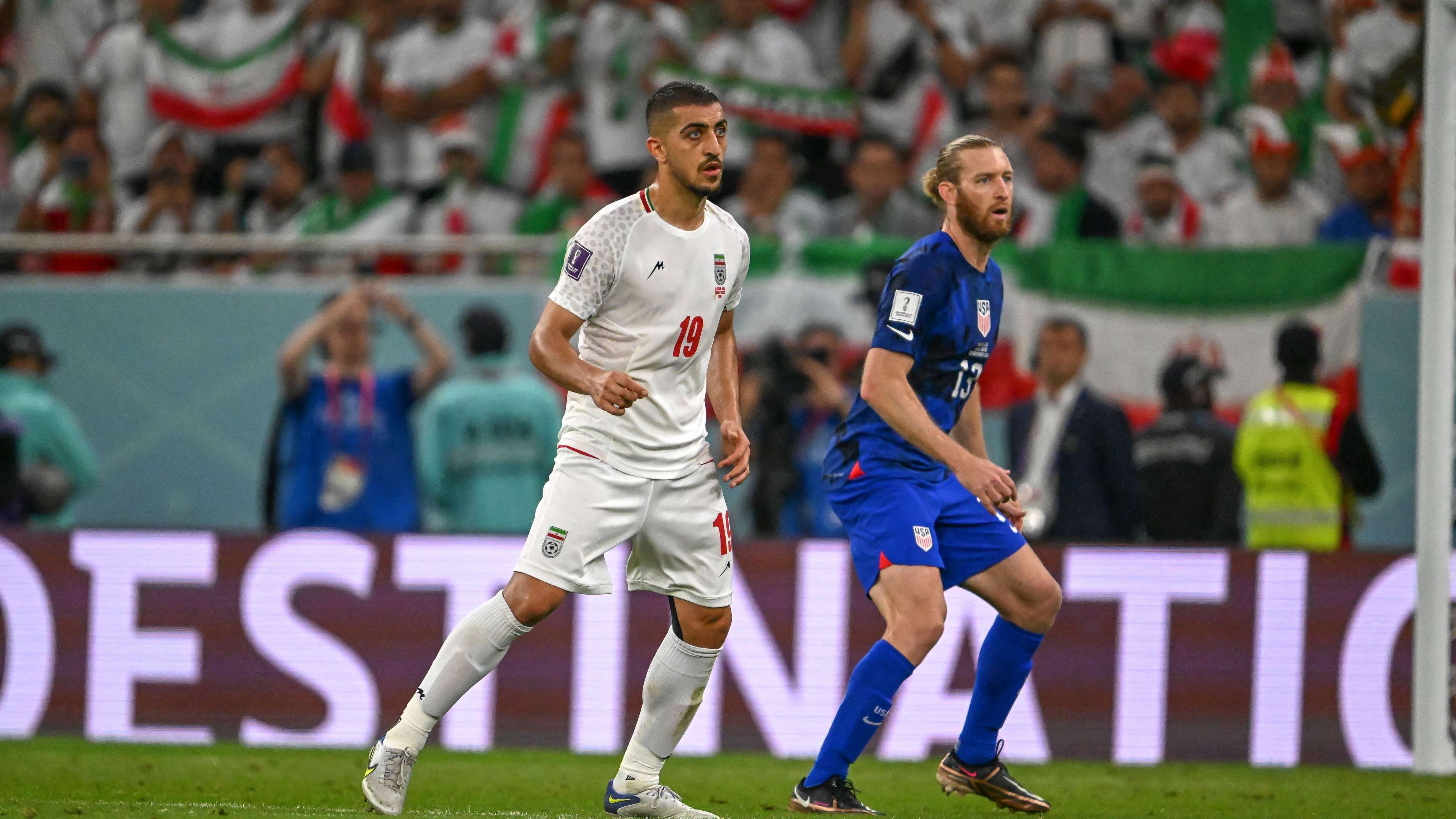
2022-World-Cup-Match-Between-USA-And-Iran-in-QatarAFP

Translated by

Before the US and Iran… historic battles played out on World Cup pitches

As the world looks ahead to the 2026 World Cup, the crisis surrounding the Iranian national team's participation in the United States stands out as the latest chapter in the complex intertwining of sport and political hostility.

Yet the plot is familiar: World Cup history is littered with cases where host countries have had to cede sovereignty, or where visiting teams have kept their players under tight intelligence watch to prevent defections on enemy turf.  

Read also

Real Madrid are not Atalanta... Kane sounds the alarm in Munich

Neymar faces a lengthy ban for insulting the referee and women

Europe and racism: England sets the standard for combating the problem, yet Yamal continues to face the same challenges as Vinicius.

  • The 1966 World Cup

    It takes us back to 1966, when Britain was compelled to host the North Korean national team, which had qualified for that year's World Cup, even though London still refused to recognise the communist state after the Korean War.

    The British Foreign Office briefly contemplated visa denial, However, FIFA warned that it would relocate the entire tournament, so London relented. A compromise was struck: the team would be listed as 'North Korea' instead of its official title, the Democratic People's Republic of Korea, and its anthem and flag would be banned from all matches except the opening and final ceremonies.

    However, the local crowd in Middlesbrough surprised everyone: English fans adopted the North Korean side as their own. and more than 18,000 spectators turned out to back them in their historic match against Italy, which the Asian side won 1-0 in a major upset.

  • Advertisement
  • The Brothers' Feud

    Against the backdrop of the Cold War, the 1974 World Cup saw the only ever meeting between East and West Germany on West German soil, in what became known as the 'Battle of the Brothers'.

    To prevent defections, East Germany banned ordinary fans, letting only about 2,000 "selected guests"—loyalists monitored by the Stasi—travel to chant a pre-approved slogan in unison.

    Stasi surveillance even extended to the pitch: East German players were banned from exchanging shirts after the final whistle to prevent any symbolic gesture of rapprochement. Armed police ringed the stadium, and helicopters circled overhead, ready to quell any unrest. In the end, the surprise 1–0 win went to the East.

  • Napoli - Football CityGetty Images Sport

    England and Argentina

    The Argentina vs England matches at the 1986 and 1998 World Cups were seen as sporting extensions of the Falklands War. those clashes were seen as a sporting extension of the Falklands War. In 1986, Mexico City's streets saw violent confrontations that left English fans hospitalised and their flags seized by Argentine 'Para Bravas' groups.

    In France 1998, 1,600 police officers were deployed to contain the 'Hooligans', while intelligence services secretly disrupted a terrorist plot targeting the match—a detail withheld from players and coaches so the tournament could continue uninterrupted.

  • ENJOYED THIS STORY?

    Add GOAL.com as a preferred source on Google to see more of our reporting

  • Cuba's contributions

    Cuba's participation in tournaments held in the United States or Canada is also a nightmare that haunts the Cuban authorities, due to the phenomenon of "mass defections"; in 2002, players Rey Martínez and Alberto Delgado fled the team's hotel in Los Angeles after pretending to go out to make a phone call.

    The situation turned even more dire in 2012, when Cuba had to field just 11 players—with no substitutes—for a decisive match against Canada after four players and the team doctor fled together shortly before kickoff to seek asylum.

  • English midfielder David Beckham (L) and his teammAFP

    North Korean barracks

    Even at regional events, these tensions persist. At the 2014 Asian Games in Incheon, South Korea, the North Korean delegation effectively became a mobile "intelligence barracks", with security officers entered as "journalists" to keep tabs on the athletes, at a ratio of one agent for every ten participants.

    North Korean journalists had to file their reports by fax only, ensuring they could not access the global internet. Meanwhile, South Korean authorities removed all national flags from the streets around the stadiums—permitting displays only inside the venues—fearing that extremist groups might tear down the North Korean flag and ignite a fresh border row.

    Such episodes confirm that, in moments of crisis, stadiums become zones of 'special sovereignty', where normal laws are suspended in favour of exceptional security protocols.