
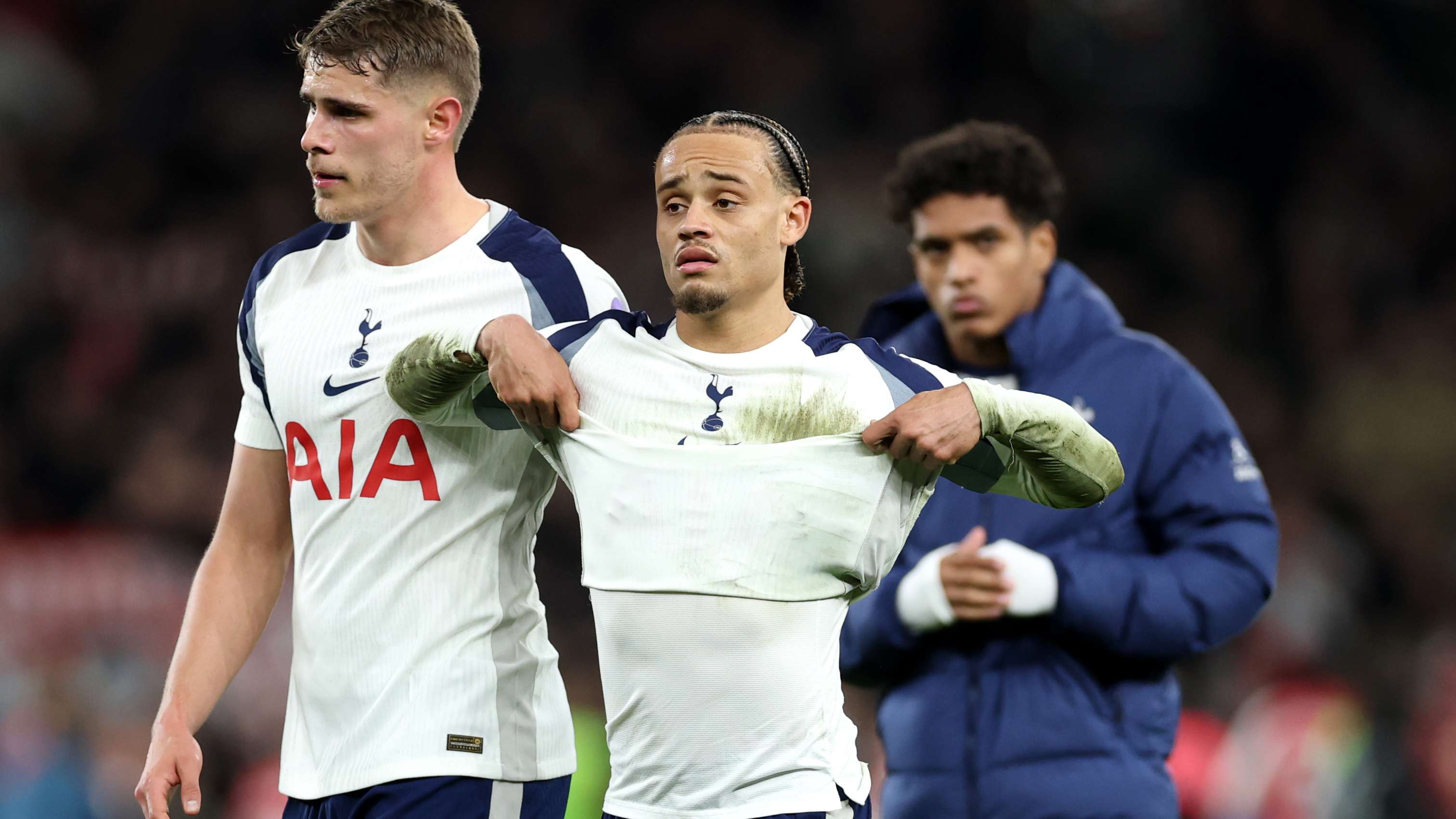
Having endured their worst-ever Premier League finish in 2025-26 - when they finished in 17th place, just outside the drop zone - the alarm bells are ringing loudly once again at Tottenham in 2025-26.
Despite delivering a rare trophy with Europa League glory, Ange Postecoglou paid the price for a bleak league campaign and Spurs sought a change of approach by hiring Thomas Frank, who had excelled as head coach of Brentford. However, Frank faltered at Tottenham Hotspur Stadium and was relieved of his duties in February 2026, having delivered a pitiful win percentage of 34.2 per cent during his tenure.
As discussions simmer over the possibility of Spurs being relegated from the Premier League, GOAL takes a look at when the Lilywhites last went down.
As fans reflect on Tottenham's history, including their journey through ups and downs, the offer of free bets can add an interactive element to tracking the team's current and past performances. Accessing these special offers allows fans to engage with matches in a unique way, enhancing the overall spectating experience.
When were Tottenham last relegated?
Tottenham last suffered relegation from the top flight of English football during the 1976-77 season. It brought an end to a 27-year spell in what was then the First Division.


Spurs finished bottom of the league in 22nd place, having managed to put just 33 points on the board from 42 games. They lost 21 games overall and had the worst defensive record that season by a considerable distance, conceding 72 goals - an average concession rate of 1.7 goals per game.
Managed by Keith Burkinshaw, Spurs actually boasted a formidable squad, with talent such as Pat Jennings in goal, Glenn Hoddle in midfield and rising star Gerry Armstrong in attack. Steve Perryman, who would go on to become Tottenham's all-time record appearance-maker, was also in the group, as were the likes of John Pratt, who had won a UEFA Cup with the club in 1972, and a young Peter Taylor, fresh of a season that saw him named Crystal Palace's Player of the Year in 1976.
Despite the severe disappointment of relegation in 1977, Burkinshaw remained at the helm and the North London club bounced back immediately, returning to the First Division for the 1978-79 campaign.
Indeed, they went from strength to strength under Burkinshaw, going on to win the FA Cup in 1981 and 1982, as well as the UEFA Cup in 1984. With additions such as Osvaldo Ardiles, Ricky Villa and Ray Clemence, Tottenham became a force to be reckoned with in the early 1980s.
Since returning to the top table in 1978-79, Spurs have remained a prominent fixture, extending their participation across five decades.
Bottom of the 1976-77 First Division table
| Pos | Team | P | W | D | L | GD | Pts |
|---|---|---|---|---|---|---|---|
| 20 | Sunderland | 42 | 11 | 12 | 19 | -8 | 34 |
| 21 | Stoke City | 42 | 10 | 14 | 18 | -23 | 34 |
| 22 | Tottenham | 42 | 12 | 9 | 21 | -24 | 33 |
What was the world like when Tottenham were last relegated?
Given that 1977 is nearly 50 years ago, a lot of younger Tottenham fans probably don't have a sense of how the world was.
In a football sense it had a familiar feel - Liverpool won the league, narrowly finishing first ahead of Manchester City (who recorded a memorable 5-0 win over Tottenham, as can be seen in the video above). Bobby Robson's Ipswich Town finished third.
Manchester United won the FA Cup and Aston Villa lifted the League Cup. Liverpool won the European Cup that season, defeating Borussia Monchengladbach 3-1 in the final, which was held in Rome.
Here is a handful of other facts from the last time Tottenham were relegated:
- Jimmy Carter was the President of the United States, having won the 1976 U.S. Presidential election against the incumbent Gerald Ford.
- The Prime Minister of the United Kingdom was James Callaghan.
- There were no generative AI systems such as ChatGPT or Claude, but computer scientist Douglas Lenat created AM (Automated Mathematician) - an AI 'discovery system' in 1976.
- Footballers Phil Neville (January 21), Raul (June 27) and Thierry Henry (August 17) were all born in 1977. Singer Shakira (February 2), actor Michael Fassbender (April 2) and wrestler John Cena (April 23) were also born this year.
- On May 25, 1977, the George Lucas film Star Wars was released in the United States. It would go on to become one of the biggest movie franchises in history.
- Amnesty International was awarded the Nobel Peace Prize "for worldwide respect for human rights."
- The Rubik's Cube (then known as the Magic Cube), became available in shops in Hungary.
- Sylvester Stallone's Rocky won Best Picture at the 49th Academy Awards. Peter Finch won the Best Actor in a Leading Role for his portrayal of Howard Beale in Network, while Faye Dunaway won Best Actress in a Leading Role for her part as Diana Christensen in the same movie.
- The Internet did not exist. Letters and telephones were the main method of long-distance communication.
- Google, of course did not come into being until 1998, but the word 'Googol' had been in the lexicon for 57 years in 1977, having been coined by nine-year-old Milton Sirotta in 1920.
- The 'Wow! signal' was detected by astronomers in August 1977.