
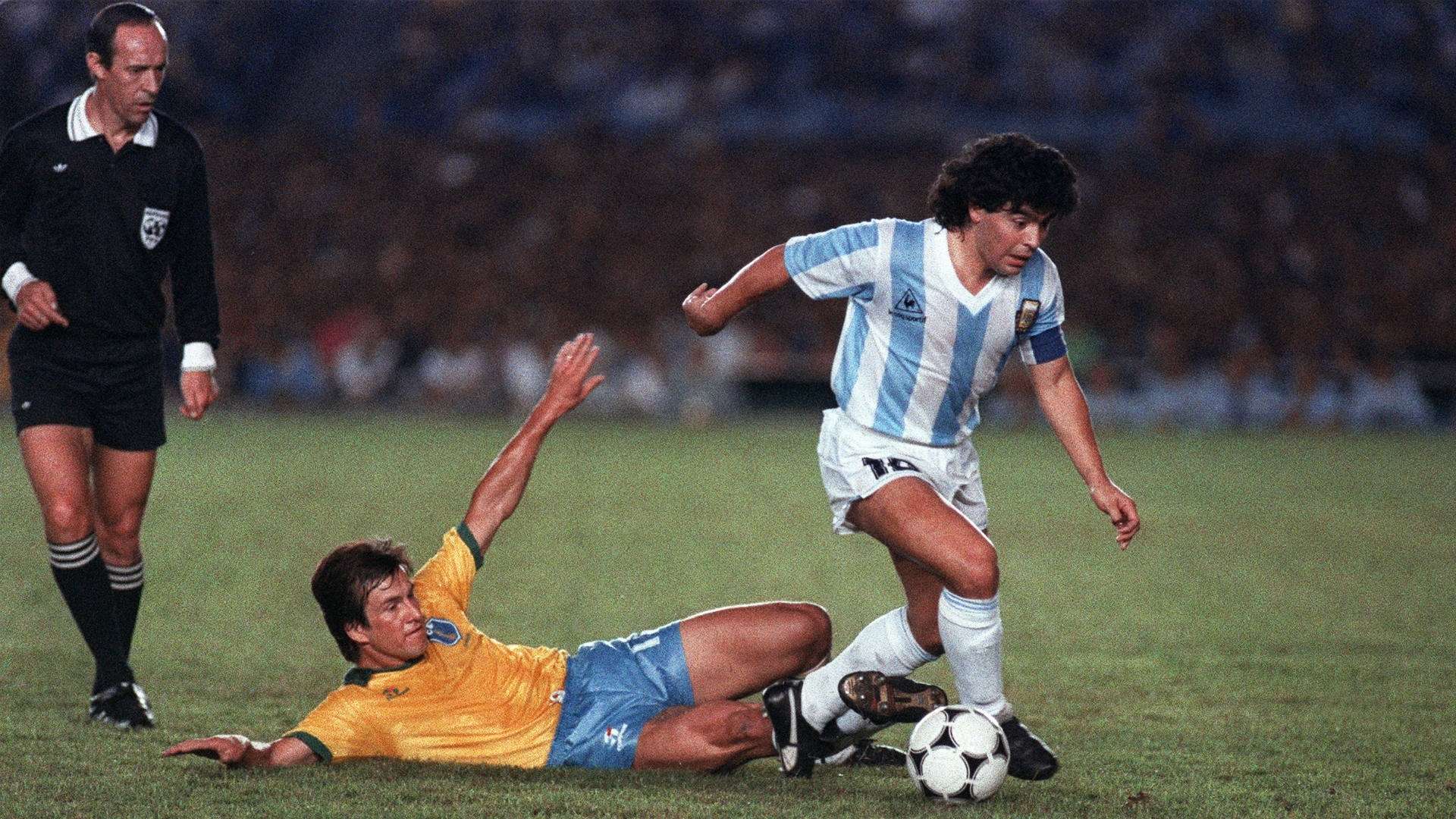
Discussing the best footballer of all time does not make much sense if it must always descend into an argument that gets in the way of fully appreciating all of the greats to have played 'The Beautiful Game'. In an age in which one can only seemingly enjoy the sublime skills of Lionel Messi or Cristiano Ronaldo - but never both, trying to have an objective debate on such matters can be a maddening exercise in futility. These days, everything and everyone must also seemingly be ranked by statistics and individual numbers, meaning certain intangibles are pushed aside.
That is, of course, until one mentions one of those footballers who broke all the rules; those who are timeless; those who endure across generations; those who appear chosen by the gods of football to rest in a select pantheon of immortals.
Indeed, looking up old footage of Diego Maradona at his brilliant best offers an instantaneous and undisputed reminder of the Argentine's footballing genius. The way he strokes the ball. The gesture of the raised right hand as if trying to paint a picture in the air. The lost gaze. The chest erect as if he were about to enter a battle. And his tongue. The tongue always out, a symbol of absolute concentration and inspiration. Maradona continues to transmit happiness, the joy of playing, an art that seems to have been lost a long time ago and has fewer and fewer worthy representatives.
In 1995, the decision was made to end years of mistreatment, when he was awarded an honorary Ballon d'Or. Why had it not arrived earlier? Due to a simple bureaucratic reason. In the 1980s, the Argentine's golden years, France Football magazine did not consider players born outside of Europe, an oversight only corrected in 1995 and one which begs the question: how many trophies would Maradona have won had he been eligible for the most prestigious individual honour in football?
At Barcelona, he showed glimpses of greatness but perhaps didn't achieve sufficient sustained excellent to land the Ballon d'Or. Maradona lifted the 1982-83 Copa del Rey in a delightful team coached by Cesar Luis Menotti, while he finished fourth in La Liga with 11 goals in 20 games in that season. Everything was going to plan until September 24, 1983, when he suffered a serious injury thanks to a criminal tackle from Andoni Goikoetxea that left him inactive for six months. That year, the Ballon d'Or winner was Michel Platini, who finished second in Serie A with Juventus and was the league's top scorer, with 16. The following season the Frenchman would lift the Scudetto and also another Ballon d'Or.
In 1986, however, Maradona would have received probably the only unanimous vote in the award's history (Lionel Messi came close in 2009 with 98.54 percent). El Diego had one of the greatest individual World Cups ever, with five strikes and sensational solo performances, against Italy, England, Belgium and Germany. In the same year, he had a brilliant second season in Napoli. The winner of the Ballon d'Or, though, was Igor Belanov, who won the European Cup Winners' Cup with Dynamo Kyiv and lost in the World Cup last 16 with the Soviet Union.
There also appears little doubt that Maradona would have retained his title as the game's greatest player the following year. Indeed, 1987 was simply an extension of the golden 12 months which preceded it. Maradona's Napoli won the Scudetto with 42 points and although he did not finish top scorer, he enjoyed a strong season, finding the net 10 times (an average of 0.41 per game in the 1986-87 campaign). He also picked up the Coppa Italia, with Napoli beating Atalanta in the final. However, it was Ruud Gullit, who started the year at PSV and later moved to Milan in a world-record transfer, who won gold.
From then on, the Ballon d'Or debate gets a little more contentious. Maradona had another very good year in 1988, top-scoring in Serie A with 15 goals as Napoli finished second. He also starred in the Coppa Italia, with six strikes in nine games, although the Partenopei's European Cup campaign, which was ended in the first round by Real Madrid, was a black spot. Marco Van Basten, however, lifted the Scudetto, the European Championship and the Ballon d'Or and it is only fair to admit that the Dutchman richly deserved his individual recognition.
However, 1989 is a tough year to judge. Maradona won the Uefa Cup, with Napoli leaving Lokomotiv Moscow, Bordeaux, Juventus and Bayern Munich in their path, and while Inter took Serie A, second place concluded another excellent campaign for the southern Italians. Maradona hit 19 goals in 50 games, a strike rate of 0.38. Van Basten, though, was Milan's star man in lifting the European Cup, scoring twice in the final against Steaua Bucharest. Consequently, we would have been treated to one of the closest Ballon d'Or votes in history.
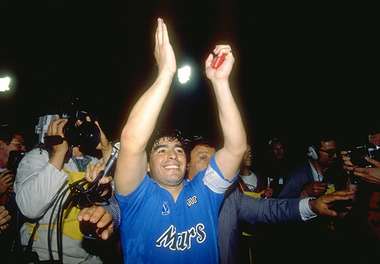
The weight of the World Cup was too strong in 1990. Lothar Matthaus, a star at title-less Inter, was one of the leading lights of Italia 90 for Germany. Maradona, though? He lifted the Scudetto. He netted 16 goals in 28 games, finishing behind Van Basten, who bagged 19. Across the entire season Maradona scored 18 in 36, a goal every two matches. In the World Cup, a brutal ankle injury held him back, although he still turned up with some gems like the brilliant pass to Claudio Caniggia in Argentina's last-16 win over Brazil. The No.10's year was probably better, overall, but the World Cup-winning Matthaus took the big individual prize.
By the time 1991 came around, things had changed. Maradona endured problems on and off the field and would hardly ever show his best side again, with a fleeting exception his early performances in the 1994 World Cup - before he was infamously banned for failing a drugs test.
In conclusion, though, there is no question he would have won at least two Ballons d'Or, in 1986 and 1987, and if the voting had gone his way, he could have added as many as two more, in 1989 and 1990.
As it stands, then, Maradona will never be remembered for his bulging trophy cabinet - however, as a footballing icon, he is peerless. It is not about silverware but golden memories of the man who carried the ball forward with his tongue sticking out, the portrait of the neighbourhood kick-around and pure defiance. He is the man who transformed football into a whole different sport. He will forever be the champion of the under-classes. And there is no greater accolade than that.