
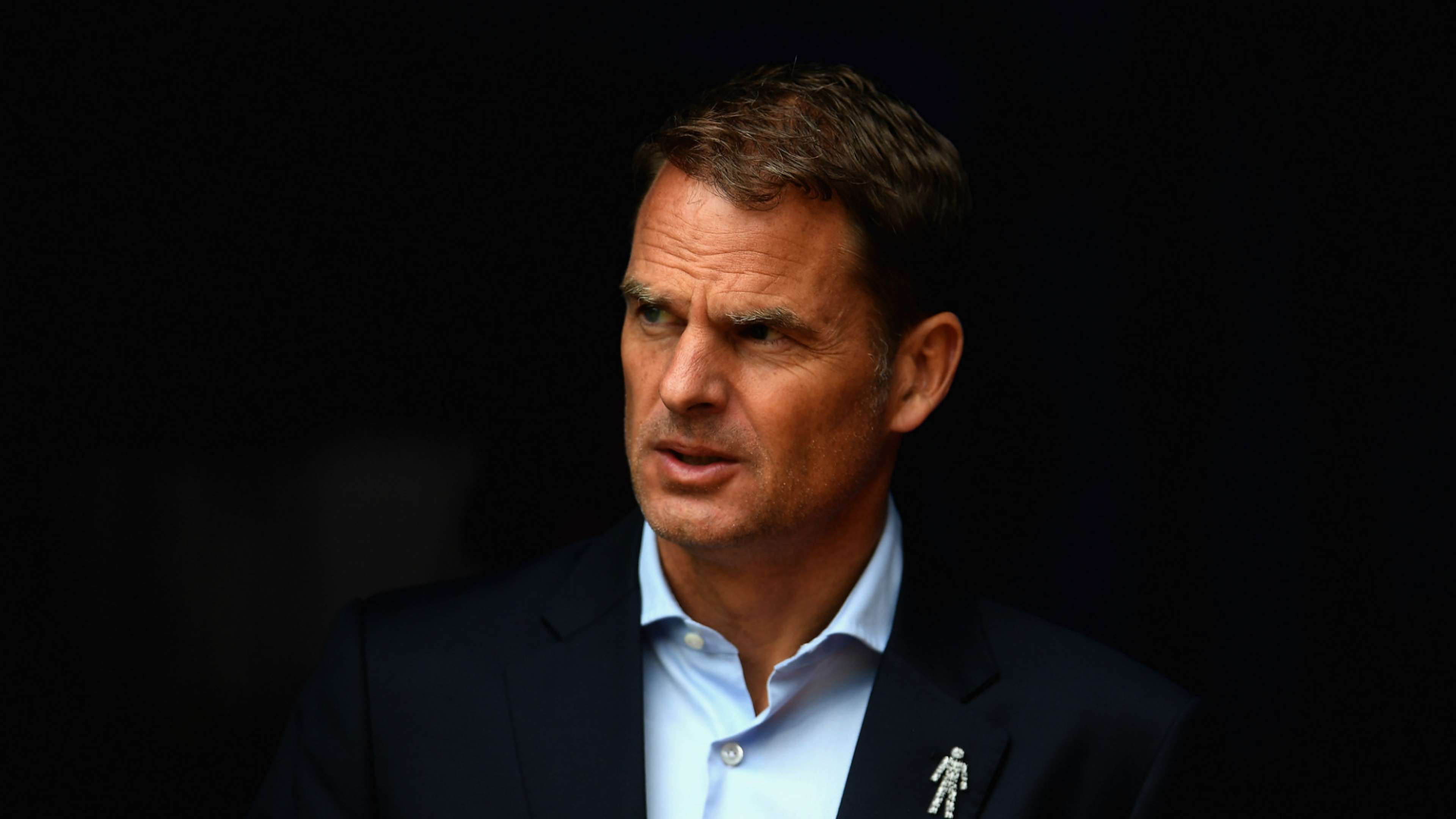
For the second time in a row, Frank de Boer has been fired less than three months after walking into a new coaching role.
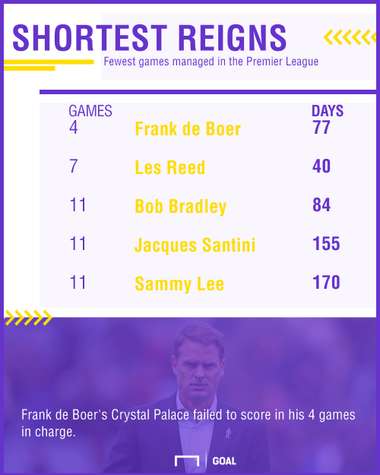
Almost a year after the former Ajax, Barcelona and Netherlands star saw his time as Inter boss cut short at just 85 days, he fared even worse in England, a league he always dreamed of coaching in, lasting just 77 days.
Sitting second bottom of the Premier League with no wins from four games and no goals scored, the board may feel justified in pulling the plug so quickly. But it is Palace, not De Boer, who must take responsibility for a farcical few months.
Chairman Steve Parish talked about “evolving” the Selhurst Park outfit upon De Boer’s arrival and handed him a three-year contract in June to achieve that goal. In the Dutchman, they hired a coach with clearly set principles about how his team play, but it took just four games for the club to realise De Boer was not the right one to develop a side that struggled last term.


While the coach stated before Sunday's defeat to Burnley that it was a “long-term” project, it’s not clear if Palace ever saw it that way.
They did little to make the squad one capable of taking on board De Boer’s style, but pivotally, there was absolutely no time for him to incorporate it.
“We spent over £30m on top of the £40m plus loan fees and wages in January,” Parish tweeted on Sunday. “We can't just keep on spending and spending.”
If they were not willing to make the necessary changes to allow their new manager to reach his goal, then they had to accept that a stunning start was an impossibility.
Four straight defeats and no goals scored looks dreadful on the 47-year-old, but there were few surprises in the way his team set up and played. What, then, did Palace expect?
When he joined, De Boer said it’s in his “DNA to try and play tactical and technical football, to try to dominate”. There was little to suggest in his and Parish’s comments that they wanted something else from him, yet the latter did not seem bothered about the key part of the new boss.
“What is an attractive style?” he said. “Our fans, I don’t think they are particularly fussed about the style of football we play.”
Palace and their fans may not care, but De Boer certainly does. To him, it is a philosophy, a word often over-used in football but apt with regards to a man steeped in Ajax’s culture - the club that produced him and set him up to reach immense heights as a player before letting him take his first steps as a coach.
Did Parish know and support this? If that was unclear when De Boer was named as Sam Allardyce’s replacement, it certainly is now that they have pulled the trigger.
De Boer is heavily concerned with the way his team play. He is of the Dutch philosophy and aligns himself as a disciple of Johan Cruyff and Louis van Gaal.
Whereas his first few seasons in Amsterdam were impressive and resembled some aspects of the Total Football that made the club and country iconic, the final three years of his time there mirrored that of Van Gaal at Manchester United more than it did anything Cruyffian.
Ajax were mindless in their wing-heavy play as the plan was mainly down to possession for possession’s sake - always building from the back - until they got to the opposition box, where the chase for the second ball became a central tenet of his style.
Again, though, Palace did not seem to realise this.
“You know, Frank talks a lot about players who can beat people one on one. We’ve got that and our fans aren’t too discerning,” Parish continued.
“If you started knocking it all round the defence and into midfield and back again... you need a purpose. It’s the Premier League, fans want to see goalmouth action. Outside of that, if you win games everybody is happy.”
Parish added that their “interests will be completely aligned”, but their methods differ greatly and it’s clear Palace did not really know what they were taking on.
De Boer needs that system of support that stretches beyond his squad. His Ajax success was helped immensely by the fact he shared the club's dogmatic way of playing and had a stream of young players developed to play his style ready to move into the first-team.
Ronald Koeman has had similar struggles in his career. His best spells as a coach have come at clubs where there is already a suitable foundation on which he can build. Ajax, where he won two league titles, Feyenoord and Southampton all had this, but the lack of structure at Benfica, Valencia and AZ saw him struggle in his earlier years.
 Getty
Getty PRO SHOTS
Palace and De Boer may have been a terrible mismatch in the end, and the coach's reputation takes another huge battering, but it's not fair to write him off completely yet.
Despite his early success – he is the only Ajax coach to win four consecutive Eredivisie titles – the one thing that has become clear in the last few years of De Boer’s career is that he needs to adapt his ideas.
His sabbatical in the wake of his ill-advised Inter spell was an opportunity to do so, but De Boer was given no time to show whether or not he has.
“If in three years’ time he manages Real Madrid, it means he will be a success at this club,” Parish said in June, but the past three months have gone in the complete opposite direction.
De Boer must take some blame for making poor decisions in his career of late. Walking into Inter just two weeks before the season started while the club were in the midst of a takeover was a disastrous decision, but the past few months have been even worse for a reputed figure in the game. However, it is hard to judge him too harshly after being sold an illusion at Selhurst Park.
"Every time a manager fails at this club I fail," the chairman said. "If Frank fails, it is my failure too.”
A sacking after four games, zero points and no goals is certainly a failure on De Boer’s part, but this reflects infinitely worse on Parish and Palace than it does on the embarrassed coach.