
+18 | Commercial Content | T&C's Apply | Play Responsibly | Publishing Principles
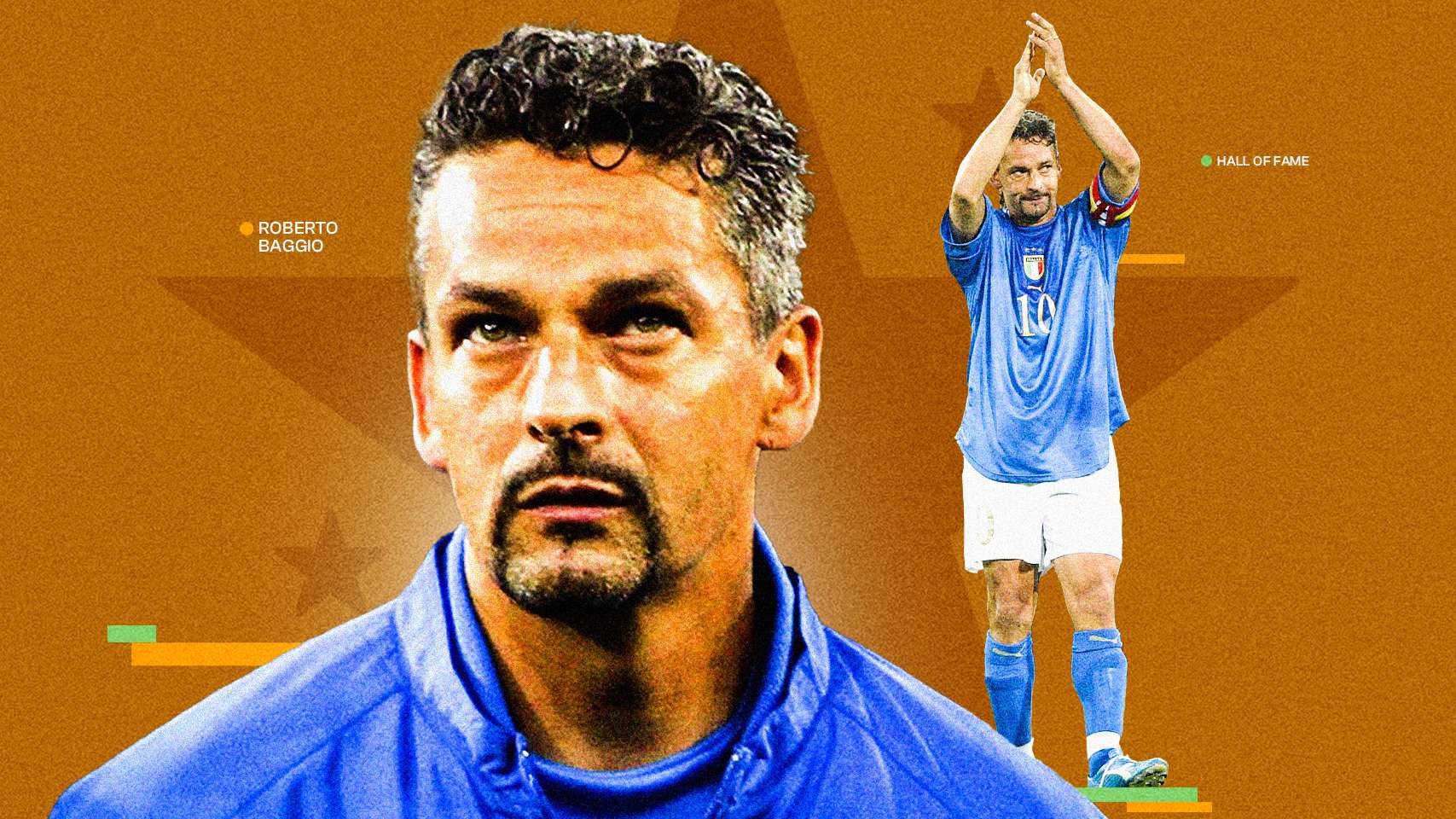
Roberto Baggio Hall of Fame desktopGOAL

GOAL's Hall of Fame: Roberto Baggio - The Divine Ponytail that became an Italian icon

Baggio was, first and foremost, a footballer, one of the best of his era and, in my opinion, the best in the history of the Italian national team. No one else has ever been identified - and probably never will be - with the blue jersey of the national team in the same way: because when you think of Gigi Riva, you imagine him in the Cagliari jersey; when you think of Paolo Maldini, you see him in the Milan jersey; when you think of Gigi Buffon, you remember him in the Juventus jersey; but when you think of Baggio, you immediately think of the national team jersey.

It doesn't matter if it's the No.15 from Italy '90, the No.10 from USA '94 or the No.18 from France '98: in the collective imagination of those who lived through the 1990s, Baggio always wears the blue shirt. Which is much more than the national team shirt in this case, but the shirt of the entire country.

Trying to describe Baggio is therefore a difficult challenge, because those who experienced him already know everything, and those who did not experience him fully – for geographical or age reasons – recognise him as an absolute champion, but struggle to understand the aura he exudes, which continues to thrill more than 20 years after his retirement from football. 

  • Brazilian players run to join their teammates as IAFP

    Loved even after a mistake

    In Italy, throughout the 1990s, the proliferation of children, teenagers and adults with ponytails was directly connected to the visceral love that bound an entire country to the player who, despite never managing to lead the national team to World Cup victory, had tried with all his might.

    In a game that, year after year, was becoming more and more about business and less and less about pure sport, Baggio became a symbol of tradition, an anchor of resistance. Baggio is and always will be a man, even before a footballer, capable of being loved even after a costly mistake.

    Even today, many Italians will still tell you that the tears shed after the penalty shootout loss to Brazil in the final of the 1994 World Cup were tears of sympathy for Baggio, who missed the decisive spot-kick. It was a mistake he never forgave himself for - but perhaps for that very reason, everyone else did. 

    But it wasn't just about Baggio's remorse. There was also the fact that Italy wouldn't have even reached the final without their talismanic No.10 and when the fatal error is made by the person who had at least allowed you to dream, it only triggers a sense of injustice, and a subsequent show of solidarity.

  • Advertisement
  • Roberto Baggio of A.C Milan (right) challenges Lula of PortoGetty Images Sport

    The Champions League argument

    Baggio did not win much during his career. That is an indisputable fact. Three league titles and one UEFA Cup are too few trophies for a champion of his calibre.

    At the same time, the unhealthy habit of evaluating players solely (or mainly) on the basis of the trophies they have won is never a good idea when it comes to a team game.

    For example, his critics always argue ‘Baggio never won the Champions League’ when it comes to discussing his place in the pantheon of Italy’s finest footballers.

    Yet they conveniently overlook the fact that, in the 1990s, the Champions League - and before that the European Cup - did not contain four, five or even six teams from the same country.

    Only the winners of the national championships were allowed to participate (unless the defending champion failed to retain their domestic title) before UEFA started to allow more teams from the same country on an annual basis.

    Given Serie A was the most competitive league in the world in the 1990s, Baggio played in the Champions League on just two occasions, once with Milan (in the 1996-1997 season) and once with Inter (1998-1999).

    Despite this, he still scored five goals in 11 appearances, two of which were scored on a memorable night when Gigi Simoni, coach of an Inter team that was anything but irresistible, thought it would be a good idea to keep him on the bench and only send him on in the final minutes.

    The result? A decisive brace from Baggio that knocked Real Madrid out of the competition.

  • Serie A: AC Milan v BresciaGetty Images Sport

    Remaining close to home

    Why, one might legitimately ask, did Baggio decide to spend part of his career in less prestigious teams, or why, when he joined Milan or Inter, was he unable to gain the complete trust of the coaches?

    The answer has never been given directly, but one need only read between the lines of Il Divin Codino's autobiography and listen carefully to some of his interviews to find the answer.

    Baggio was indeed a professional athlete, but above all, Roberto loved playing football. And to do so in the best possible way, he wanted to do it in an ideal environment, both from a sporting and a strictly human point of view.

    Do you think he would have had difficulty finding a lucrative contract with a top club abroad or perhaps in Japan, where in those years the Land of the Rising Sun would have been willing to cover him in gold from head to toe just to have him, even if only for one match?

    Instead, choosing the provinces was a lifestyle choice for him. This should not be interpreted as a lack of ambition, but simply as the pursuit of less conventional ambitions.

    "The team that was supposed to relaunch my career," he explained in his autobiography Una porta nel cielo (A Door in the Sky), "had to meet three requirements: be in Serie A; be close to home; and give me reasonable assurance that I would play.

    “This ruled out all the offers I had from abroad from the outset: playing outside Italy inevitably meant saying goodbye to the national team. "

  • Fiorentina v Brescia XGetty Images Sport

    A World Cup dream dashed

    Essentially, Baggio’s head and heart were always with the Azzurri, and when he chose to go and play for Brescia in the summer of 2000, it was because his ultimate objective was to earn a call-up for the World Cup scheduled to take place in Japan and Korea two years later.

    And, for younger people, that's how it was back then: for reasons that are honestly still difficult to understand, choosing to play abroad meant tacitly accepting that you would be overlooked by the Italy national team.

    It had happened to Gianfranco Zola and Gianluca Vialli while they were starring for Chelsea in the Premier League - and Baggio knew that it would have happened to him too.

    Of course, his enduring excellence was infamously ignored anyway.

  • WC2002-ITA-PRESS-TRAPATTONIAFP

    The Trapattoni snub

    Even though Baggio produced two sensational seasons at Brescia, then-Azzurri coach Giovanni Trapattoni left the trequartista out of his squad for the 2002 World Cup to widespread disbelief in Italy.

    And to think that FIFA's decision to increase squad sizes to 23 players was effectively an open invitation for Trapattoni and Brazil boss Luiz Felipe Scolari to include two men adored in Asia: Baggio and the injury-ravaged Ronaldo.

    Scolari took advantage of what was effectively a wildcard to call upon Ronaldo, who was the undisputed star of the tournament.

    There was to be no shot at redemption for Baggio, though, and his 2002 World Cup snub ranks second only to his penalty miss as the greatest disappointment of his international career.

  • CUP-FR98-ITA-AUT-R. BAGGIO-JUBOAFP

    The man was an emotion

    When Michel Platini described Baggio as “a nine and a half”, he gave him – perhaps unwittingly – one of the most valuable compliments that could be paid to a footballer at the time.

    During Baggio’s playing days, forwards could be clearly defined as either playmakers or strikers. The days of false nines and support strikers were a long way off. Depending on whether you had goalscoring instincts or creative talents, you were either a 9 that scored goals or a 10 that created them. But Baggio could do both - like no other Italian player before him.

    Platini noticed this immediately, recognising his uniqueness, while perhaps wanting to highlight how the magic of the pure No.10, which had characterised the 1980s, was gradually fading away. But then again, in an era when the average number of goals per game in Serie A was infinitely lower than it is today, Baggio was able to score 205 times in 452 top-flight appearances - a strike-rate worthy of a striker at the time, no doubt about it.

    And if that's not enough to explain Baggio to those who are too young to remember him or too far away to admire him on a daily basis, we can add that he is Italy's all-time leading scorer in World Cup history, one of only five Italians to win the Ballon d'Or, one of the last Italians to play in three World Cups as a key player, one of the most elegant free-kick specialists in the history of the sport, and probably the most skilled player at controlling the ball on the run that the game has ever seen.

    And no, the admiration of Italian millennials (and others) for Baggio is not the result of a collective hallucination or that nostalgic effect that turns everything experienced during one's best years into gold. Baggio wasn’t just one of the best players of his era; he ranks among the finest of all time.

    However, he was also something different and, thus, difficult to describe. Because Baggio really was - and is - an emotion, which is precisely why the mere mention of his name still provokes a feeling of child-like excitement in Italian football fans everywhere.