
Goal.com
Live
+18 or +21, depending on state | Commercial Content | T&C's Apply | Play Responsibly | Publishing Principles
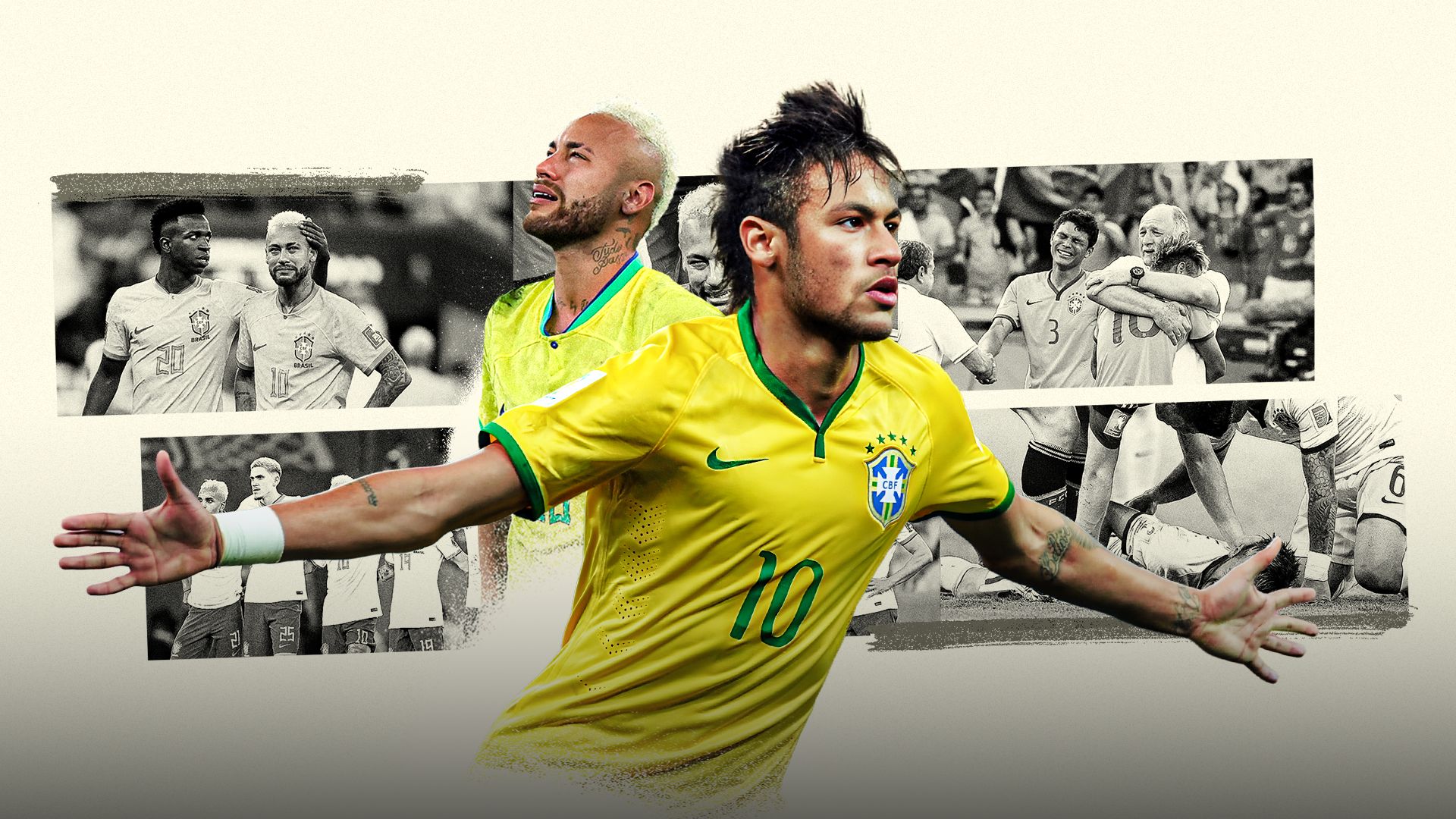
Legacy Brazil Neymar GFXGetty/GOAL

LEGACY: Neymar was once Brazil's only World Cup hope - but will he even make it to 2026?

Hands on hips, distant gaze. Tears of sadness, of pain. Even though Neymar’s eight World Cup goals put him alongside Rivaldo, and ahead of champions like Rivellino, Bebeto, Romario and Garrincha on Brazil's all-time scoring list, the image that defines him in the greatest of all football tournaments isn’t one of celebration. It’s a picture of melancholy that also mirrors Brazil’s disappointing campaigns through 24 long years of drought since the 2002 title.

It’s impossible to place the entire weight of almost a quarter-century without a trophy on Neymar’s shoulders alone. He didn’t play in 2006 or 2010, after all. The greatest Brazilian talent since Ronaldinho didn’t inherit a torch from anyone, either. There was no symbolic scene of a legend passing the baton to the new prodigy from Santos, showing him the way forward, much like Pele did to Rivellino or Romario did to Ronaldo.

When Neymar began his story in Brazil’s famous yellow shirt in 2010, he found an empty throne - thrones, in fact. Almost by chance, a break in tradition had left a national team that was once overflowing with attacking leaders suddenly abandoned. Ronaldinho and Adriano were in decline, and Kaka was never the same again after a series of hip injuries. With no one else ready to share the burden, Neymar had no other option but to unify all that responsibility into one single reign.

It was the only possible path. And that’s also where part of the problem lay.

The only thing that truly kept Brazil’s World Cup hopes alive between 2014 and 2022 was the presence of one player, as if the most successful team in history had been reduced to a small European side that produces a genius only once every half-century.

Now, ahead of the 2026 World Cup, Neymar is far from the player he once was. Though still revered, he no longer plays the same role for a Brazil team that is full of doubts heading into the tournament in North America.

  • Brazil v Chile: Round of 16 - 2014 FIFA World Cup BrazilGetty Images Sport

    Filling the void

    When he debuted for Brazil in 2010, Neymar already carried enormous expectation. He was the face of a promising generation meant to bring back a new era of flair and creativity to the Selecao after the Dunga-led, discipline-first team had fallen to the Netherlands in the 2010 World Cup quarter-final. The problem was that the veterans supporting that rebuild effort were not of the same calibre as the great stars of the recent past.

    Neymar fully assumed the No.10 shirt only in 2013, when Luiz Felipe Scolari, the coach who led Brazil to the 2002 title, surprisingly returned to lead the national team into their long-awaited home World Cup. The other young hopefuls who had sparked excitement in 2010 ended up disappointing, thus costing Mano Menezes his job. Ganso and Alexandre Pato never took flight, while Lucas Moura also failed to convince.

    Seeing the best Brazilian player wearing the number immortalised by Pele sent a clear message. Although Scolari insisted that, "Neymar doesn’t have to alone decide the game; he has to play for the team", it was obvious that the team was Neymar’s. And while it’s not unusual for a superstar to be the main protagonist, the issue was that no other attacking player even came close to matching the No.10’s impact.

    For context, in 1958, a teenage Pele became a world star, but Garrincha was just as decisive, while the World Cup’s best player, according to FIFA, was Didi. In 1962, the same core team continued, with Garrincha starring again while a young Amarildo replaced the injured Pele.

    In 1970, Pele had spectacular partners such as Jairzinho, Rivellino, Gerson and Tostao, while the 1994 title was marked by the Bebeto–Romario partnership, and the 2002 triumph featured shared brilliance between Ronaldo and Rivaldo. Glory had never depended on a single name, not even Pele’s.

    At 22, Neymar impressed at the 2014 World Cup, not only with his skill but with his ability to carry the team amid the pressure of playing at home amid a politically-charged atmosphere. It was no task for the faint of heart. The term ‘Neymar-dependencia’ had gained popularity since 2013, and even appeared on O Globo’s pages before the semi-final against Germany, underlining that only one player truly made things happen for Brazil.

    Of the 10 goals Brazil scored before that match, Neymar contributed directly to half of them, with four goals and one assist. But a brutal back injury caused by a robust challenge from Colombia’s Juan Camilo Zuniga in the quarter-finals sidelined Neymar for the rest of the tournament. Without their lone star, Brazil were humiliated 7–1 by Germany in the semi-final for the worst defeat ever suffered by a major football nation.

    Neymar’s absence that night in Belo Horizonte only deepened the shadow of ‘Neymar-dependencia’, a word that would haunt the national team for the next eight years.

  • Advertisement
  • FBL-WC-2018-MATCH53-BRA-MEXAFP

    Prince who failed to be king

    Ahead of the 2018 World Cup in Russia, that term was no longer used to highlight Neymar’s feats, but the fear of what Brazil would be without him at full strength.

    In 2017, Neymar made the most expensive transfer in football history, leaving Barcelona to become the absolute protagonist at Paris Saint-Germain. In France, he collected injuries and controversies at a similar rate. The worst, in early 2018, taught Brazilians more about metatarsal bones than they ever knew about possible attacking formations.

    Neymar wasn’t near full fitness for the World Cup, but the bigger problem was his behaviour. He was so emotionally on edge that he cried after an easy group-stage win over Costa Rica, and although he scored in that game, and against Mexico in the round of 16, the images that defined his second World Cup were the ones that turned him into a global meme, a player who exaggerated every foul with theatrical rolls on the ground.

    Adults, kids and even seniors around the world filmed themselves rolling over and over to mimic the Brazilian’s reactions. Neymar had become comic relief for opposition fans. When the face of Brazil’s national team becomes a punchline, the image of the entire country suffers as well.

    With no one else stepping up when things got serious in the knockouts, Brazil fell to Belgium in the quarter-finals on a day when their main player lacked inspiration. Belgium’s ‘Golden Generation’, led by Romelu Lukaku, Eden Hazard and Kevin De Bruyne, showed more decisive and dominant attacking power than Brazil’s. And so while the 2018 exit wasn’t as ugly as 2014’s, this time it was Neymar who left carrying images of embarrassment.

  • FBL-WC-2022-MATCH54-BRA-KORAFP

    End of 'Neymar-dependencia'

    In the coming years, Brazil seemed to finally start freeing itself from 'Neymar-dependencia' when they won the 2019 Copa America without the injured No.10. But beyond physical issues, Neymar’s personal life began to spill over into the national team environment more than ever. The relationship grew less and less healthy. For Brazil, he always gave maximum effort, scoring goals and assisting team-mates, but the constant off-field controversies began to overshadow the football itself.

    Amid the chaos, there were bright spots showing signs of hope. In 2022, Vinicius Jr’s Champions League–winning goal for Real Madrid against Liverpool signalled a new Brazilian protagonist on the rise, with Rodrygo also playing a key role for Los Blancos in that season. But it was still too soon to end something so deeply ingrained in the Selecao’s recent history.

    Neymar arrived in Qatar for the 2022 World Cup healthy at last, only to sprain his ankle in Brazil’s opening win over Serbia. Richarlison briefly seemed ready to seize the vacant No.9 role, scoring twice that night, and Vinicius added an assist.

    Without Neymar, Brazil still advanced, beating Switzerland 1-0 thanks to Casemiro’s goal. The absence of the star forward didn’t cause the same panic as at previous tournaments, but the tension remained.

    The 4-1 rout of South Korea in the round of 16 thrilled fans. Led by the new generation, with Vinicius shining, Neymar also contributed a goal and an assist. The team’s talisman had returned, this time not just as a scorer but as a mentor. The Neymar who had grown up in the national team as a a samurai without a master now acted as a teacher for Brazil’s young forwards.

    For a moment, it felt like things were back to normal. But football rarely delivers fairy tales.

  • ENJOYED THIS STORY?

    Add GOAL.com as a preferred source on Google to see more of our reporting

  • Uruguay v Brazil  - FIFA World Cup 2026 QualifierGetty Images Sport

    Void not yet filled

    In the 2022 quarter-final against Croatia, Neymar scored in extra-time and celebrated as if redemption had finally come. The semi-final seemed within reach, this time with him on the field.

    But moments later, the experienced No.10 was stunned as his team-mates pushed forward instead of holding back. 'Why are you going up?' he screamed as the final throes of the match played out. Croatia counter-attacked and equalised, forcing penalties. Neymar, listed by coach Tite as Brazil’s fifth taker so as to take the decisive kick, never got his turn. Before it reached him, Rodrygo and Marquinhos had already missed.

    Once again, Brazil were eliminated in the quarter-finals, and the dream of a sixth title was postponed, extending the drought to 24 years, the same length as the gap between 1970 and 1994. Neymar’s tears that night reflected the belief that it might have been his final World Cup chance - and he may have been right.

    The cycle leading to 2026 has marked Neymar's decline from the sport’s top level. He ended the 2022–23 season at PSG, a club that had long since shifted its spotlight to Kylian Mbappe, and was subsequently sold to Saudi Arabia’s Al-Hilal. No European club thought he was worth the investment anymore, and so at 31, he was taking a path usually reserved for those near retirement. Even there, he barely played.

    With Brazil, there was still time for two more goals - both in a 5-1 win over Bolivia in World Cup qualifying - that brought his total to 79, surpassing Pele as Brazil’s all-time top scorer. It was, however, more a nod to his lonely hero legacy than a reflection of his current performance.

    A few months later, in October 2023, Neymar tore his knee ligaments and was sidelined for a year. When he returned, playing just his seventh match for Al-Hilal, he was injured again, and he soon ended his Saudi stint. Months later, he sealed an emotional return to Santos, but by 2025, he had gone two full years without playing for Brazil.

    During that same period, the national team itself stumbled through turmoil. It spent too long under an interim coach, Fernando Diniz, and too little time with a permanent one, Dorival Junior,  who himself wasn’t the first choice. Only on the eve of the World Cup did the Brazilian Football Confederation finally hand the job to Italian icon Carlo Ancelotti.

    There are plenty of doubts, but one thing is certain: Brazil no longer inspire confidence heading into the 2026 World Cup. This time, though, the criticism isn’t about their 'Neymar-dependencia', because Neymar has barely played. The thrones are, in fact, empty again.

    Not that there’s a lack of candidates. For the first time since Kaka in 2007, a Brazilian was named FIFA’s best player when Vinicius earned the award in 2024 after starring in Real Madrid’s Champions League triumph. Rodrygo, alternating between starting and bench roles, also remained decisive for the club. Raphinha, meanwhile, took on a leading role at Barcelona and even emerged as a strong Ballon d’Or contender before the award went to France’s Ousmane Dembele in 2025.

    That should be reason for excitement before the tournament in North America, but Brazil’s disastrous post-2022 cycle has pulled expectations back down. Having great players isn’t enough - and so far, none of these new stars has replicated their club form with the national team. Neymar’s seat remains vacant.

  • Santos v Fluminense - Brasileirao 2026Getty Images Sport

    Symbol of hope

    For more than a decade, Neymar embodied Brazil’s greatest hope, yet he also became the reflection of its recurring disappointments. Ancelotti still hints that chances remain for the No.10, but they’re increasingly slim - and even if they come, they’ll be questioned. Could a possible redemption arrive in a supporting role? As an unexpected spark of light when no one expects anything more from him?

    One thing is clear: Neymar and Brazil are no longer on concurrent paths, yet both need to deliver an answer of some kind. The World Cup remains the fastest and most powerful stage to do so.

    Neymar’s history with Brazil at the tournament has been defined far more by absence than by presence; the injury in 2014, the doubts over his fitness in 2018, the penalty he didn't take in 2022. Could the end of 'Neymar-dependencia' finally bring a happy ending? Unlikely - but in football, nothing is impossible.