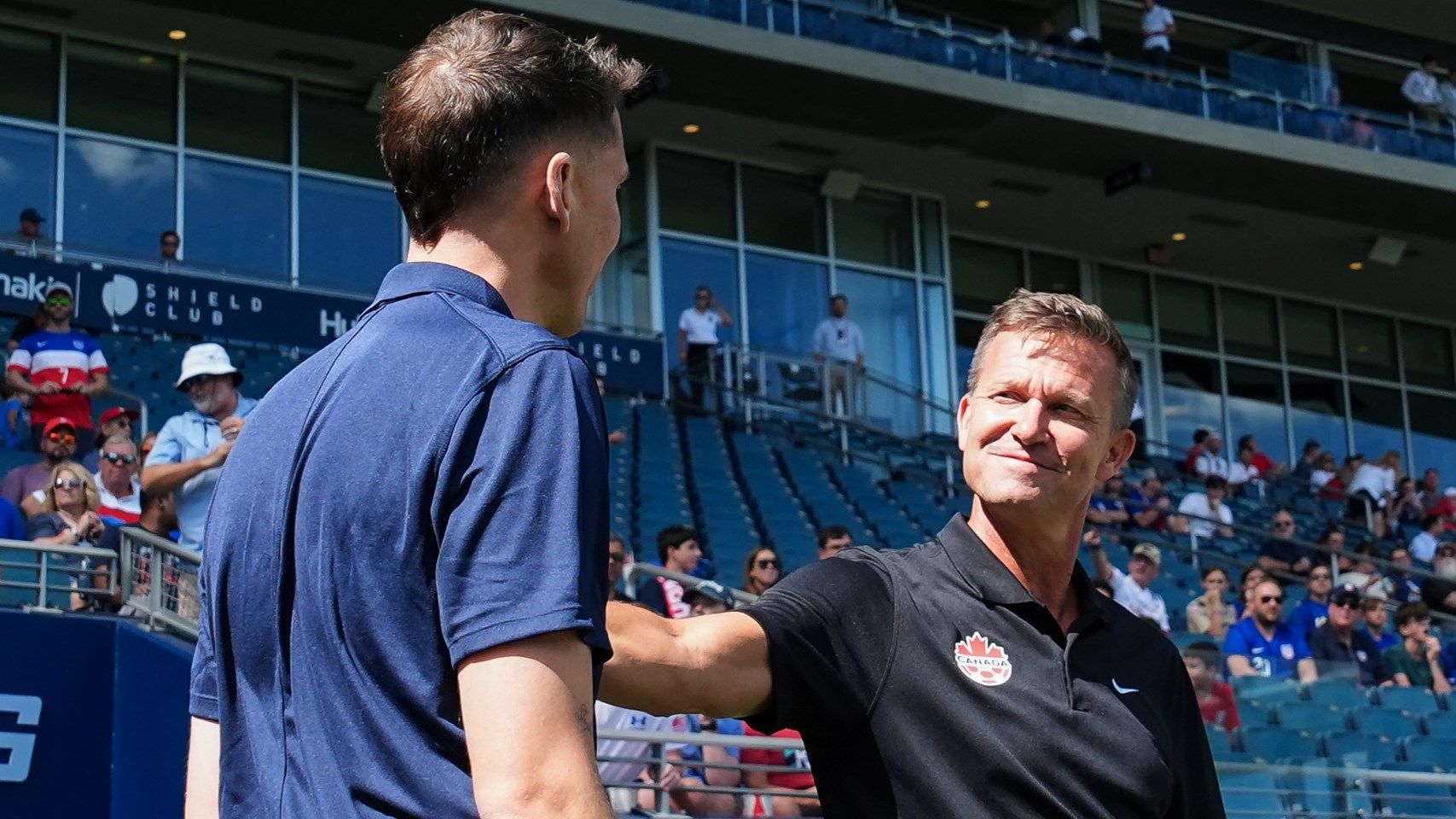
Jesse Marsch, Alphonso Davies, Jacob Shaffelburg CanadaGOAL

'Pushed some American ideals' - Jesse Marsch is the 'perfect coach at the perfect moment' as Canada close the gap on USMNT

MIAMI - Jesse Marsch summed it all up following Canada's exit at the hands of Argentina in the 2024 Copa America. Les Rouges played the eventual champions mostly even, only for two individual moments of quality - one from Julian Alvarez, a second from Lionel Messi - to see them denied of the chance to win the first international tournament in the program's history.

Marsch, though, saw the growth.

"There's still a lot of work to do. But we've built a really good foundation," he said following Canada's exit. "I think we've made a lot of progress together. And I'm really optimistic about what the future can look like."

Six months on, and that progress has only further crystallized. They haven't lost since September, and failed to win only once - a drab scoreless draw against Mexico in Austin. Marsch has now been in the job for nine months. The revolution is underway, and the American coach has stamped his own identity on a side that is closing the gap on its southern neighbors.

"The combination of the qualities of the players in the team, and what I'm trying to do with them, meshes really well," Marsch told GOAL.
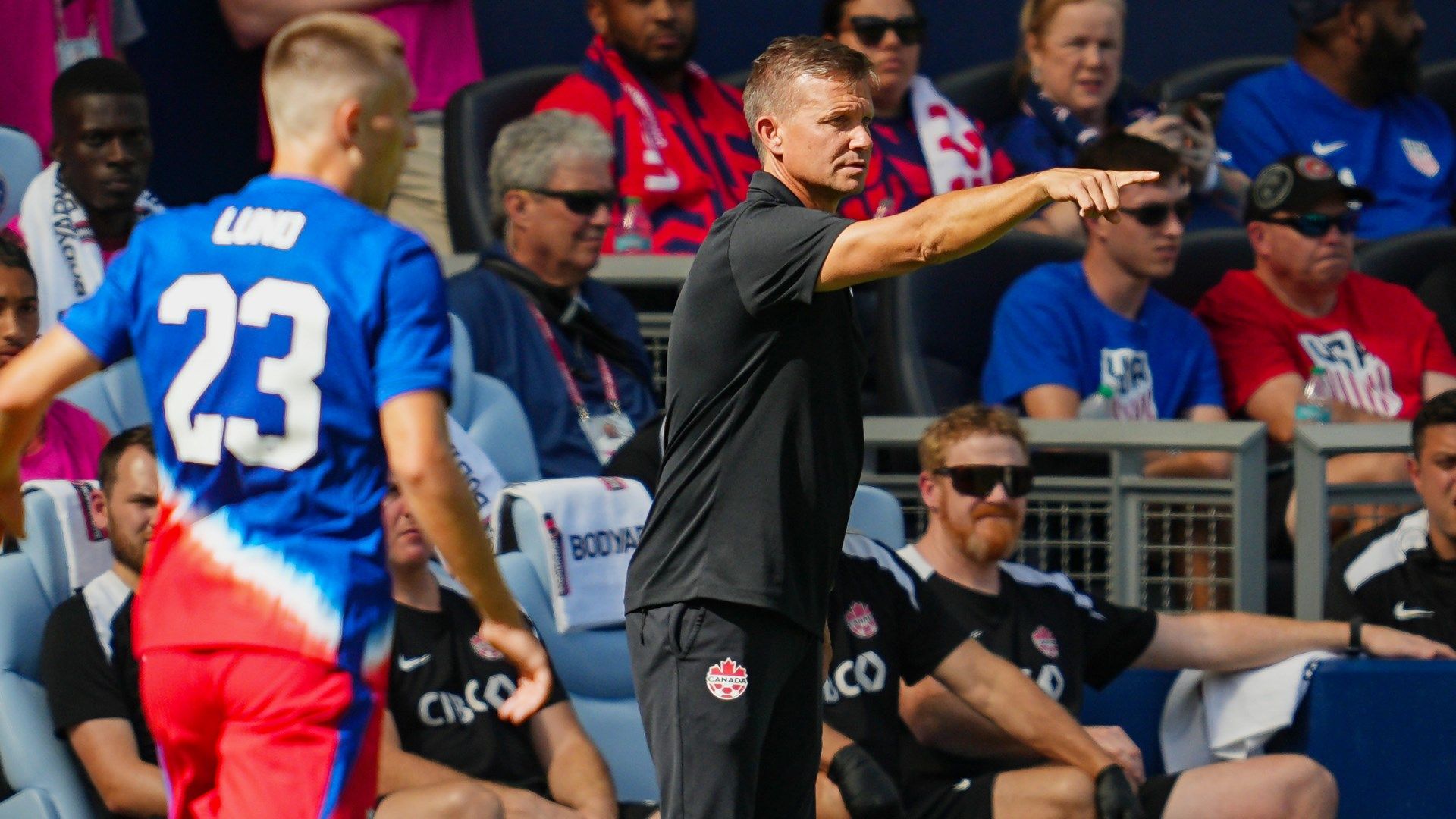
  • Jesse MarschUSA Today

    'He thinks of us as being too nice'

    Marsch-ball is in full effect. Yes, there is a signature playing style to be found. Canada are quick, athletic and young. They play fast, and use the dynamism of star man Alphonso Davies and the finishing prowess of Jonathan David to full effect. But the real difference, according to those who have been around Marsch is a newfound attitude towards the sport.

    "I think he thinks of the Canadians as being a bit too nice," winger Jacob Shaffelburg told GOAL at MLS Media Day. "He wants to kind of bring that bit of American in there."

    This isn't necessarily a manners thing. Marsch isn't asking for rudeness. He doesn't want his side to bend the rules, or treat the game with disrespect. Rather, the Wisconsin-born former USMNT assistant is asking his side to show a bit of a cocky streak.

    "I have pushed some American ideals within the team," Marsch admitted. "About being a little bit more arrogant, believing in themselves a little bit more. Really trying to push them to not just be footballers because they like it and it's fun and they're good at it, but more about a pursuit of excellence."

    That injection of confidence was exactly what the Canada side required.

    “Jesse Marsch is the perfect coach at the perfect moment for that group,” said former Canadian goalkeeper and current Houston Dynamo GM Pat Onstad said, “someone is a little bit brash and is ready to go and be on the front foot.”

  • Advertisement
  • From afterthoughts to competitors

    That attitude - as a concept and an adjective - has proliferated through a team that was long regarded as an afterthought in CONCACAF. At the turn of the 2000s, the USMNT was just starting to tussle with regional power Mexico for supremacy in the federation (the 2-0 win by the U.S. at the 2002 World Cup is seen as the singular fixture that brought the two sides onto level footing.)

    Meanwhile, Canada struggled to assert itself. It won the 2000 Gold Cup, and finished third in 2002. They made the semifinal of the tournament again in 2007, but losses to the likes of Haiti, Honduras, Jamaica and Martinique were more indicative. They had to wait until 2022 to qualify for the World Cup.

    Although qualification was an achievement, that tournament brought further disappointment in terms of results. Canada finished bottom of their group, losing all three games. They led just once, when Davies opened the scoring against Croatia after two minutes in a win-or-go-home match (the European side eventually won 4-1.)

    At that point, the problems were everywhere. The federation was strapped for cash, John Herdman was flirting with MLS clubs, and a number of senior players outright refused to play in the 2023 Gold Cup, with one eye on the wear and tear brought about by the European calendar. That they made the quarter-finals of that tournament, while Herdman was in the process of agreeing terms with Toronto FC, is, in hindsight, a significant feat.

    Marsch, it was widely rumored, was the U.S.'s top choice to replace Gregg Berhalter. The then-USMNT manager's contract expired after the World Cup, and it was no secret that the U.S. were assessing their options for a new manager. However, when Berhalter was brought back into the fold - largely due to reported pleas from the U.S. player pool - Marsch became available

  • Venezuela v Canada - CONMEBOL Copa America USA 2024Getty Images Sport

    'I waited a long time'

    But Marsch didn't immediately jump at the job.

    "I waited a long time before I made the decision to take the Canada job, and I was looking for a situation that I thought would be rewarding for me and for the team," Marsch explained.

    And even after agreeing, Marsch stalled further. He needed 24 hours to address a problem position before signing on the dotted line: center back.

    "We knew that this was going to be an area that hadn't been the greatest in the past. This was the talk of the player pool. And then when I watched Moise [Bombito] and Derek [Cornelius,] I thought, OK, there's something,'" Marsch said.

    That caliber of talent - Bombito plays for Nice, while Cornelius has impressed for Marseille - has become the norm for Canada. Traditionally, this was a side that relied on a handful of veterans, scattered MLS players, and some additional names from the country's own domestic league.

    Now, things look very different.

    "I think the national team has got a ton of really good young players," Onstad said. "They're developing, Jonathan David and Alphonso Davies, obviously the two bigger stars. But it was really Atiba Hutchinson and the guys kind of behind them that set the stage for these guys."

  • Jesse Marsch New York Red BullsGetty

    'It has made me feel empowered'

    That has been part of Marsch's remit. He has taken the job at a unique time in the scope of Canadian soccer. The talent pool is younger and deeper than it has ever been - both in MLS and abroad. But that, too, comes with its challenges.

    Marsch's full job title is "MLS Canada Men’s National Team Head Coach." The owners of three MLS clubs - CF Montreal, Toronto FC and the Vancouver Whitecaps - are paying parts of his $3 million salary in what a release dubbed “philanthropic contributions.” Marsch insists that the money coming from the trio of teams hasn't influenced his squad selection. If anything, it has only brought the group together.

    "It all started with the fact that those three clubs and ownerships, and specifically the three people that committed to it, really wanted me here, and were committed to it all the way,” Marsch said. “And it's made me feel empowered and like we have a really strong foundation as a team.”

  • Alphonso Davies Canada Copa America 2024Getty Images

    'He has understood what kind of player I am'

    That confidence has proliferated throughout the group. This team is younger and more diverse than ever. The squad that played against Suriname in the Nations League quarterfinals drew on talent nine different countries. Junior Hoilett and Jonathan Osorio are the only two players that remain from the dark days of the 2010s.

    It helps, too, that there are some world-class players. Davies is first choice at Bayern Munich. David, currently at Lille but linked with a move abroad, has tallied 22 goal contributions in 28 games for the Ligue 1 side.

    "He's undervalued in the world market as to how good he is," Marsch insisted. "He's one of the most in-form strikers. With strikers, usually, you look for someone who is fast or strong or good in the air. And he's not, like, exemplary in any of these categories, but he's great in all categories," Marsch said.

    And for the rest of the players who operate at a cut below the elite - the ones brought into the side and given the trust of the new manager - there is a real belief.

    "Since day one,” Shaffelburg said, “[Jesse] has understood what type of player I am, what I need to succeed, and everything he needs to do to help me get to the where I should be. You can see that on the field that he gives me a lot of confidence to play how I want.”

  • Jesse MarschUSA Today

    'I think we've caught up to them'

    To be clear, there are still some issues. The federation remains strapped for cash, and was unable to piece together the funds to hold a January camp, similar to the one the USMNT puts on every year.

    For Marsch, the priority is to ensure that the player pool continues to get younger, and develops. He is on a two-year contract. The focus, long term, is on the 2026 World Cup, to be hosted in the U.S., Canada and Mexico. Canada will host 13 matches of that tournament, and have already booked their spot as automatic qualifiers.

    Right now, though, there might just be a sense of equal footing. For so long, they were playing catch up to Mexico and the United States, two teams running away with CONCACAF supremacy. Under Marsch, and with a revamped squad, that gap is closing.

    "I think we've caught up to them," midfielder Samuel Piette said. "I'm not saying we're better than them... but what you can judge is results."

    So far, the results look pretty compelling.