
Goal.com

This page contains affiliate links. When you purchase through the links provided, we may earn a commission.

+18 or +21, depending on state | Commercial Content | T&C's Apply | Play Responsibly | Publishing Principles
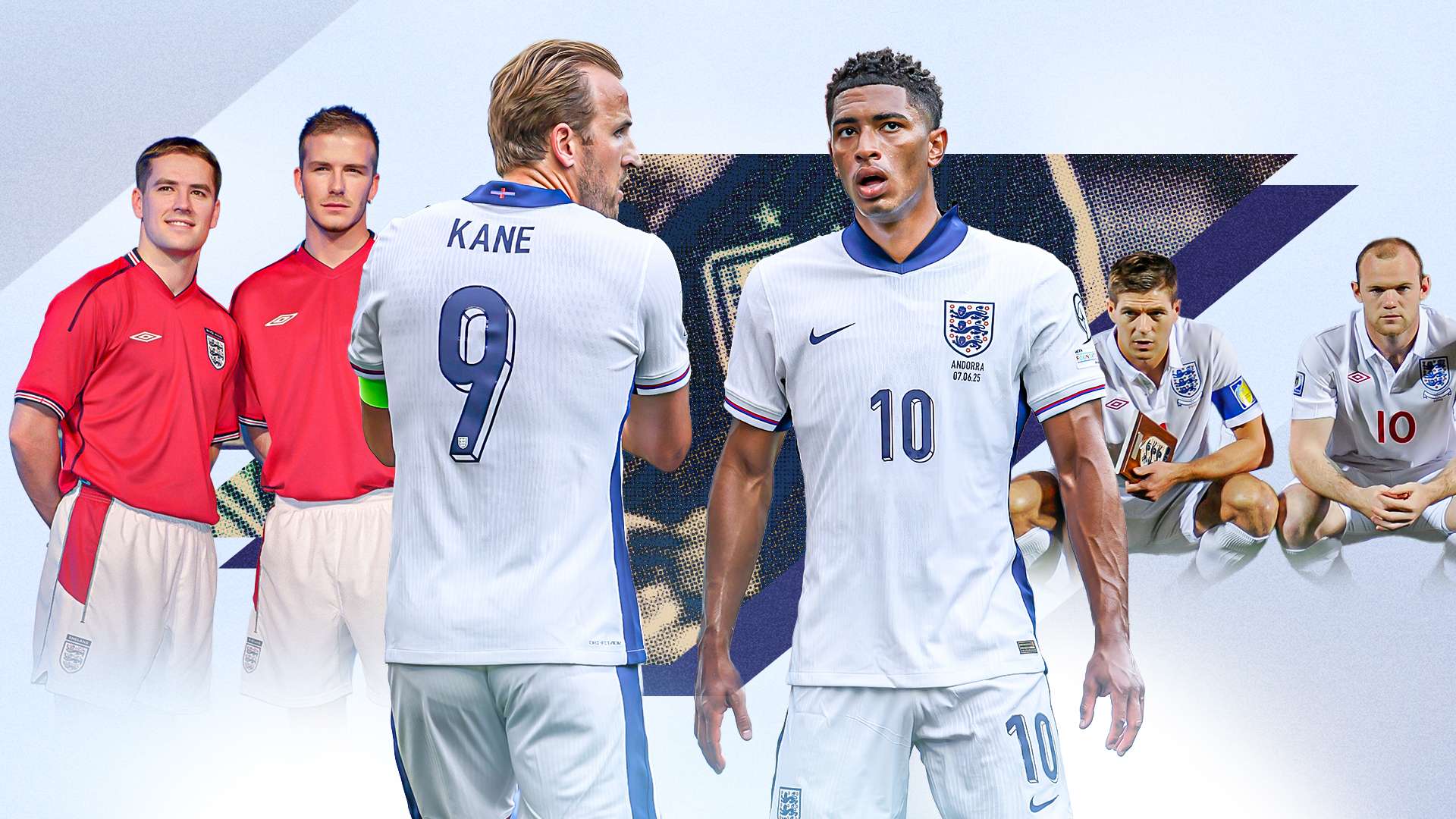
England squads GFXGetty/GOAL

Is Thomas Tuchel's team better than the 'Golden Generation?' England's 21st century World Cup squads - ranked

Indeed, it set expectations for years to come. That was 2001, and the head honcho of the FA declared that it didn't really get any better than this in terms of talent. At the time, England were 35 years - and counting - removed from winning a World Cup. They had reached semi-finals of major tournaments since, most notably five years earlier at Euro '96, but Crozier's assertion set expectations for Sven Goran Eriksson's team.

England, of course, would never quite live up to them. The name stuck, but tournament after tournament, squads failed. That group aged, got better, fell short, and new players come along. Not until the supposed 'golden generation' had all moved on did England really start announce themselves as true World Cup challengers once again.

Indeed, each version of England at the last seven World Cups has looked slightly different. During that run, four managers have taken charge (soon to be five), and a handful of players survived multiple eras. Some were too quickly moved on, while others outstayed their welcome.

With that in mind, GOAL has ranked the England World Cup squads of the 21st century in terms of their talent level, from 2002 to the group selected by Thomas Tuchel to represent the Three Lions in 2026:


  • Gerrard Rooney 2014Getty

    72014

    There truly wasn't anything to like about England's 2014 World Cup campaign. A group consisting of Italy, Uruguay and Costa Rica looked tricky on paper, but England made look far more difficult than it was.

    An opening loss to Italy was swiftly followed by a defeat to Uruguay, and after Costa Rica managed a shock win over the Azzurri in their second game, England were mathematically eliminated before they could kick a ball on the final matchday.

    The squad was a mix of young and old, but without many talented players in the primes of their careers. Steven Gerrard was an experienced captain, but less than two months removed from a heart-breaking end to his penultimate campaign at Liverpool, while Wayne Rooney and Frank Lampard had also seen their best days pass them by.

    There was youthful verve to be found in Daniel Sturridge and Raheem Sterling, but a defence marshalled by Gary Cahill and Phil Jagielka was, in hindsight, never going to be good enough.

  • Advertisement
  • Lampard Rooney 2010Getty

    62010

    A squad that contained remnants of the the 'golden generation' but perhaps showcased the fallow years that were likely to follow, Fabio Capello suffered a blow on the eve of the tournament when his captain, Rio Ferdinand, suffered an injury in England's first training session after landing in South Africa, leaving Jamie Carragher or Matt Upson to partner John Terry in defence.

    This was a squad that was bitten by the injury curse, as both Rooney and Gareth Barry - the man earmarked to play between Gerrard and Lampard so that both could be effective on the same pitch - suffered injuries leading into the tournament, meaning they were a shadow of themselves once they got on the pitch.

    And so while there were a smattering of world-class talents in the squad - Rooney, Gerrard, Lampard, Terry and Ashley Cole - there wasn't enough quality elsewhere if those players didn't perform. In the end, England crashed out in the last 16, with their most memorable moments proving to be Rob Green's error against the United States and Lampard's goal that never was against Germany.

  • England 2002 World Cup squadGetty

    52002

    While there was plenty of star power in England's 2002 squad - David Beckham, Michael Owen, Ferdinand, Sol Campbell and Paul Scholes were all included - Eriksson was hamstrung somewhat by a couple of crucial absentees, with Gary Neville and Gerrard both ruled out due to injury. Danny Mills stepped in at right-back, while Gerrard's replacement, Danny Murphy, also went down pre-tournament, meaning West Ham winger Trevor Sinclair was drafted in.

    Sinclair ended up starting three games on the left of midfield, with this the peak of England's infamous 'left-sided problem'. Experiments with Darius Vassell and Owen Hargreaves didn't work in the opening two games, leaving Sinclair, who only had five international appearances to his name before his call-up, to step in.

    Factor in Beckham's infamous metatarsal injury and how that inhibited him to a degree, and England still performed relatively well, beating Argentina in the group stages before producing one of their best all-round tournament performances of the 21st century in dismantling Denmark.

    They might have gone all the way, too, had Ronaldinho not lobbed David Seaman with that free-kick? They were not, however, the most talented bunch to ever represent the Three Lions.

  • ENJOYED THIS STORY?

    Add GOAL.com as a preferred source on Google to see more of our reporting

  • England 2018Getty Images

    42018

    England may have reached the semi-finals at the 2018 World Cup to equal their best performance since triumphing in 1966, but there is no doubt that Sir Gareth Southgate's squad far outperformed their abilities.

    Yes, there was reason for optimism. Harry Kane and Dele Alli had become a fearsome combination at Tottenham while Sterling had been one of Manchester City's best players during their 'Centurions' season, but there were also plenty of areas of perceived weakness.

    Kyle Walker was forced into a back three that also included a pre-Manchester United Harry Maguire, while Ashley Young was the preferred choice at left wing-back. Jesse Lingard, meanwhile, was a starter in midfield, while Ruben Loftus-Cheek's regular appearances off the bench highlighted a lack of quality depth, something which eventually came back to bite England in their extra-time defeat to Croatia.


  • Declan Rice Jude Bellingham Phil Foden England 2022Getty Images

    32022

    The trip to the Euro 2020 final was a wonderful for journey England supporters, as the team that outperformed expectations at the previous World Cup developed while added quality in key positions shone through.

    Arriving in Qatar 18 months later for the World Cup, the momentum was with Southgate's team. Declan Rice, Bukayo Saka and Phil Foden were among the Premier League's best young players, Trent Alexander-Arnold and Kyle Walker - both at the peak of their powers - were duking it out to start at right-back, while the emergence of Jude Bellingham added a creativity and drive to the England midfield that had been missing for over a decade.

    With Kane still banging them in for club and country, as well the battle-worn experience of Jordan Pickford, John Stones and Maguire, this was a squad built to compete with the very best. Even Kalvin Phillips and Mason Mount hadn't suffered their respective drop-offs yet, while Jack Grealish and Marcus Rashford provided genuine game-changing abilities off the bench.

    That this squad only made it to the quarter-finals, then, was disappointing to say the least. A heart-breaking loss to France - complete with a Kane penalty miss - felt harsh, and may be looked back on as a huge missed opportunity.

  • Harry KANE-england-202511(C)Getty Images

    22026

    Tuchel seems to have looked at how Southgate failed and learned from his predecessor's mistakes. The 2026 England squad is full of stars, sure, but it's a little more pragmatic. Kane arrives at the tournament as the frontrunner for the Ballon d'Or after a 60-goal season at Bayern Munich, Rice was arguably the best player in the Premier League, while Bellingham and Saka have world-class tendencies.

    But perhaps more important here are the pieces added for balance. Elliot Anderson, a remarkably disciplined midfielder will anchor the side, while Reece James is a more sensible pick than Alexander-Arnold.

    Yes, there are question marks over a lack of experience in defence, while there are certainly better wingers than Anthony Gordon or Rashford at the tournament. A lack of game-changers off the bench could also prove to be a problem after Cole Palmer and Foden were left at home. But there has not been an England squad for at least two decades with as much top-end quality as Tuchel's first tournament group.

  • England Golden GenerationGetty

    12006

    You'd be hard-pressed to find a better squad than what England took to the 2006 World Cup in Germany.

    A back four of Neville, Ferdinand, Terry and Cole is fearsome, while having Gerrard and Lampard in central midfield was, on paper at least, a scary proposition. Ahead of them were Rooney, who was nursing an injury but was otherwise at the peak of his powers, alongside Owen, who, despite having lost his pace, was still an intelligent striker with unerring finishing ability.

    Campbell, Michael Carrick and Hargreaves - players who would have walked into most other teams - were limited to bench roles, alongside the precocious talents of teenager Theo Walcott (who, as it turned out, was something of a wasted pick by Eriksson).

    So what went wrong? Well, England could never quite get on the same page. Team rivalries tore the squad apart, and Eriksson wasn't strong enough personally or tactically astute enough to fix it. An injury to Owen in the third group-stage game didn't help, either.

    In the end, Rooney, who struggled with his own fitness throughout the tournament, was sent off against Portugal in the quarter-finals and penalties were once again England's undoing. A team good enough to win the whole thing were, thus, sent packing early.