
.png?auto=webp&format=pjpg&width=3840&quality=60)
Over under betting is simply a bet on the amount of total points scored in a game.
Point totals betting as it can also be known, is amongst the easiest methods for newcomers to start sports betting.
What does Over/Under mean in sports betting?
Often referred to as "O/U" or "Total," an over/under betting is a gamble on whether the final total of points scored, goals, or stats will be greater or less than the amount determined by the sportsbook.
You're making predictions about how the game will unfold in terms of output or scoring, not choosing a team to win or lose. For instance:
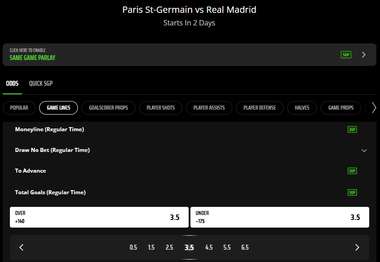
Assume that a sportsbook sets the goal total for a PSG vs Real Madrid soccer match at 3.5.
- Over 3.5 Goals: If four or more goals are scored overall, the bet wins.
- Under 3.5 Goals: If there are three goals or fewer at the end of the game, the bet wins.
Already know about over/under betting? Our sports betting glossary has all the terms that may confuse bettors.
Over/Under Example – NBA
Basketball is fast-paced, high-scoring, and quite predictable if you know what to look for, which is why NBA games are among the most popular events for Over/Under bettors.
The team's pace, injuries, and previous performance may all affect totals, which can vary from the average NBA total of around mid-200s to the 240s.
Let's use an actual NBA betting totals case to illustrate how Over/Under betting operates:
NBA Game Total

Matchup: Oklahoma City Thunder vs Denver Nuggets
- Total: 211.5 points
- Over 211.5: -115
- Under 211.5: -105
You decide to place a bet: $10 on Over 211.5 at -115
- If the score is 120–115 (235 total), bettors win $8.70 profit
- Total return = $18.70
But what if you placed $10 on Under 211.5 at -105
- If the score is 104–106 (210 total), you win $9.52 in profit
- Total return = $19.52
It makes no difference who wins or loses the game. Whether the final combined score surpasses or falls short of 218.5 is the only factor that matters.
What Impacts NBA Totals?
Whether you should bet on the Over or the Under in basketball depends on a number of factors:
- Pace of Play: Teams that push the pace, such as the Pacers or Warriors, get more possessions each game, which can result in greater totals.
- Matchups Between Defense and Offense: A game between two of the best defensive teams may have fewer baskets and a low scoring game.
- Key Scorer Injuries: Unless someone steps up, the absence of a star like Steph Curry or Jayson Tatum could lower the total.
- Back-to-Back Games: Teams may relax or play more slowly on the second night of a back-to-back, which is something that bettors keep a careful eye on.
NBA Prop Totals – Player Over/Under
You can also bet on individual player stats in the NBA:
Market: Lebron James - Blocks

- Over/Under: 3.5
- Over 3.5: -120
- Under 3.5: -110
$10 on Over 3.5 blocks → If James blocks four or more, you have a winning bet with $8.33 profit
$25 on Under 3.5 blocks → You win if he hits four or less. $22.73 in earnings
Pro Tip: Player prop Overs, such as threes made, assists, or points, can have greater value in fast-paced games or shootouts. However, before placing a wager, carefully review the opponent's defensive rating, matchup history, and current form.
Point Totals Betting Example – Super bowl
A mainstay of NFL betting, over/under betting attracts both savvy and novice gamblers. Since football is the most popular sport in the US for betting, there is a lot of activity in the totals markets, particularly for Sunday games and primetime matches.
In a football game, totals often fall between the low 30s for defensive games and the mid-50s for offensive powerhouses. You can identify value before the line shifts if you understand how situational elements and combined score trends affect the number.
NFL Over/Under Betting

Matchup: Kansas City Chiefs vs Philadelphia Eagles
- Total: 47.5 points
- Over 47.5: -110
- Under 47.5: -110
Here’s how your bet plays out:
$10 on Over 47.5 at -110
- Final score: 31–24 (55 points total)
- You win $9.09 profit
- Total return = $19.09
$25 on Under 47.5 at -110
- Final score: 24–20 (44 total)
- You win $22.73 profit
- Total return = $47.73
In this case, just like the NBA or an MLB game, the winner of the game is irrelevant—the total is judged solely on the final combined score of the football game.
Factors That Move NFL Totals
- Weather Conditions: Rain, snow, and especially wind can lower scoring. Always check the forecast—bad weather usually favors the Under.
- Quarterback Play: Elite QBs like Lamar Jackson and Josh Allen can push the total points, scoring higher. If backups are starting, lines often drop.
- Game Script: Teams expected to trail may throw more, inflating scoring late. This is especially important for live point total betting.
NFL Prop Totals – Player Over/Under Betting
You can also wager on totals for player stats like passing, receiving, or rushing yards:
Market: Saquon Barkley – Rushing Yards

- Over/Under: 113.5
- Over 113.5: -120
- Under 113.5: -110
$10 on Over 113.5 @ -120 → Barkley finishes with 123 yards = win $8.33 profit
$25 on Under 113.5 → He finishes with 78 yards = win $22.73 profit
Player prop totals in the NFL have exploded in popularity, especially during big games.
Over/Under Betting Example – Soccer
There's much more to point totals in soccer than just goals. Although the most common totals are still standard ones, such as Over/Under 2.5 goals, sportsbooks also include a variety of prop markets linked to shots, corners, cards, and team statistics. Because of this, bettors have a lot more options for how to approach each game.
Because soccer often has lower average combined scores than basketball or football, there is less room for error and a chance for an advantage, making totals particularly helpful in this sport. Thus, a careful examination can have a significant impact.
Game Total Example – Goals

Let’s say PSG is playing Real Madrid in a Club World Cup match.
Market: Total Goals
- Over/Under: 2.5
- Over 2.5: -120
- Under 2.5: +100
$10 on Over 2.5 → Match ends 2–1 (3 total goals) → Win $8.33 profit
$25 on Under 2.5 → Match ends 1–1 (2 goals) → Win $25 profit
Smart Soccer Over/Under Tips
- Tight matchups = Low goal totals: Defensive-minded teams or rivalry matches often trend Under.
- Form matters: A team scoring freely across recent matches may push a match over.
- Card/Corners bets: Consider match intensity. Derbies and knockout games tend to produce more fouls and set pieces.
Totals in soccer rewards both tactical insight and statistical analysis. Whether you're targeting goals, corners, or shots, there’s always an angle to exploit.
How to Place an Over/Under Bet - Key Takeaways
1. Join a legitimate sportsbook.
Select a reliable sportsbook that is authorized to operate in your state. Numerous totals markets are available at sites like Caesars, FanDuel, and BetMGM. Fill out the registration form and you're nearly ready to go.
2. Select your event and sport.
Go to the sport you wish to wager on, such as the Premier League, NBA, or NFL. Click into a game or match to view all available markets.
3. Find the Over/Under betting line
Usually, the total is shown as "O/U" or "Total." It may look like Total 217.5 (NBA) or O/U 44.5 (NFL). Some games may offer multiple totals for halves or quarters.
4. Pick your Point total
Choose the standard or alternative total points that you wish add to your bet slip.
5. Pick the side of the total
Think the score or stat total will go higher? Bet the over. Expect a defensive, low-scoring outcome? Bet the under.
6. Enter your stake
You may choose to bet $5, $10, or $25, and the sportsbook will figure out how much you might win automatically.
7. Verify and make your wager.
Verify the market and odds one more time, then select "Place Bet." As soon as it is locked in, you will receive confirmation.
Point Totals Bet Types
Over/Under betting isn’t just about total game scores anymore. Modern sportsbooks offer a deep lineup of totals markets across halves, quarters, players, and team stats, letting you zoom in on specific parts of a game or individual performances.
These options make Over/Unders one of the most flexible bet types available to US sports bettors oftentimes unlike point spread.
Game Total Bet

This is the classic and most widely available Over/Under market. You bet on the total combined score from both teams in a full game.
- Example: Lakers vs Spurs
- Total: 175.5
Bet Over if you expect a high-scoring shootout.
Bet Under if you expect a low-scoring one
Half-Time Totals

You may wager on just the first half of the game rather than the entire match. This is useful if you anticipate a low-scoring opening or if one team gets off to a quick start.
Example:
- PSG vs Real Madrid Jaguars 1st Half Total: 1.5 Goals
Bet Over if you expect early fireworks.
Bet Under if you think the game will start slowly
Quarter or Period Over/Under
Many bookmakers provide totals for certain quarters (NBA) or periods (hockey/soccer).
For example, 1st Quarter – Suns vs Nuggets: Over/Under 55.5 points
Player Prop Over/Unders
You may wager on whether a certain player will go over or under a given stat line, such as points, rebounds, assists, yards, or even three-pointers, using these markets. For instance:
- Shai Gilgeous-Alexander over/under 30.5 points scored
- Jalen Williams over/under 2.5 steals
These bets are especially popular in fantasy sports circles, where players already study individual performance trends.
Stat-Based Totals
These go beyond scoring and dive into game stats. You’ll find these in both team and match markets. Examples:
- NFL: Over/Under 3.5 total touchdowns
- NBA: Over/Under 10.5 made free throws
Exotic & Live Totals
Live Over/Unders that change as the game goes on are available at certain bookmakers. These are ideal for bettors keeping a close eye on things and responding to changes in strategy, injuries, or in-game momentum. Additional specialized markets consist of:
- Over/Under number of offsides
- Over/Under pitch count for MLB pitchers
- Over/Under shot attempts in NHL
Summary: When to Use Each Type
| Bet Type | Best For |
| Game Totals | General predictions |
| Halves/Quarters | Focused plays or slow starts |
| Player Props | Fantasy-style research |
| Stat Totals | Analytical bettors |
| Live Totals | Reacting to game flow |
The depth of totals markets gives you the flexibility to bet your way—whether you’re tracking team trends, live stats, or individual player form.
Strategies for Over/Under Betting
On the surface, totals sport betting can appear straightforward—you are simply wagering on whether a number is too high or too low. However, you'll need more than just a gut feeling if you want to regularly beat the odds. To identify value in totals lines, astute gamblers combine statistics, timing, and study.
Here are some strategies to follow for all your bets on point totals:
1. Do Your Research
- Before betting an Over or Under, ask:
- Are both teams in strong scoring form?
- Who is injured?
- What style of play do both teams use?
- Favourite (negative odds)
- Underdogs (positive odds)
Check team stats like:
- Number of points scored per game
- Possessions per game (NBA)
- Yards per play (NFL)
2. Analyze Pace and Play Style
Pace directly impacts scoring totals—especially in the NBA and NFL. In basketball, fast-paced teams like the Pacers or Warriors generate more possessions, leading to higher scores. In football, teams that play no-huddle or air-it-out offenses are more likely to hit the Over. For soccer, tempo is more tactical:
- High press teams = more transitions = more scoring chances.
- Compact defenses = low-event games = likely Under.
Tip: Look at each team’s last five games for pace, scoring, and defensive metrics.
3. Account for Weather (NFL, Soccer)
Outdoor sports like football and soccer are impacted heavily by weather conditions:
- Rain or snow → slippery conditions = dropped passes, slower pace
- High wind → limits deep throws and field goals
- Extreme heat → slows tempo late in games
Always check the forecast—especially for winter NFL games and rainy MLS matchups as these adverse condition regularly affect the number of points scored.
4. Track Injuries and Lineup News
A single injury can swing the total:
- Missing QB or striker = reduced scoring
- Missing elite defender = game opens up
- Star player returns = the line may not adjust fast enough
Tip: Watch injury reports and beat writers. Look for value before sportsbooks adjust the line.
5. Watch for Reverse Line Movement
If most bets are on the Over but the line drops, that’s called reverse line movement—often a sign that sharp money is on the Under. Fade the public when the market shows a different story.
6. Live Betting Strategy
If you’re watching a game and notice a slow start with lots of missed shots or penalties, it might be a good time to hit the live Under—especially if the line hasn’t adjusted yet. Live totals can also offer great value if you know how each team tends to finish games (e.g., fast-scoring 4th quarters). Successful Over/Under betting isn’t about guessing—it’s about reading the game before it happens. The more disciplined your research and timing, the more consistent your edge.
Why Do Sportsbooks Use Decimal Numbers in Over/Under Betting?
When looking at totals bets, one of the first things you'll notice is how frequently a half number appears in the total, such as 3.5, 35.5, or 217.5. At first glance, this may appear strange. After all, you can’t score half a goal or half a point in most sports. So why do sportsbooks use decimal totals? Avoiding what is known as a "push"—a wager that falls precisely on the line—is the primary motivation.
No one wins or loses when a game concludes with a total that precisely equals the Over/Under figure (for example, you bet on Over 35 and the final total is 35). Your original stake is refunded. This is known as a push or tie. Sportsbooks don’t like pushes, and bettors don’t either. They create uncertainty and take money out of the betting pool. Sportsbooks remove the chance of a push and ensure a victory or a loss, which is why they set totals like 35.5 or 3.5.
Example:
- Total = 35.5
- Final score = 19–20 → Total = 39 → Over wins
- Final score = 15–20 → Total = 35 → Under wins
There’s no middle ground with a half-point total.
Can I bet both sides of an over/under?
Though not at the same sportsbook or in the same wager, it is theoretically possible to wager on both the Over and the Under on the same total. For a particular market, the majority of sportsbooks only let you choose one side of the line.
However, some savvy bettors use multiple sportsbooks to “middle” a total—a strategy where they bet both sides at slightly different lines in hopes of cashing both or minimizing risk.
Example: Middling Opportunity
Let’s say:
- Sportsbook A offers Over 217.5 points
- Sportsbook B offers Under 219.5 points
You could:
- Bet Over 217.5 at Book A
- Bet Under 219.5 at Book B
If the total lands on exactly 218 or 219, you win both bets. If it falls outside that window, you may only lose the vig (or win one and break even overall).
Middling opportunities don’t happen often, but when they do, they offer low-risk value for disciplined bettors.
Why The Difference in totals lines on different sportsbooks
Internal Models & Risk Management: Every sportsbook calculates totals using a unique system that takes historical data, injuries, current performances, and weather into account. But once they post a line, the real driver becomes betting volume.
Market Reaction: If a lot of money is placed on the Over at one book, it might shift the total from 44.5 to 45.5 to balance the action. Another book may have different betting behavior and keep the line unchanged.
Tip: Shop around. This is why experienced bettors shop lines across different sportsbooks. This way, you can find hidden value in betting odds.
When it comes to fantasy sports, does total bets matter?
Indeed, over/under betting may be a useful tool in fantasy sports, particularly in prop betting and Daily Fantasy Sports (DFS). In addition to being widely employed in conventional sportsbooks, totals wagers are also quite useful for forecasting player success in fantasy competitions. Greater fantasy potential is associated with higher totals.
A high game total indicates the possibility of greater scoring, pace, and stat accumulation. For example, an NBA game with 230+ total score or a soccer match with 3+ goals will typically lead to more fantasy points for players. This is true across the board for all the major sports.
- Points, rebounds, and assists in basketball
- Goals, shots, and key passes in soccer
- Passing and receiving yards in football
If the total is low, it may indicate a defensive battle with limited stat upside.