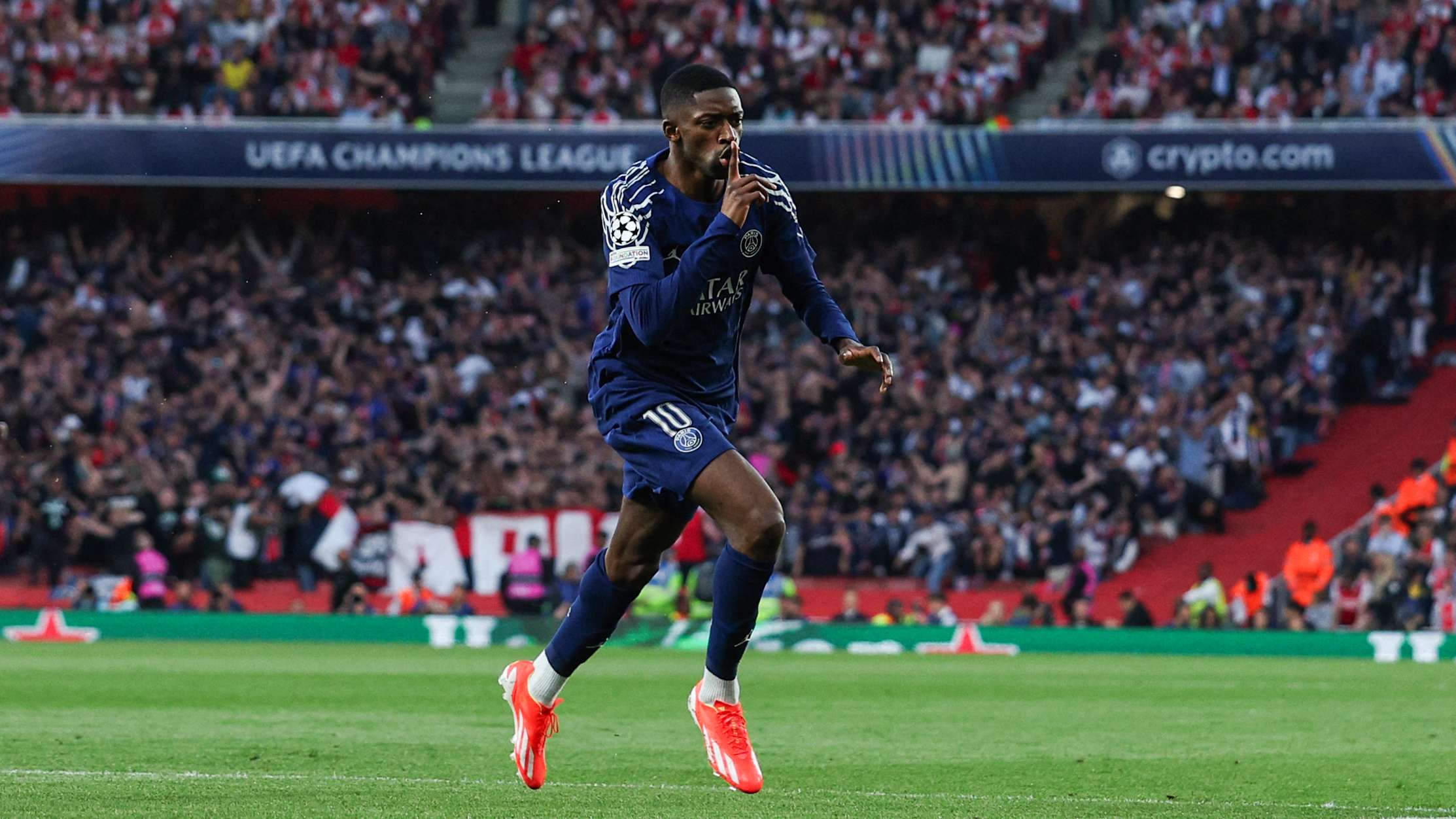
In an interview with GOAL, Arsenal legend Ray Parlour has already identified Kvaratskhelia as the PSG player that Mikel Arteta's men need to "worry" about most going into Saturday's Champions League final in Budapest - and with good cause.
'The Georgian George Best' is on a historically good run of form. With his brilliant assist for Dembele in the second-leg draw with Bayern at the Allianz Arena, Kvaratskhelia became the first man to register a goal involvement in seven consecutive games in the knockout stage of the Champions League.
Were he to maintain that remarkable run in Budapest, he would almost certainly move to the top of the Ballon d'Or power rankings ahead of the World Cup. Staying there without participating in the biggest competition in sport would obviously be difficult, and doubtless depend on how his main rivals fare in North America.
Since non-Europeans became eligible for the Ballon d'Or in 1995, four of the seven victors in 'World Cup years' also won the latter trophy: Zinedine Zidane (1998); Ronaldo (2002); Fabio Cannavaro (2006), and Lionel Messi (2023, due to the delayed 2022 World Cup). A fifth victor, Luka Modric, claimed the Ballon d'Or primarily due to the fact that he won the Golden Ball at Russia 2018.
Kvaratskhelia can, however, take inspiration from Messi and Cristiano Ronaldo. They not only failed to win the World Cup in 2010 and 2014, respectively, they also performed poorly at the tournament in question - and yet it didn't prevent either from finishing first in the Ballon d'Or voting.
Of course, Kvaratskhelia may not have yet reached that level of play, or perhaps more importantly, popularity, but the point is that Toni Kroos could yet be proven wrong. Just because Kvaratskhelia definitely won't be a world champion this year, it doesn't necessarily mean he won't win the Ballon d'Or. With one more dazzling and decisive display in this season's Champions League, he would become the worthiest of winners.