+18 or +21, depending on state | Commercial Content | T&C's Apply | Play Responsibly | Publishing Principles
AFCON PUMA shirts GFXGOAL/PUMA

How PUMA just get it so right with their Africa Cup of Nations kit designs

When it comes to the African Cup of Nations, PUMA do not miss. The German sportswear giant has become synonymous with AFCON, with many of their designs for the continent's leading nations down the years becoming iconic.

There's Didier Drogba banging goals in the vibrant orange of Cote d'Ivoire's skin-tight shirt in the mid-noughties, you've got Michael Essien bossing the midfield with the Ghana's Black Star on his chest, and, of course, who could forget Samuel Eto'o's bare arms holding the trophy aloft in Cameroon's FIFA-banned sleeveless strip in 2002.

PUMA has been a constant in modern African football, but what is the secret behind their success? Upon the release of their roster of kits for the 2025 edition of AFCON, GOAL spoke to one of the creative minds behind their latest mesmerising collection for the continent's leading nations to try to find out.

  • PUMA AFCON shirtPUMA

    'The essence of African culture'

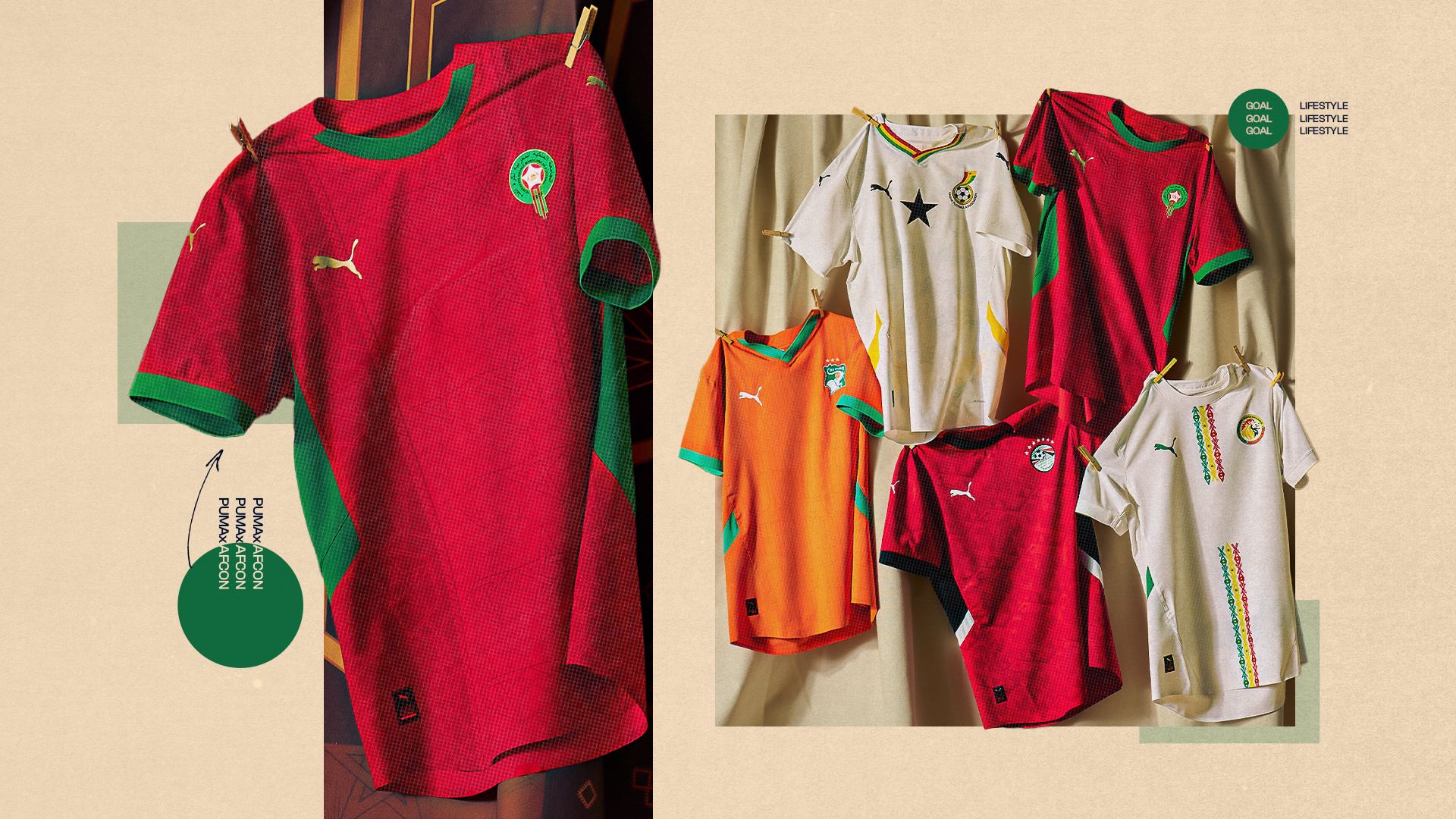
    PUMA have dropped new home and away kits for hosts Morocco, Ghana, Cote d'Ivoire, Senegal and Egypt ahead of the tournament, which gets underway in December next year.

    The German sportswear giant describes the collection as a 'celebration of the essence of African culture', with each unique design drawing inspiration from the cultural identity of that country.

    In order to better understand those identities, guest designers originally from those nations were brought on board, with the founders of Amsterdam-based streetwear label Daily Paper, Abderrahmane Trabsini and Jeff Osei, designing the Moroccan and Ghanaian shirts respectively.

    "We're delighted to have had the opportunity to create both home and away kits that embody the spirit of African nations," Peter Dangl, director at PUMA EEMEA distribution said. "We based all designs for Morocco, Egypt, Senegal, Ivory Coast and Ghana kits on in-depth conversations with natives to ensure we captured each culture’s nuances accurately, and we’re incredibly excited to see these stories unfold on players and supporters alike."

    This bespoke approach is reflected in the details of each design: the Egyptian kits, of course, draw on the country's rich history of pharaohs and pyramids; Cote d'Ivoire's are inspired by the annual Fete des Masques at the heart of its folklore; Senegal's evokes the theme of Teranga - the spirit of hospitality; Ghana's incorporates traditional 'Adinkra' symbols.

    Made from at least 95% recycled textile waste, all of them are strikingly beautiful in their own right, undeniably putting the lazy modern approach of template designs to shame.

  • Advertisement
  • Morocco shirts PUMA AFCONPUMA

    Homage to Moroccan craftsmanship

    Daily Paper co-founder Abder Trabsini, born and raised in Amsterdam, was given the privilege of designing the home and away shirts for his ancestral home and the 2024-25 AFCON host nation, Morocco.

    He decided to pay tribute to the country's perhaps underappreciated craftsmanship, with the home shirt featuring an all-over geometric print, while the away is adorned with symbols usually found on the country's famed rugs. The name and numbers will also be in the indigenous Amazigh language, rather than Arabic - a nod to Trabsini's own background.

    "I'm honoured to design something for my country, Morocco, and capturing it the way I wanted it - in this case highlighting the beauty of the country in terms of craftsmanship," Trabsini tells GOAL. "With the home kit, the all-over print is inspired by the 'zellige' tiles, Moroccan tiles which are well-known - yeah, beautiful craftsmanship. With the away I wanted to have a bigger story and put some Amazigh inspiration, like the Berber carpets that you see, and incorporating those symbols.

    "And for me the cherry on the top is changing the Arabic language to the Amazigh language on the back, which PUMA thought was a very brave step, but I told them 'Hey guys, as you can see if you look at the Moroccan street signs, everything now is in three languages - it's in Arabic, French and the Berber language'. I said 'If we do that we finally acknowledge that this is the language of Morocco - the indigenous language'."

    He continued: "When we presented it to the [Moroccan] federation they really liked the idea, they thought it was very fresh and very cool from a cultural point of view, but also from a national point of view, because all the Berber people, all the Amazigh people will be like 'Wow, we're finally also being acknowledged in sports'. It's amazing because my mother is also from that culture, from the Amazigh in the south. When it dropped all my family members called my mum and they were very proud that I incorporated this storytelling, and I saw some Amazigh-Berber Instagram accounts that posted it as well which is cool and very refreshing and a positive angle."

  • Morocco shirt AFCON PUMAPUMA

    Streetwear inspiration

    Leaning on his streetwear MO and empowered by PUMA with creative license, Trabsini's desired outcomes were original designs that hit that sweet spot at the intersection of fashion and football.

    "I think from my background in terms of streetwear, designing something is cool but what's the story? What's the marketing?" he says. "Trying to incorporate other things, like the craftsmanship, the design details that Morocco has, and also using my Daily Paper ethos, using all-over prints, which is very cool to do.

    "I went back to the archive, I found this website with all the vintage Moroccan jerseys, I went to the store, I went to PUMA, Nike, Umbro - they had some legendary kits. Based on that I really checked like 'Hey, what's something they didn't do?', and that's something I incorporated with the away shirt.

    "The last couple of jerseys they didn't do an all-over print, and I really wanted to do something cool that's like visible but not too loud, you know? It's not a visible all-over print - if you look at it closely you see the print but from afar it's not a loud t-shirt. I also wanted to create a lifestyle item."

  • PUMA Morocco kits AFCONPUMA

    Pushing the boundaries

    Trabsini really took advantage of that creative license, as he pushed the boundaries of what was possible: "Obviously the colours, the red, green, and the away in white. It's always a standard colour palette for the country," he says.

    "The only thing I wanted to try was adding a blue colour. You have this Majorelle blue from the Marrakech. You have this specific blue, and that was one of my ideas to use that colour as a way to highlight also the design because it's such a specific, Moroccan blue, but they said 'No, we need to stick to the colour palette'.

    "Which is fine, because as a creative you need to challenge yourself to work within specific parameters - as a designer, as a creative you're always thinking solutions. Most of our things are problems that you need to solve, which is always fun to do. It's been a nice process, and big shout out for PUMA - they gave me a lot of freedom as well."

  • Bridging the gap

    The 18-month design process was clearly a personal journey of identity for Trabsini, as he sought to do the design process and his ancestral home justice. One clear aim was connecting the Moroccan diaspora to its homeland through the designs.

    "It doesn't matter where we are in the world as Moroccans, we always remain Moroccan. I want to highlight the cultural bridge we always have. I always like when you meet a fellow Moroccan in Europe, you click instantly because you share the same values, and in my opinion that doesn't change when you grow up somewhere else," he tells GOAL.

    "The fact that 70-80% of the Morocco national team are Moroccans from Europe, which is beautiful and a good example for the world, to be like 'Hey, we still have strong cultural ties with our motherland', so that's something I want to celebrate."

    Indeed, Daily Paper's outlook is steeped in its African heritage. "Even me as a designer, with what we're doing with our brand Daily Paper, it's me, Jefferson and Hussein from Moroccan, Somali and Ghanaian heritage, but with our brand we really show people that we're really proud Africans and we celebrate the beauty of it," Trabsini continues.

    "And it's cool to grow up with two different cultures, because back in the day it wasn't cool to say 'hey, I'm a proud Moroccan', or you've always been ashamed and you want to assimilate to a country your parents moved to, but now you can be fully proud to say 'Hey, I'm a proud Moroccan-Dutchman'. That's how I feel and that's the energy I want to give."

  • PUMA AFCON kits homePUMA

    Unique approach

    So what is PUMA's secret to that synonymity with African football? How do they keep getting it so right time and time again?

    From Trabsini's perspective, it's that bespoke approach that makes PUMA's designs so special. "PUMA has always been a pioneer in investing in African sports," he says. "And I think what PUMA does really well, and this is a good example, is how they approach creatives like me, Jeff and other people to ask us like 'Hey, can you guest design something?'.

    "I feel like they're very open to feedback outside of their company to learn more about the [country's] culture. For example, that Amazigh storytelling, that idea wouldn't have come internally - you need someone externally who looks differently at it and be like 'Ok, what's the story we want to tell right now?', especially during AFCON.

    "PUMA is always keen to have external people helping them to push the stories of different nations. That's super cool to allow people from that heritage to create something."

    The full range of AFCON kits is available to purchase now across PUMA stores and online