


Palmer is genuinely one of my favorite players, the kind I would pay to watch. His style of play is so entertaining. Back in Summer 2023, when Chelsea was spending heavily on young talents, they signed Palmer from Man City on deadline day for £40 million. At the time, I didn’t know much about him and thought the fee might be too high. But by the end of that season, Palmer was everywhere in the headlines, a true new gem.
After a slow start in the Euros, he made a mark in the semi-final with an assist to Watkins and scored in the final against Spain. He kicked off the 2024-25 season with week-after-week standout performances. In FPL terms, he started the 2023-24 season at £5m and began 2024-25 at £10.5m, a record-breaking £5.5m increase, surpassing Andy Carroll’s previous £5.0m rise.
Although his 2024-25 season slowed toward the end, he shone in the Conference League final and lit up the World Cup final against PSG. Unfortunately, the 2025-26 season has been plagued by injuries, requiring careful management to prevent him becoming injury-prone. His gameplay also appears to have evolved, something glimpsed in big matches last season but now more fully visible.
Looking at his output, it’s true that Palmer’s numbers have dropped in 2025-26. But does that really mean he’s having a bad season, or is it more about injuries, role changes, and adaptation? What does the data say?



The 2024-25 Season: Quantity, Quality and Maximising Potential
Last year, some labelled Palmer’s season as underwhelming; in reality, it was more a dip in form. It took him time to fully break through, but he still delivered. He finished the Premier League campaign with 15 goals (4 from penalties) and 8 assists, numbers that compare favourably with elite players, including PFA Player of the Year winners, even in a season widely seen as “down” for Chelsea. His drop-off from January to April is worth a closer look another time, but it doesn’t change the bigger picture: across the full season, Palmer combined quantity and quality, and the setup helped maximise his potential.
To understand that profile, I looked at his open-play shots and his involvement in moves that led to high-xG chances (xG ≥ 0.1). Here’s what emerged.
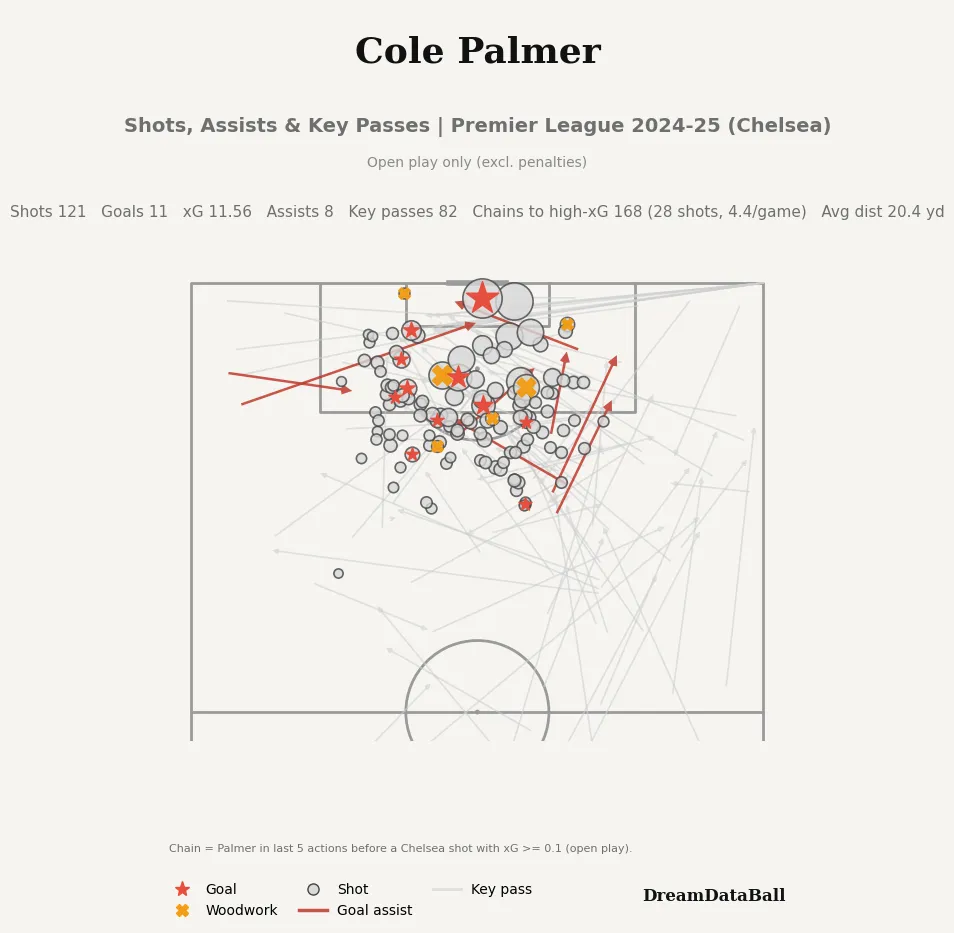
In open play only (excluding penalties), Palmer took 121 shots, scoring 11 goals from 11.56 xG, finishing in line with the quality of chances he was getting. He also registered 8 assists and 82 key passes, underlining his dual role as finisher and creator. Beyond direct output, he was involved in the build-up to 28 distinct high-xG shots, with 168 chain involvements over the campaign, about 4.4 per game. That blend of volume and threat in central areas is what “maximising his potential” looks like in the data.
Enzo Maresca’s positional play put Palmer in favourable central positions and maximised his shooting opportunities, a clear system effect. Palmer found and exploited space and contributed through both assists and key passes. Nicolas Jackson was important beside him, drawing defenders and offering link-up play despite some rough edges; some analysis argues Palmer has missed that profile this season alongside different striker types such as João Pedro (a false nine) and Delap (more of a poacher).
Last season, then, was one of quantity and quality: high volume in the right areas and a system that got the best out of him. The xG map shows where that threat was concentrated.
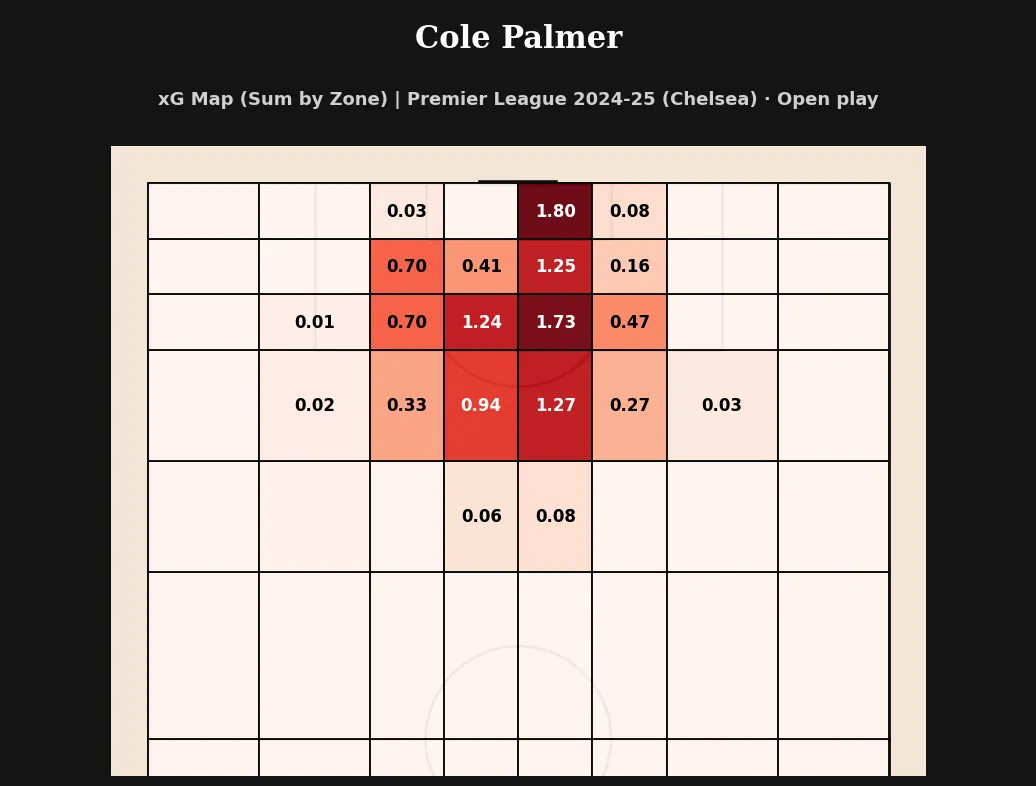
As expected, the system channelled his shooting into central, high-value zones. Some efforts were ambitious, but overall the setup allowed Palmer to play to his strengths. Maresca’s system clearly maximised his potential.
So when we turn to this season, the question is not whether Palmer lost his level, but whether Chelsea are still creating the same volume and variety of moments for him and whether his role in those moments has stayed the same.
The 2025-26 Season: Fewer Finishing Moments, More Build-Up Involvement
After a long season stretching until the middle of July, a new Premier League campaign starting mid-August, games every three days, recurring injuries, a managerial change, and evolving tactical demands, it’s understandable that replicating last season’s form would be extremely challenging. Chelsea’s medical team will need to manage Palmer carefully, a player of his quality cannot have his career derailed by injuries.
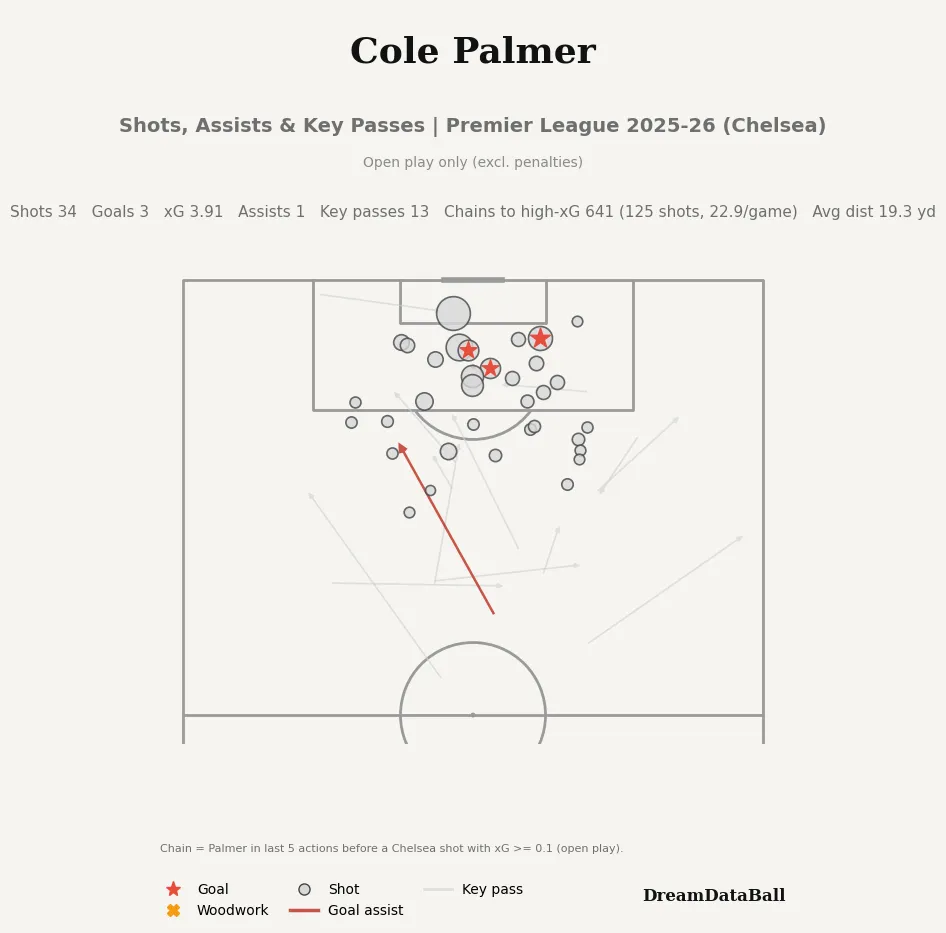
So far this season, Palmer has started only 15 games out of 28 gameweeks, scoring 3 non-penalty goals and registering 1 assist. On the surface, these numbers might worry some and be labeled a disappointing season, but a deeper look tells a different story.
The main difference this season is quantity. His shots are more thinly spread and less consistent in pattern than last season. He’s also contributing further from goal, including assists from deep near the halfway line. Palmer has been involved in 641 high-xG chain involvements so far, compared with 125 high-xG shots (22.2 per game) last season, showing a significant increase in build-up participation.
This suggests that his role has evolved. The positional play introduced by Maresca, aimed at maintaining structure and delivering the ball into dangerous areas, still benefits Palmer, but under new manager Liam Rosenior, he’s taking on more responsibility in the build-up. He’s becoming more involved in orchestrating play rather than just finishing it.
The difference is clear: he’s being fed less frequently in central, high-danger zones, resulting in fewer high-quality finishing opportunities. The central shooting pattern remains similar, but Palmer’s overall output is now more dependent on getting the ball in dangerous positions. What we may be seeing is “Palmer v2”: a more dynamic, slightly chaotic version, marked tightly by opponents due to his reputation. Alternatively, this could simply be a dip in form, and he may adjust as the season progresses. One thing is certain: the quality is still there, and with the ball more often in dangerous areas, Palmer has the potential to become even more unplayable.
Conclusion: Same Threat Profile, Different Environment
Put side by side, the xG comparison tells the story in one frame. In 2024‑25 (left), Palmer’s threat is spread across several boxes inside the area: the central lane is bright, but there is also serious xG on either side of the six‑yard box and across the penalty spot. That’s what volume and variety look like, multiple pockets inside the box lighting up because Chelsea repeatedly found him there.
In 2025‑26 (right), the map doesn’t fall apart, it narrows. The highest xG cells are still in the right places, close to goal and in the centre of the box but far fewer zones are active, and the totals in each are smaller. Combined with the shot map and the chain data, the pattern is clear: Palmer is touching the ball more often in the build‑up to big chances, but he is being fed less often as the actual shooter in those zones.
So the question is not whether Palmer has regressed, it’s whether Chelsea can rebuild the kind of volume and variety around him that Maresca’s system provided. If Rosenior’s Chelsea can turn Palmer’s heavy involvement in high‑xG chains back into repeated finishing moments in these central pockets, the goals and assists should follow the xG, just as they did last season.