+18 or +21, depending on state | Commercial Content | T&C's Apply | Play Responsibly | Publishing Principles
This page contains affiliate links. When you purchase through the links provided, we may earn a commission.
Diego MaradonaGetty Images

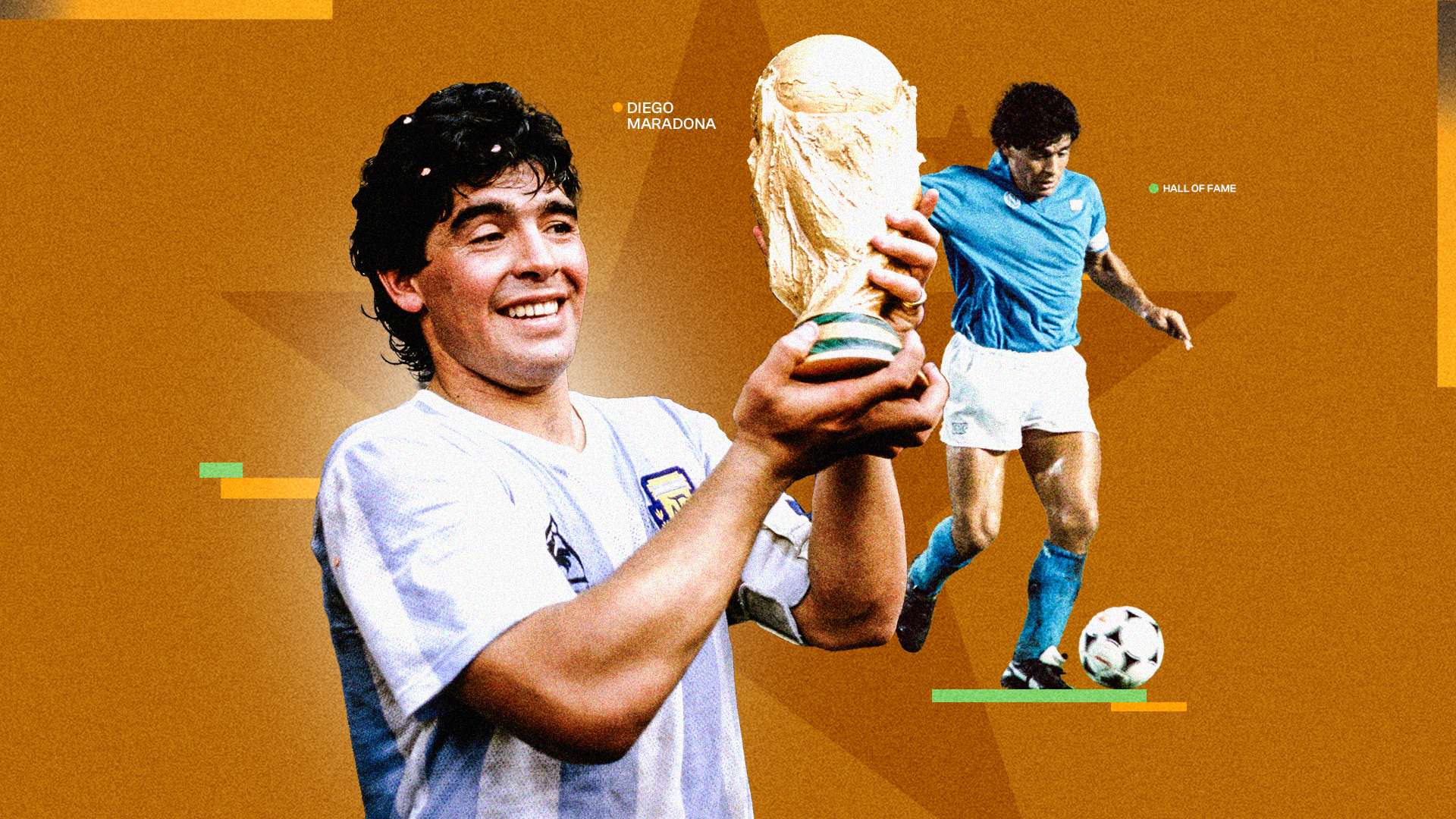
GOAL's Hall of Fame: Diego Armando Maradona - the god of football who made the impossible possible

The Hall of Fame is for footballers who have defined an era, meaning there is, of course, a place for the player widely regarded as the greatest of all time. There is, in fact, a before and afterDiego Armando Maradona, a character so compelling that the story of the 20th century could not be written without devoting at least a chapter to his exploits on and off the field.

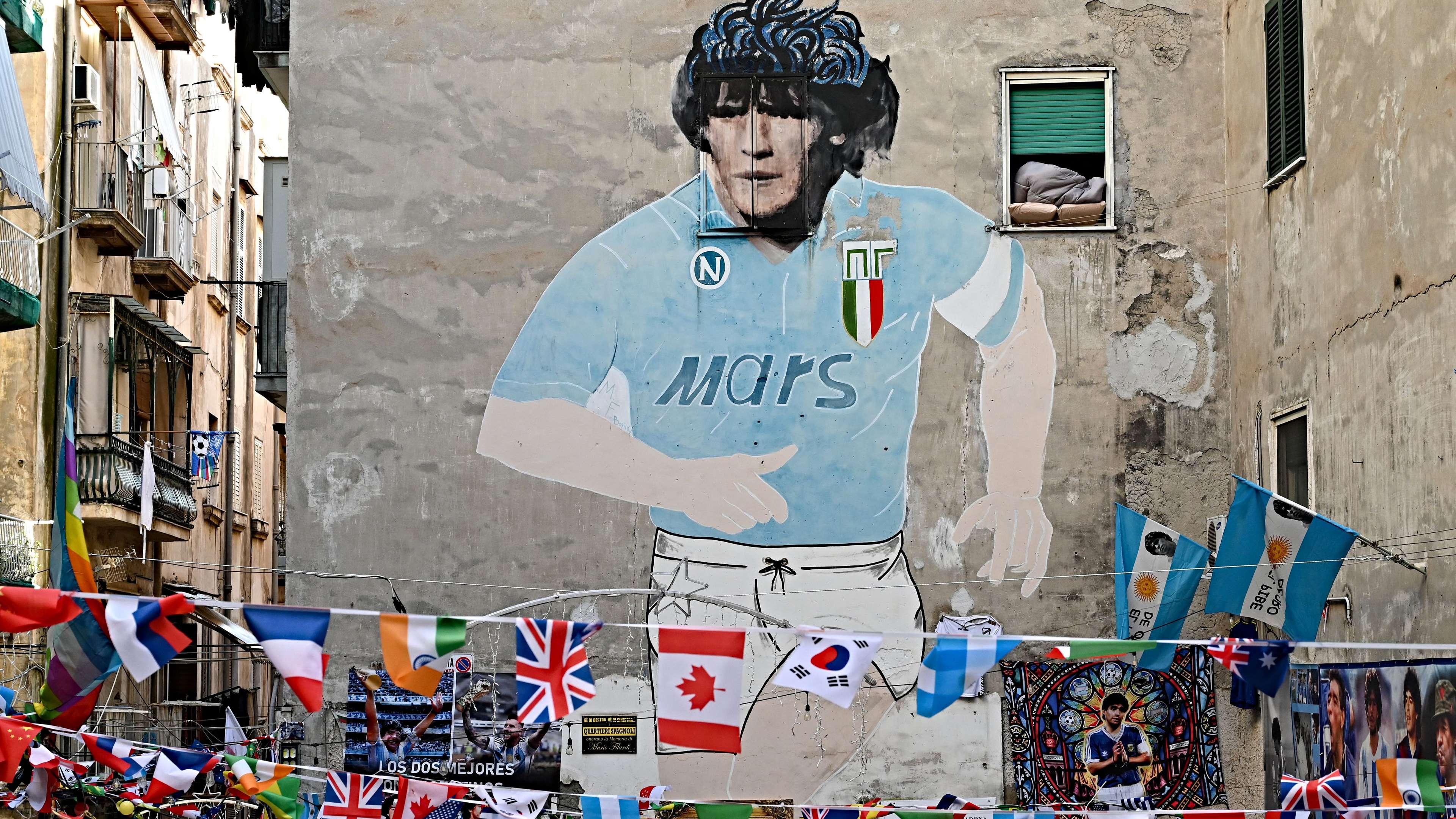
Maradona the player and Maradona the man have both been immortalised in books, songs, films, paintings, murals and statues all across the world. He was an icon, a legend, a talent so pure that he could do things with a football that appeared to defy the laws of physics. Basically, Maradona made the impossible possible - in every sense.

For millions of people, particularly the working class from which he came, Maradona was more than a mere footballer. Because of his rebellious nature, he became - and remains - a source of inspiration, a spectacular symbol of hope and defiance.

He won titles, albeit much less than other greats of the game, by choosing the underdogs and challenging the established order. He also won with his national team, taking a group of modest players to the top of the world.

More than anything else, though, Maradona was a champion of the people, a very human god that demonstrated, like ever before or since, how a single individual can sometimes make historyin a team sport.

  • BIO-MARADONA-BALLAFP

    Football's answer to Atlas

    Just mentioning Maradona immediatelyevokes a vast array of images, ideas, anecdotes and possibilities, including the very real risk of repetitive rhetoric.

    The aim here, then, is to simply highlight one of the things that most distinguished the Argentine from the plethora of phenomena that have graced football pitches across the globe: his ability to convince groups, teams and players - who would never have dreamed of achieving certain goals without him - that winning was a legitimate objective. And then to actually realise it.

    The history of football is, of course, full of remarkable feats achieved by charismatic leaders - yet there has arguably never been a single player like Maradona, a kind of footballing equivalent of Atlas, capable of carrying the weight of the world - or at least entire teams - on his shoulders.

    Maradona didn't just do it once either. He did it several times.

    He stayed away from the game's established super-powers tojoin the opposition and try start a revolution. He did play for Barcelona - but a very different version of the Blaugrana we know today. He also left after just two years and made the stunning decision to commit his peak years to a losing team.

  • Advertisement
  • Diego Maradona Napoli 1984Hulton Archive

    Turning doubters into believers

    Before his arrival in 1984, Napoli had never won an Italian championship, and it would be more than 30 years before they did so again after his departure.

    In total, Maradona claimed two Scudetti, a Coppa Italia and a UEFA Cup during his truly dramatic seven-year stay at the Stadio San Paolo (which now bears his name) - but the titles and numbers (115 goals in 259 games for Napoli) don't even tell half the story of his time in Naples.

    El Pibe de Oro was a driving force in the dressing room, getting under the skin of his team-mates and creating an unbreakable bond of trust between them. Essentially, they believed they could win titles together because he made them believe.

    Maradona may have been the face of the club but he was also their friend. They were more than willing to live in his shadow for the greater good - not least because he was the first to admit that they had no chance of upsetting the odds if they were not fully united.

  • Diego Maradona Napoli v Stuttgart UEFA Cup Final 2nd Leg 1989Hulton Archive

    The brightest star in Serie A

    Maradona knew right from the off that Napoli would not want for support from the stands. After arriving from Barcelona, he was greeted at the San Paolo by 70,000 fans. However, the Argentine knew he had joined a mediocreteam, one that only escaped relegation by a single point just a few months earlier. He would be surrounded by journeymen rather than stars.

    Slowly but surely, club president Corrado Ferlaino began to strengthen the squad, providing Napoli's leading man with a more impressive supporting cast.

    However, Maradona also improved, taking his game to a whole other level, first with Argentina, at the 1986 World Cup, and then Napoli, who won their first-ever Scudetto the following year.

    At the time, Serie A was the strongest league in the world. There was Michel Platini's Juventus, Arrigo Sacchi's magnificent AC Milan side, Gianluca Vialli and Roberto Mancini's Sampdoria - the depth of talent and level of competition were truly extraordinary.

    And yet the only team to win two titles between 1984 and 1991 were Napoli. Why? Because they had Maradona, who shone more brightly than anyone else in a star-studded Serie A.

    Unfortunately, the physical and mental strain of spending so long in the spotlight eventually took its toll on Napoli's No.10, whose life off the field began to spiral out of control, resulting in a 15-month ban for testing positive for cocaine that signalled the end of his spell at the San Paolo.

  • Diego MaradonaGetty Images

    As close to perfection as humanly possible

    Maradona's time with his national team mirrored that of his club career, with just as many joyous highs and devastating lows - primarily because he was as revered in Argentina as he was in Naples, meaning there was no off switch on the spotlight when he returned home either.

    He was still only a kid at Argentinos Juniors when his talent first came to the public's attention and he made his Albiceleste debut at 16. There were even calls for him to be included in the squad for the 1978 World Cup on home soil but Cesar Luis Menotti felt he wasn't yet ready to play in such a pressurised environment - and he was probably right.

    Even as a 21-year-old at Spain '82, it was clear that Maradona still hadn't fully matured, as he was sent off for lashing out at Batista during Argentina's 3-1 loss to Brazil. However, Maradona was a different beast four years later in Mexico.

    The Argentina squad may not have been as strong on paper as the one that had been eliminated after the second group stage in Spain but Maradona approached his second World Cup with a very different mindset. He better understood the importance of the collective and, at Mexico '86, he bent the team - and thus the tournament - to his will, deciding that Daniel Passarella and Ramon Diaz should be sacrificed for the good of the group.

    Just like pretty much everything else Maradona did in Mexico, it proved an inspired choice. His decision-making really was flawless. His play was as close to perfection as humanly possible.

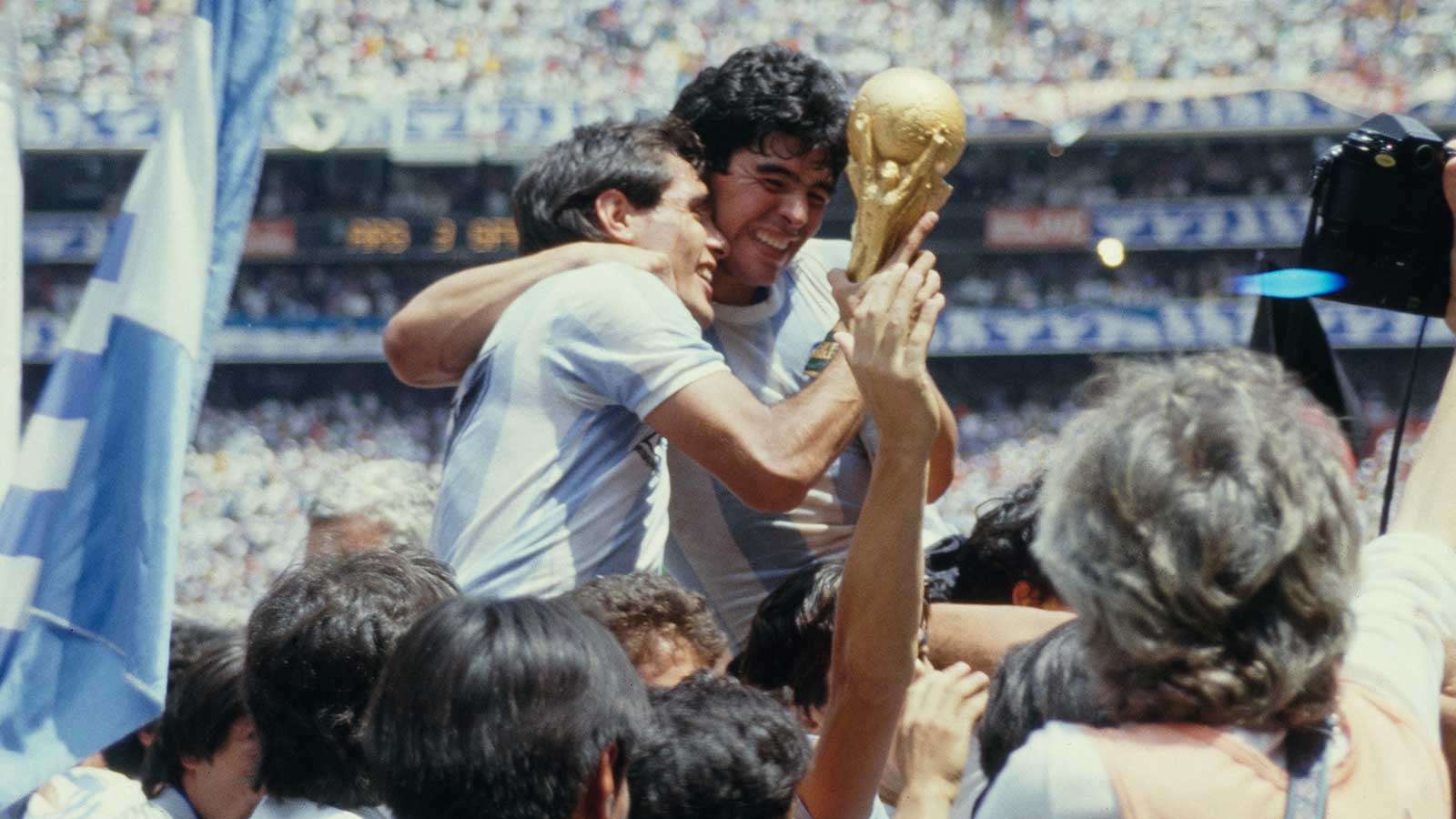
    Maradona was involved in 10 of Argentina's 14 goals, scoring five himself, including an iconic double against England in the quarter-finals. His first goal came via 'The Hand of God' and was wrapped up with all sorts of political and social significance. Then, less than five minutes later, he scored 'The goal of the century', with Maradona picking the ball up inside his own half before skipping past one Englishman after another.

    There really was no end to his brilliance and no player had ever before dominated a World Cup to such an extent - not even Pele. He was utterly unstoppable, the difference between Argentina and every other team at the tournament. As England's Peter Beardsley said, "If Maradona had been born in Toronto, Canada would have become world champions."

  • FOOTBALL-WORLD CUP-USA-MARADONAAFP

    In decline and in disgrace

    Maradona and Argentina would try to retain their crown at Italia '90 and while they very nearly did so, both were significantly weaker than they had been in Mexico.

    There were flashes of the old Maradona magic, most notably when the Albiceleste beat Brazil in the second round, but penalties were required to get past both Yugoslavia and Italy, in the quarters and semis.

    In the final in Rome, amid whistles and insults towards Maradona and his compatriots, which were reciprocated, Germany prevailed in a dire affair.

    It looked like a rather ignominious end to Maradona's relationship World Cup adventure but worse was actually to follow.

    Maradona managed to get himself in something resembling decent condition to represent his country at USA '94 and scored a stunning goal against Greece in the group stage, venting all the anger he had pent up during his drugs ban.

    However, the joy was short-lived, as traces of ephedrine were found in his blood during an anti-doping test after Argentina's win over Nigeria. This time, Maradona's international career was really over. He was disqualified and forced to leave the United States. Unsurprisingly, a shell-shocked and devastated Argentina were eliminated in the last 16.

  • FBL-ITA-NAPOLIAFP

    The GOAT

    Maradona essentially lived a thousand lives. He repeatedly fell from his perch but never stopped trying to get back on top. Despite - or perhaps because of - his great contradictions, one of the world's great rebels became a role model to millions.

    When he first arrived at the foot of Vesuvius, he said he wanted to be "the idol of the poor kids of Naples, because they are like I was in Buenos Aires" - and he succeeded in doing so by creating a symbiotic relationship with the city and its inhabitants, which was sometimes too close for comfort.

    He was a protagonist of his time. As a footballer, he could do it all. He was the game's greatest entertainer. He put on a show not only during matches - but also before them. And although he boasted a superstar status, he was never selfish. He simply set about making those around him better.

    His rivals for the title of the greatest of all time all played with some footballing legends. Pele was part of some of the finest teams ever seen. The same goes for Johan Cruyff, Lionel Messi and Cristiano Ronaldo.

    This is why El Diez stands alone. Other players may have scored more goals, or won more trophies, but Maradona's ability to lead modest teams to unexpected titles was - and still is - unparalleled.

    He did not play for the strongest teams but against them. And, not only that, he beat them more times than anyone could have ever dreamed.