+18 or +21, depending on state | Commercial Content | T&C's Apply | Play Responsibly | Publishing Principles
This page contains affiliate links. When you purchase through the links provided, we may earn a commission.
Presented byModeloDrink responsibly. Modelo Especial® Beer. Imported by Crown Imports, Chicago, IL For 21+
How Man Utd maintain momentum gfxGetty/GOAL

Springboard or another false dawn? Six things Man Utd and Ruben Amorim MUST do to build momentum after massive Anfield win

Last season, Ruben Amorim oversaw a 2-2 draw at Anfield, an FA Cup victory at Arsenal (albeit via a penalty shootout), a smash-and-grab win at Manchester City and a 7-1 aggregate win against a highly-fancied Athletic Club in the Europa League semi-finals. But each of those results, which were hailed as the platform on which United would kickstart the Amorim era, proved to be false dawns.

After their cup success at the Emirates, they had to come from behind late on to beat basement club Southampton and then lost three of their next four league games; the last-gasp victory at the Etihad was followed by four successive defeats in all competitions; the Athletic Club results were sandwiched by defeats to Brentford and West Ham, and ultimately only led to United losing to Tottenham in the Europa League final.

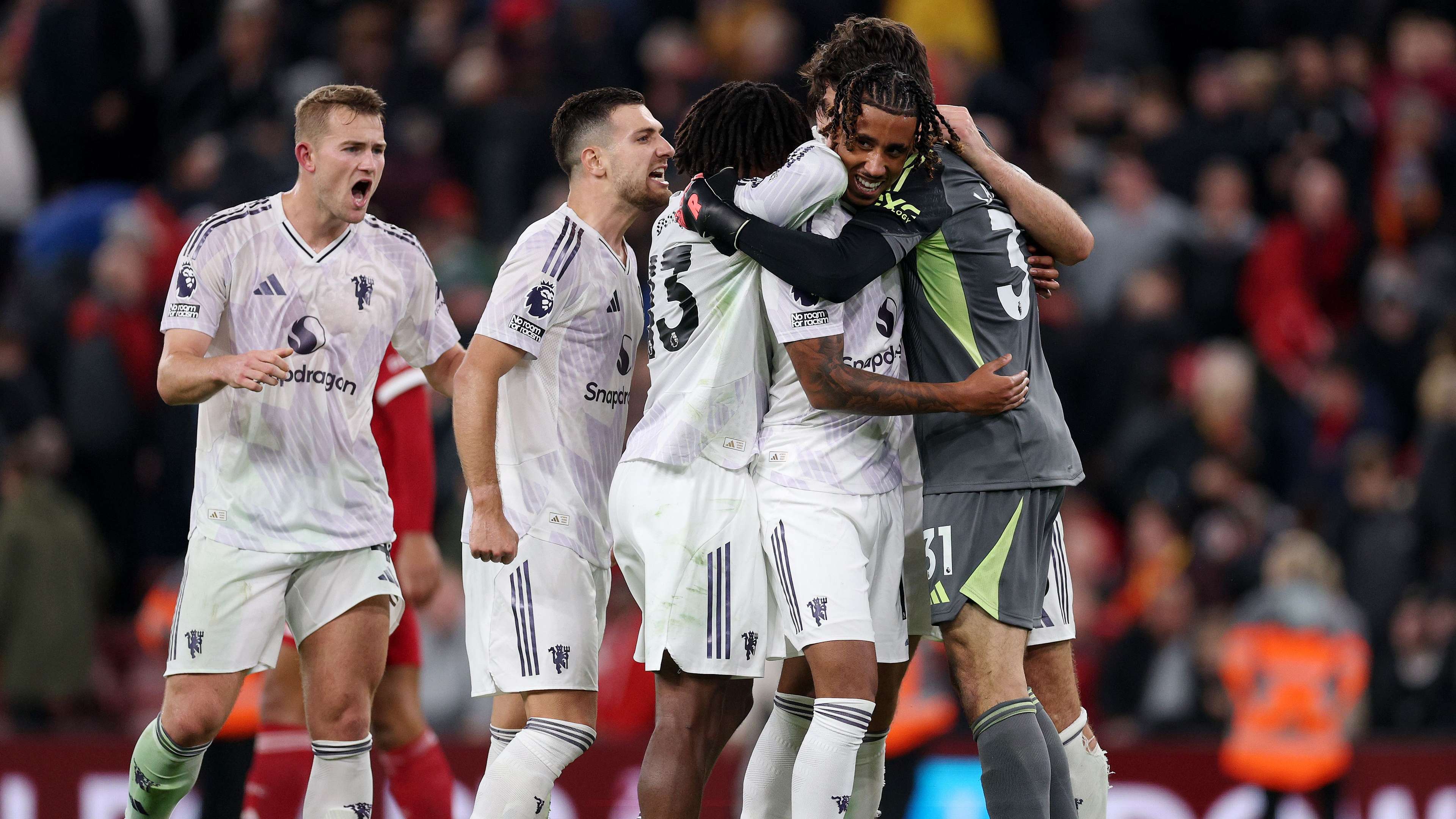
Amorim is painfully aware of this, and during his Sky Sports interview following Harry Maguire's late winner he was already thinking about the next game, signing off by saying "It was a good day and now I am concerned about Brighton." It prompted a light-hearted telling off from interviewer Patrick Davison, but Amorim insisted: "It means a lot today but tomorrow, it won’t mean a lot."

Having finally won back-to-back league matches for the first time since taking charge at United last November, Amorim's great challenge now is to build some momentum and put together a consistent run of results. To do so, there are a number of elements they must get right:

  • Brighton & Hove Albion v Newcastle United - Premier LeagueGetty Images Sport

    Beat the middle-class

    When Amorim left Anfield last season with a point, he said he was "upset" with his team for being able to raise their game against their eternal rivals and the then-league leaders after losing their previous three games against Wolves, Bournemouth and Newcastle. And while fans will remember Sunday's result for years to come, it is games against the Premier League's middle-class that will determine whether or not United can qualify for Europe, and by extension whether Amorim succeeds. 

    Next opponents Brighton are the perfect example: United have lost their last three games against the Seagulls at Old Trafford, by a combined score of 3-8. Erik ten Hag lost the first game of his tenure against Brighton and his side were beaten 3-1 at home in the following season. United succumbed to the same scoreline against Fabian Hurzeler's side in January, and Amorim was so angry with his team's performance that he smashed a television in the dressing room. 

    Brighton, who finished eighth last season, are far from the only upper-to-mid-table team to have tormented United in the last couple of years. They have lost three and drawn one of their last four meetings with Crystal Palace, whom they visit on November 30. Then there's Bournemouth, who thrashed United 3-0 on each of their last two trips to M16, both of which took place in December, and the Cherries visit The Theatre of Dreams on December 13.

  • Advertisement
  • Sanne LammensGetty

    Help Lammens continue his solid start

    Is it any coincidence that United's first successive league wins under Amorim came when someone other than Andre Onana or Altay Bayindir was between the posts? Sanne Lammens played a key role in the victories over Sunderland and Liverpool, and he hasn't even made any top-drawer saves yet. All the Belgian has done is to do the basics right by confidently dealing with crosses, handling the ball well and not taking unnecessary risks with the ball at his feet.

    But that is no small feat after Bayindir gave away two goals in his first three games of the season and Onana made two embarrassing gaffes against Grimsby Town. Lammens is also proving a useful weapon with his long kicks downfield; while most of his kicks on Sunday went straight to Liverpool players, United were able to scoop up the bulk of the second balls due to their field position.

    It has been a strong start by the 23-year-old and United need to ensure he is in the right environment so he does not succumb to the pressure and scrutiny that comes with being the Red Devils' goalkeeper, which ultimately ate away at Onana and the likes of Ben Foster, Tim Howard and Fabien Barthez before him.

    "I try my hardest, I think I’m quite OK at this, trying to keep the noise out from outside,” Lammens said on Sunday. If he can keep blocking out the noise, then he can give United a solid platform to put a run of results together.

  • Liverpool v Manchester United - Premier LeagueGetty Images Sport

    See less of the ball

    Amorim came to United with the idea that his team must dominate possession. One of his last great results as Sporting CP manager was beating Manchester City 4-1 in the Champions League while having just 27 percent possession, but he warned: "United cannot play the way we play, they cannot be so defensive. It’s good to beat City. But I’ll be living in a different world; we’ll have to start from a different point."

    Amorim's best results with United, though, have actually come when his team have seen less of the ball. They had 36.5% possession against Liverpool on Sunday, while there was a wafer-thin margin in their previous win over Sunderland, when they had 50.2% of the ball. When they beat Chelsea in September, they had only 41% possession, despite having a man advantage for a big chunk of the match. And conversely when they lost to City the previous week, they saw more of the ball (54.7%) than Pep Guardiola's side.

    All three of United's defeats this season have come when they have had more possession than their opponents, while the victory over Burnley was the only time in their four wins when they had significantly more of the ball. There is also an argument that having less of the ball is to be expected when you play 3-4-3 and have one fewer player in midfield than in most other formations. That's how Oliver Glasner's Palace operate; the Eagles have the third-lowest average possession in the league (42.5% per game). United are currently eighth in the possession table, but falling a little lower and being really comfortable without the ball could be the key to them finally turning a corner.

  • Amad Diallo Bryan MbeumoGetty

    Keep the Amad-Mbeumo connection going

    Amad Diallo would not have been many fans' choice to be wing-back when Amorim took over, but the Ivorian now looks settled in the role and an interesting pattern has emerged: Amad has started at wing-back in three of the four games United have won this season. He was one of the standout players at Liverpool, setting up Bryan Mbeumo's opening goal before providing a lay-off which should have led to Bruno Fernandes scoring a second in the first half. 

    Amad also contributed defensively, and it was no coincidence that Liverpool started to grow into the game when he was withdrawn, along with Casemiro, as a precaution after picking up a yellow card. The Ivorian established himself in the first team last season, but what he lacked was a consistent position and partner. He now appears to have both, having locked down the right-wing-back role while dovetailing superbly with Mbeumo.

    Amad missed the defeat at Brentford due to a family bereavement, and though Amorim pledged "we can win without him", they could not. After a glowing display at Anfield, the coach was in thrall to his new-found wing-back. "Amad is doing so well in that position, he is perfect for that position."

    Noussair Mazraoui's return from injury gives the coach another option in the position, but he would be advised to retain Amad and try to squeeze even more productivity out of his relationship with the electric and clinical Mbeumo.

  • Matheus CunhaGetty

    Rotate Cunha and Sesko

    There was some confusion when the United starting XI landed at Anfield and the Benjamin Sesko was not in it. And while the new striker might have felt aggrieved not to have been involved from the start, the move paid off as Matheus Cunha thrived in the false nine role due to his link play, which is superior to Sesko's.

    "Sometimes the characteristic of the game changes the way we approach it," Amorim explained. "Cunha in the middle, if we put Ben it is easier for their centre-backs to control our striker."

    The manager's reasoning was ever so slightly insulting towards Sesko, but it also made perfect sense. United were able to unsettle Liverpool's defence thanks to the fluid movement of Cunha, Mbeumo and Mason Mount, and when Sesko did come on in the second half, his physical stature helped United defend their lead before Cody Gakpo's leveller and after Maguire had restored their advantage.

    Amorim should be unafraid of repeating that front three against Brighton or indeed against any other opponent. While it does risk upsetting Sesko, playing Cunha as the false nine can give a new lease of life to the Brazilian, who is yet to score or provide an assist for the club thus far.

  • Liverpool v Manchester United - Premier LeagueGetty Images Sport

    Keep embracing the long game

    Arne Slot was less than complimentary of United's tactics at Anfield, calling them a "long ball team" and stressing how the visitors had set up as a low block. What the Liverpool boss was actually doing, though, was effectively praising the Red Devils for getting with the times and understanding the direction the Premier League is heading in.

    Opta analysis of the first 50 games of this season showed that the game is becoming much more direct, with route-one tactics such as long kicks and long throws becoming increasingly common. Their research showed that short passing numbers were the lowest they have been for 15 years while the top teams, including Liverpool, are getting the ball forward using fewer passes. 

    Amorim admitted to being shocked by how physical the Premier League was and how dependent teams were on set-pieces when he first joined United, but while he is sticking with his 3-4-3 formation, he is becoming more flexible with his overall approach, hence encouraging Lammens and Bayindir to launch the ball downfield after dispensing with Onana. In Diogo Dalot, Amorim also has a secret weapon when it comes to long throws.

    While United fans do demand attacking football, they are not that fussy about the manner in which they get the ball forward. Amorim remarked a few weeks ago that the Old Trafford faithful are "easy to please", so he should take Slot's remarks as a badge of pride and encourage his team to become even more streetwise.