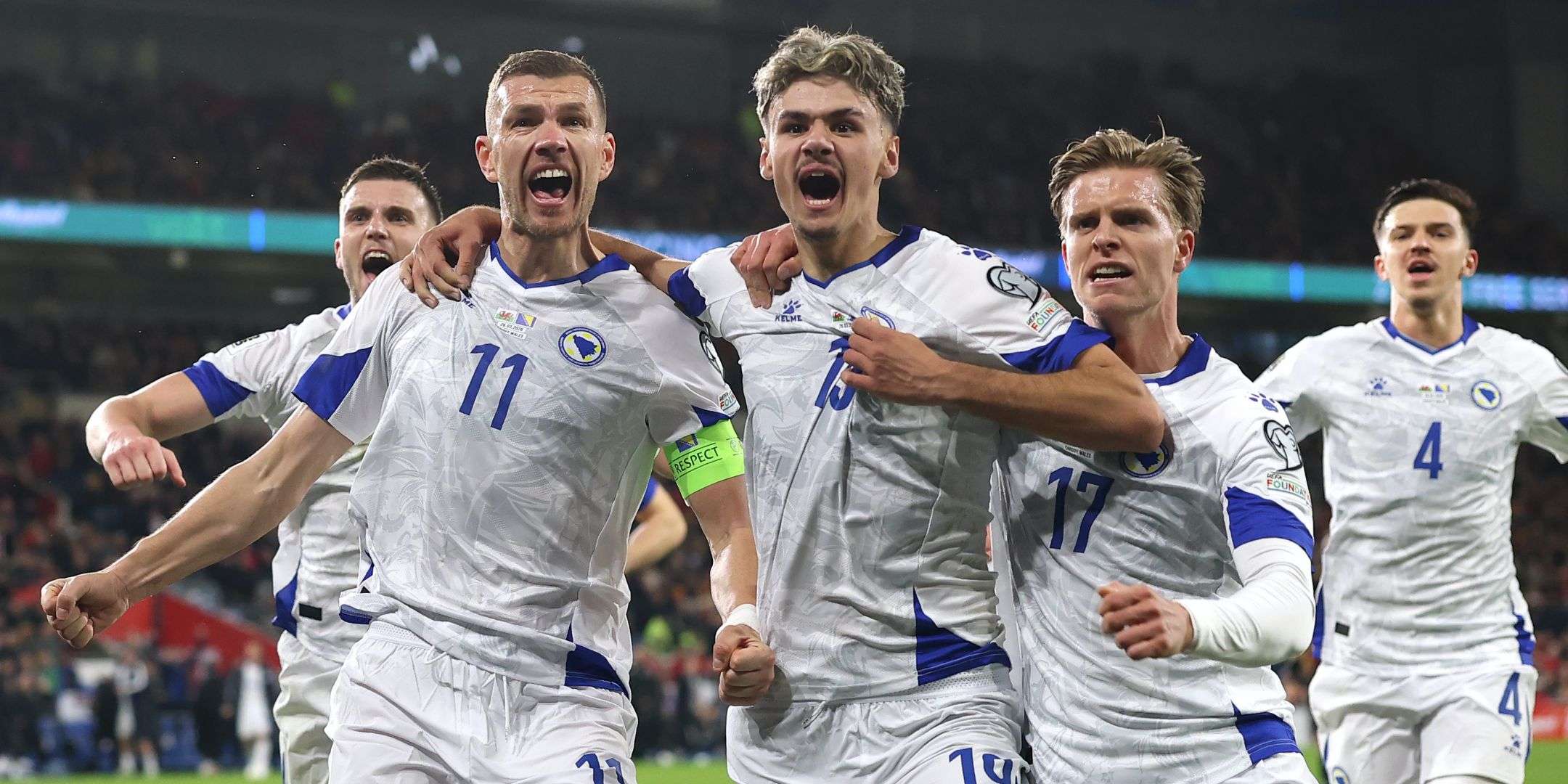
Edin Dzeko Bosnia-Erzegovina DESKTOPGETTY

Translated by

Dzeko and a squad worth as much as Bastoni and Dimarco: everything you need to know about Bosnia, the final hurdle between Italy and the 2026 World Cup

Edin Dzeko, Bosnia’s greatest ever footballer, leads a squad valued at €120 million across 24 players – a figure that matches the combined Transfermarkt value of Alessandro Bastoni and Federico Dimarco, who together cost exactly the same as the entire squad managed by head coach Sergej Barbarez: €70 million plus €50 million. The final hurdle, on Tuesday evening in the fortress-like stadium in Zenica, stands between Gennaro Gattuso’s Italy and the 2026 World Cup in the United States, Canada and Mexico, is, however, a proud, tenacious national team representing a people steeped in history, even though their official debut in FIFA and UEFA competitions only took place in 1995, following the dissolution of Yugoslavia in the wake of the Balkan War.


Let’s find out together everything there is to know about the Bosnia and Herzegovina national football team, or rather the Ногометна репрезентација Босне и Херцеговине


  • THE ZMAJEVI AND DZEKO

    The Zmajevi are the only national team in the world to have qualified for a World Cup – in 2014, when they were knocked out in the first round – but never for their own continental tournament, the European Championship: the record-holder for both appearances and goals is Edin Dzeko, the former striker for Manchester City, Roma and Inter, who has 147 caps and 73 goals for the national team. They are currently ranked 75th in the FIFA rankings, and their kit sponsor is Kelme, a Spanish multinational company. Their international debut came on 30 November 1995, in a friendly match in Tirana against Albania.

  • Advertisement
  • BETWEEN PJANIC AND LULIC, KEEP AN EYE ON BARBAREZ

    It’s not just Dzeko, though: recent years have seen the emergence of the best Bosnian footballers of all time, such as former Juventus and Roma player Miralem Pjanic, a key figure in Massimiliano Allegri’s Juventus side, and former Lazio player Senad Lulic, who scored the winning goal in the historic Coppa Italia final derby victory against Roma in the 2012/2013 season. Among Bosnia’s finest players, however, is undoubtedly the current head coach, Sergej Barbarez, 54, born in the beautiful city of Mostar, the main historical, cultural and economic centre of Herzegovina, at the southern tip of Bosnia, between Croatia and Montenegro. A former midfielder or striker, he has Bosnian, Serbian and Croatian roots, and with 330 appearances, he is the foreign player with the most appearances in the Bundesliga,a feat that earned him a statue in his hometown. Although he began playing for Velez Mostar, in 1992 he moved to Germany, where he was staying with his uncle Mujo when the Yugoslav conflict broke out; his uncle secured him a contract with Hannover. From there, he went on to play for Union Berlin, Hansa Rostock, Borussia Dortmund, Hamburg and Bayer Leverkusen, spending 16 consecutive seasons in the top flight of German football. He ranks among the players with the most caps for the national team, 47, and among those with the most goals, 17: he became a legend among the Zmajevi when, during a match against Serbia, he had the game stopped three times because Bosnian fans were being targeted by their rivals. He began his coaching career in 2024, taking the helm of the Bosnia and Herzegovina national team, having been loudly called upon by his people for the nationalistic spirit that sets him apart: previously a professional poker player, he is now facing the first major challenge of his managerial career.


  • FROM SUSIC TO THE CROATIANS OF MOSTAR

    The history of the Bosnian national football team is relatively short, spanning just 30 years: from 1920 to 1992, the country’s best players represented Yugoslavia. One player in particular? Safet Sušić, a PSG legend in the 1990s and the inventor of the legendary ‘kičma’, the feint that defined his career, a key player in the last ever Yugoslav national team at the 1990 World Cup in Italy, alongside the likes of Stojković, Boksić, Prosinecki, Šavićević and Šuker. Bosnia are training at the FK Sarajevo sports centre and are staying at a five-star hotel in the capital. There is great enthusiasm among Bosnians scattered across the globe, who are returning home to watch the match. However, the league is currently led by Borac Banja Luka, the team from Banja Luka, ahead of Zrinjski, the club representing the Croats of Mostar, which holds the record for the most wins – nine – since the founding of the Premijer Liga Bosne i Hercegovine in 2000.

  • ENJOYED THIS STORY?

    Add GOAL.com as a preferred source on Google to see more of our reporting

    Add as preferred source on Google
  • SACCHI'S "AVENGERS"

    The first match against Italy? On 6 November 1996, when Bosnia secured its first victory since joining FIFA, winning 2-1 in a high-profile friendly at the Koševo Stadium in Sarajevo against Arrigo Sacchi’s Italy, who were World Cup runners-up at the time, with goals from former Juventus and Bayern Munich player Hasan Salihamidžić and Elvir Bolic. Following that match, Sacchi was sacked by the FIGC.

  • BLAZEVIC'S ACHIEVEMENT

    Then came a dark period lasting around ten years, until the arrival of Dzeko’s “golden generation”, who made his international debut in 2007 alongside teammates such as Ibisevic, Misimovic, Salihovic, Ibricic and Pandza, the key players in the historic qualification for the 2014 World Cup in Brazil, first under the guidance of the veteran coach Miroslav “Ciro” Blazevic and then under – none other than – Safet Susic.

  • THE ZENICA FORT

    We’ll conclude with alook at the Stadion Bilino Polje, the venue for Tuesday’s do-or-die match, which will take place in snowy and hostile conditions – and not just for the opposing fans: the stadium in Zenica, which is sometimes also used for rugby matches, has a capacity of 15,600 seats, although only around 8,000 will be allowed into the play-off due to an old, pending ban. Opened in 1972, in 2009 it hosted the play-off for qualification for the 2010 World Cup, which was lost 1-0 to Portugal following a goal by Raul Meireles. The Bosnian national team remained unbeaten at this ground from 1995 until October 2006. It certainly won’t be a walk in the park.