+18 | Commercial Content | T&C's Apply | Play Responsibly | Publishing Principles
Legacy Senegal GFXGetty/GOAL

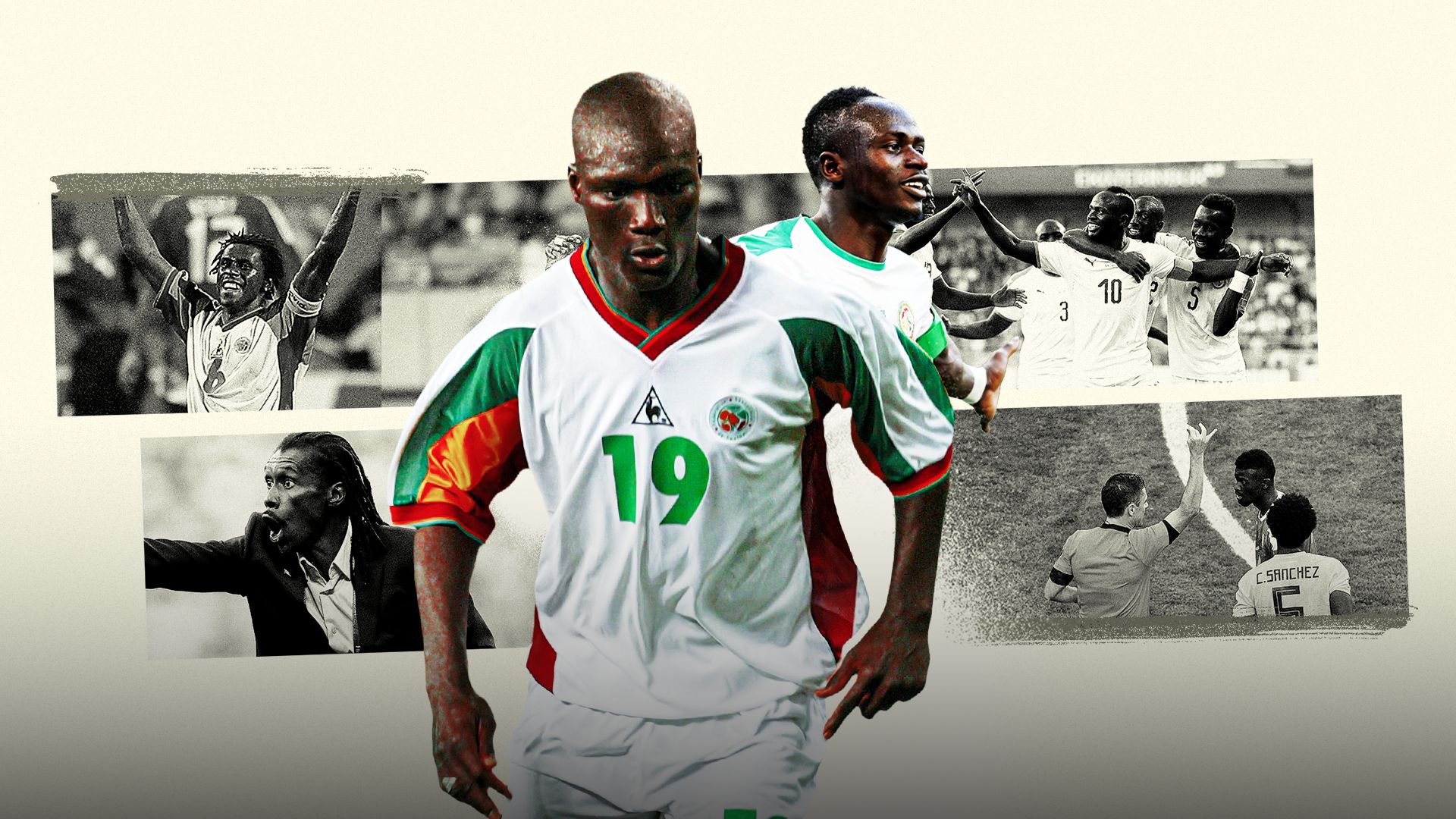
LEGACY: Senegal's World Cup journey - from a historic debut to Fair Play heartbreak and a squad built to make history in 2026

In the vast and storied archive of World Cup drama, few exits have felt as quietly brutal, as strangely surgical, as Senegal’s in 2018. No last-minute goal; no penalty shootout; no dramatic collapse. Just a rule. A column buried deep in the FIFA handbook. A count of yellow cards. And with that, the Lions of Teranga were gone; erased not by defeat, but by discipline.

It was the first time in history a team had been eliminated from the World Cup by the Fair Play rule; a technicality that punished restraint over recklessness, discipline over destiny. But for Senegal, that moment wasn’t just a heartbreak; it was a hinge, a turning point, a line drawn sharply between what had been and what could be.

Because Senegal’s World Cup story is not one of failure, but rather one of evolution. From the seismic shock of 2002 to the cruel arithmetic of 2018, and now to a 2026 squad that may be Africa’s strongest yet, the Lions have roared, stumbled, regrouped and risen again.

This is their saga, of flair and fury, of stars and scars, of rhythm and resilience. Of a team that refuses to fade, refuses to be forgotten and refuses to be defined by anything less than greatness...

  • Senegalese midfielder Pape Bouba Diop (L) celebratAFP

    Shaking the world

    Senegal’s World Cup debut in 2002 wasn’t just historic, it was mythic. Drawn into Group A with defending champions France, Denmark and Uruguay, the Lions of Teranga were expected to be spectators. But in the opening match, they stunned the world.

    Papa Bouba Diop’s scrappy goal against France, the nation that had once colonised Senegal, secured more than just a 1-0 upset win. Rather, it caused a cultural earthquake.

    Led by captain Aliou Cisse, the Senegal team played with swagger, unity and joy. They danced after goals and pressed with abandon. They subsequently drew with Denmark and Uruguay, then beat Sweden in the round of 16 via a golden goal.

    Senegal reached the quarter-finals as only the second African team to do so, after Cameroon in 1990. Their run ended against Turkey, but the message was clear: Africa could compete. Senegal weren’t just a surprise; they were a statement.

    That 2002 squad became legend: Diop, El Hadji Diouf, Khalilou Fadiga, Tony Sylva. They weren’t just players, they were pioneers. And their legacy still echoes in every Senegalese jersey worn today.

  • Advertisement
  • FBL-WC2010-SEN-GAMAFP

    Long silence

    After 2002, expectations soared, but Senegal’s next chapter was silence. They failed to qualify for the 2006, 2010 and 2014 World Cups, a decade of absence that felt like exile.

    The reasons were complex, as internal politics, coaching instability and a gap in generations all played a part. The magic of 2002 had faded, and Senegal struggled to find its rhythm again.

    Yet beneath the surface, something was stirring. Youth academies were growing and players were emerging in Europe. In 2015, the Senegalese Football Federation made a bold move: they appointed Cisse, the captain from 2002, as head coach. It was a symbolic return, a man who had led on the pitch would now lead from the touchline. And he came with a vision of discipline, identity and long-term growth.

    Cisse’s appointment wasn’t universally celebrated as critics questioned his inexperience. But he brought something deeper, a sense of continuity, of unfinished business. He knew what Senegal could be, and he was determined to build it.


  • TOPSHOT-FBL-WC-2018-MATCH48-SEN-COLAFP

    Fair Play fallout

    Russia 2018 was supposed to be Senegal’s resurgence. Sixteen years after their dazzling debut, they returned with flair, discipline, and a squad that blended experience with youth. In Group H, they faced Poland, Japan and Colombia. After a 2-1 win over Poland and a 2-2 draw with Japan, Senegal headed into their final match with Colombia knowing they only needed only a draw to advance.

    They lost, 1-0, meaning they and Japan had the same points, same goal difference and same goals scored. The final tiebreaker? Fair Play. Japan’s four yellow cards gave them the edge over the Lions of Teranga’s six cautions. Senegal were out.

    It was the first time in World Cup history that the fair play rule had been used to eliminate a team, marking a truly heart-breaking ending for the West African nation. However, their inability to close out their second group match against Japan and a lack of discipline was at the heart of their failure, rather than merely bad luck.

    Yet even in heartbreak, there was progress. Senegal had played with structure, with maturity and with a sense of purpose. The seeds were being sown.


  • ENJOYED THIS STORY?

    Add GOAL.com as a preferred source on Google to see more of our reporting

  • Ecuador v Senegal: Group A - FIFA World Cup Qatar 2022Getty Images Sport

    Return and the rise

    After the heartbreak of 2018, Senegal regrouped; not just tactically, but spiritually. They returned to the drawing board, recalibrated their ambitions, and began to rebuild with purpose. In 2021, they lifted the Africa Cup of Nations for the first time in their history, a triumph that felt like both a breakthrough and a coronation, a signal that the Lions of Teranga were ready to roar again.

    They thus entered Qatar 2022 with renewed belief, carrying the momentum of continental glory and the quiet confidence of a team that had learned from its scars. Even without star forward Sadio Mane, ruled out due to injury just days before the tournament, the team showed remarkable resilience.

    In the group stage, they lost to the Netherlands in a hard-fought opener, but bounced back with wins over Qatar and Ecuador to secure a place in the knockout rounds. In the round of 16, they faced England, but the gulf in class was evident. A 3-0 defeat ended their run, but it didn’t erase their progress.

    Cisse, in his seventh year as coach, continued to instill discipline, identity and a sense of collective purpose. Senegal had evolved. They weren’t just a team of moments anymore; they were becoming a machine, a system, a structure built to last. And that system was beginning to bear fruit, not just in results, but in belief. In the quiet certainty that something special was taking shape.

  • FBL-AFR-2025-MATCH 52-SEN-MARAFP

    Strongest squad in Africa

    Senegal’s current squad is arguably the most complete in African football. It’s not just about individual brilliance, though there’s plenty of that. It’s about balance, depth and experience.

    At the heart of Senegal’s golden generation stands Mane, the enduring talisman whose influence transcends the pitch. Revered not just for his blistering pace and clinical finishing, but for his intelligence, humility and relentless work ethic, Mane has become a symbol of Senegalese excellence. He is the emotional engine of the team, the player who carries the weight of expectation with grace and whose mere presence galvanises those around him.

    Alongside him, a new wave of talent is rising, none more emblematic than Nicolas Jackson. Currently on loan at Bayern Munich from Chelsea, Jackson brings a fresh surge of dynamism to Senegal’s frontline. The 24-year-old plays with fearless urgency, a centre-forward who thrives on space, who presses with intent and who finishes with flair. His runs stretch defences, his touch invites chaos and his confidence is contagious. In a squad rich with experience, he is the wildcard; the player who can tilt a match with one moment of brilliance. 

    Behind them, Senegal’s last line of defence is Edouard Mendy, a goalkeeper whose rise from rejection to Champions League glory is the stuff of football folklore. Mendy remains a commanding presence between the posts. His reflexes are razor-sharp, his composure under pressure unwavering and his leadership from the back is vital to Senegal’s defensive structure. In moments of chaos, he is the calm.

    Anchoring the defence is Kalidou Koulibaly, the indomitable centre-back whose blend of physicality and finesse has made him one of the most respected defenders in world football. A natural leader and vocal organiser, Koulibaly brings steel and serenity to the backline. His ability to read the game, win duels and launch attacks from deep makes him the spine of Cisse’s system, a true general in every sense.

    And in midfield, the emergence of Pape Matar Sarr has added a new dimension to Senegal’s engine room. The Tottenham midfielder plays with a maturity beyond his years, gliding across the pitch with purpose and precision. Equally adept at breaking up play and driving forward, Sarr is a quintessential box-to-box force; a player who stitches defence to attack with vision, bite and boundless energy.

    Together, this core forms the heartbeat of a team that is no longer content with potential. They are the architects of a new ambition; one built not just on talent, but on trust, experience and a shared hunger to make history. Add to that a bench filled with talent including Iliman Ndiaye, Ismaila Sarr, Abdou Diallo, and you have a squad that can rotate, adapt and compete at the highest level.

    Cisse’s long tenure has created continuity. His pragmatic style, once criticised, now looks prophetic. Senegal doesn’t just play with flair, they play with purpose. And in a 2026 World Cup expanded to 48 teams, with more room for chaos and opportunity, Senegal may be better equipped than ever to go deep.

    What sets this squad apart isn’t just talent, it’s cohesion. These players know each other. They’ve won together, lost together and grown together. They carry the scars of 2018 and the lessons of 2022. They are not just a team - they are a unit.
  • FBL-AFR-2025-SEN-MAR-TROPHY-PARADEAFP

    Beyond the pitch

    Senegal’s World Cup journey isn’t just about results, though. It’s about representation, about pride, about the way football reflects a nation’s spirit.

    The Lions of Teranga play with rhythm; a blend of European structure and African spontaneity. Their fans are among the most passionate in the world. Their players carry the weight of history, not as a burden, but as fuel.

    From the streets of Dakar to the academies of France, Senegalese footballers grow up with the memory of 2002 and the sting of 2018. They know what it means to shock the world. They know what it means to fall just short. And now, they know what it takes to build something lasting.

    Senegal’s rise is also a model for African football. Stability in coaching, investment in youth and a clear identity. These are not luxuries, they are necessities. And Senegal, more than any other African qualifier, seems to understand that.

    They’ve become more than a team, rather a blueprint. And their influence stretches beyond borders. European clubs now scout Senegalese talent with intent. Young players see a pathway, a purpose and a promise.

  • Senegal v Peru - International FriendlyGetty Images Sport

    What comes next?

    Senegal’s fifth World Cup appearance in 2026 won’t be about redemption; it will be about realisation. The squad is ready, the coach is seasoned, and the scars have healed. The dream remains. They’ve beaten world champions; they’ve reached the last eight; they’ve been eliminated by the finest margins. Now, they aim higher.

    Because for Senegal, the World Cup isn’t just a tournament. It’s a mirror, a proving ground, a place where legends are born, and where unfinished business demands resolution.

    And this time, they’re not just hoping; they’re hunting. They are hunting for history, to become the first Senegalese squad to reach a World Cup semi-final, or perhaps even more. They are hunting for validation, to prove that their golden generation is not just talented, but timeless. They are hunting for justice, to exorcise the ghosts of 2018, when yellow cards, not goals, ended their campaign.

    But most of all, they are hunting for something deeper, a moment that transcends football. A moment that unites a nation, electrifies a continent and rewrites the narrative of what African teams can achieve on the world stage.

    Senegal’s journey has always been about more than results. It’s about rhythm and resilience, about pride and perseverance, about the power of sport to reflect a people’s spirit. In 2002, they shocked the world. In 2018, they were undone by the rulebook. In 2022, they rebuilt. And in 2026, they return; not as underdogs, but as contenders. The Lions of Teranga have roared before, but now, they are ready to rule.

    And when they step onto the pitch in North America, they won’t just carry the hopes of Senegal. They’ll carry the weight of a continent. The memory of every near-miss. The fire of every child who grew up dreaming in the shadow of 2002. And the belief that this time, the story ends differently.

    The Fair Play rule may have written them out once, but this time, they’re writing their own ending. One pass at a time. One goal at a time. One roar at a time.