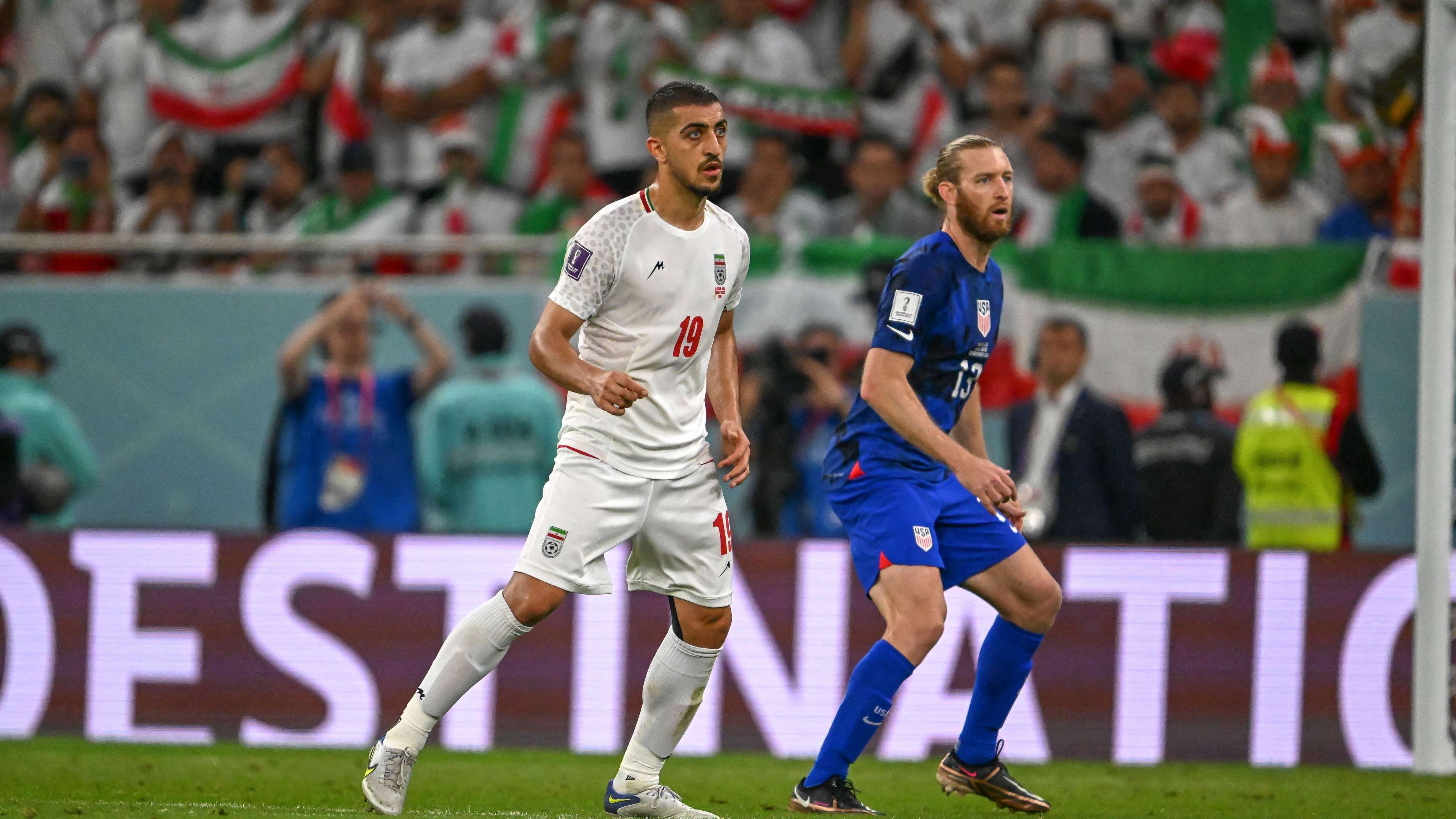
2022-World-Cup-Match-Between-USA-And-Iran-in-QatarAFP

Translated by

Before the US and Iran… historic clashes that took place at World Cup stadiums

As the world looks ahead to the 2026 World Cup, the crisis surrounding the Iranian national team’s participation in the United States stands out as the latest chapter in the complex intertwining of sport and political hostility.

But this scenario is not new; the history of the World Cup is replete with instances where host nations have been forced to make concessions regarding their sovereignty, or where visiting nations have imposed suffocating intelligence surveillance on their players to ensure they do not defect on enemy soil.  

Read also

Real Madrid are not Atalanta... Kane sounds the alarm in Munich

A long suspension awaits Neymar after insulting the referee and women

Europe and racism: England leads the way in tackling the issue... while Yamal suffers from Vinícius’s weakness

  • 1966 World Cup

    It takes us back to 1966, when Britain found itself compelled to host the North Korean national team, which had qualified for the World Cup that year, despite London’s official refusal to recognise the communist state following the Korean War.

    The British Foreign Office considered refusing visas, but backed down in the face of FIFA’s threat to move the entire tournament out of England. A diplomatic solution was eventually reached, stipulating the use of the name ‘North Korea’ instead of the official name (the Democratic People’s Republic of Korea), and prohibiting the playing of the national anthem or the raising of the flag at all matches, except for the opening and final.

    However, in a surprise move, the local crowd in Middlesbrough broke through these official barriers, with English fans embracing the North Korean team as their favourites, and more than 18,000 spectators turned out to support them in their historic match against Italy, which the Asian side won 1-0 in a major upset.

  • Advertisement
  • The Brothers' Feud

    Against the backdrop of the Cold War, the 1974 World Cup saw the only ever meeting between East and West Germany on West German soil, in what became known as the ‘Battle of the Brothers’.

    To ensure its citizens did not defect, East Germany banned ordinary fans from travelling, allowing only around 2,000 “selected guests” loyal to the regime to travel, under the strict supervision of the Stasi, the state security apparatus, to chant a unified, pre-determined chant throughout the match.

    The surveillance extended to the pitch itself, where East German players were forbidden from swapping shirts after the final whistle to avoid any display symbolising rapprochement, whilst the stadium was surrounded by armed police and helicopters circling above the green turf, in anticipation of any security incident, during a match that ended in a surprise victory for the East (1-0).

  • Napoli - Football CityGetty Images Sport

    England and Argentina

    As for the Argentina–England matches in the 1986 and 1998 tournaments, were a sporting continuation of the Falklands War; in 1986, the streets of Mexico City witnessed violent clashes, resulting in English fans being taken to hospital and their flags being stolen by Argentine ‘Para Bravas’ groups.

    At the 1998 tournament in France, the authorities deployed 1,600 police officers to deal with the ‘Hooligans’, whilst the intelligence services worked covertly to foil a terrorist plot targeting that specific match – a fact kept hidden from the players and coaches at the time to ensure the tournament went ahead without interruption.

  • ENJOYED THIS STORY?

    Add GOAL.com as a preferred source on Google to see more of our reporting

  • Cuba's contributions

    Cuba’s participation in tournaments held in the United States or Canada is also a nightmare that haunts the Cuban authorities, due to the phenomenon of ‘mass defections’; in 2002, players Rey Martínez and Alberto Delgado fled the team’s hotel in Los Angeles after pretending to go out to make a phone call.

    The scene was repeated in even more tragic fashion in 2012, when Cuba was forced to play a decisive match against Canada with just 11 players and no substitutes on the bench, after four players and the team doctor defected en masse just before the match in search of asylum.

  • English midfielder David Beckham (L) and his teammAFP

    North Korean barracks

    Even at regional events, these tensions remain present; At the 2014 Asian Games in Incheon, South Korea, the North Korean delegation turned into a mobile ‘intelligence barracks’, with security officers registered as ‘journalists’ to monitor the athletes, at a ratio of one agent for every ten participants.

    North Korean journalists were required to send their reports via fax only, to ensure they were not exposed to the global internet, whilst South Korean authorities were forced to remove the flags of all nations from the streets surrounding the stadiums, limiting their display to inside the stadium, for fear that extremist groups might tear down the North Korean flag and spark a new border dispute.

    These historical events confirm that, in times of crisis, stadiums become zones of ‘special sovereignty’, where ordinary laws are suspended in favour of exceptional security protocols.