.jpg?auto=webp&format=pjpg&width=3840&quality=60)
The FIFA World Cup has expanded to 48 teams in time for the 2026 tournament, meaning it will be the biggest ever edition of the global football competition.
Co-hosts Mexico, the United States and Canada qualified automatically and will be joined by 45 nations from across the globe who have all safely made it through a lengthy qualification process.
But what happens next? GOAL brings you everything you need to know about how World Cup groups are decided ahead of the big kick-off.
How are FIFA World Cup groups decided?
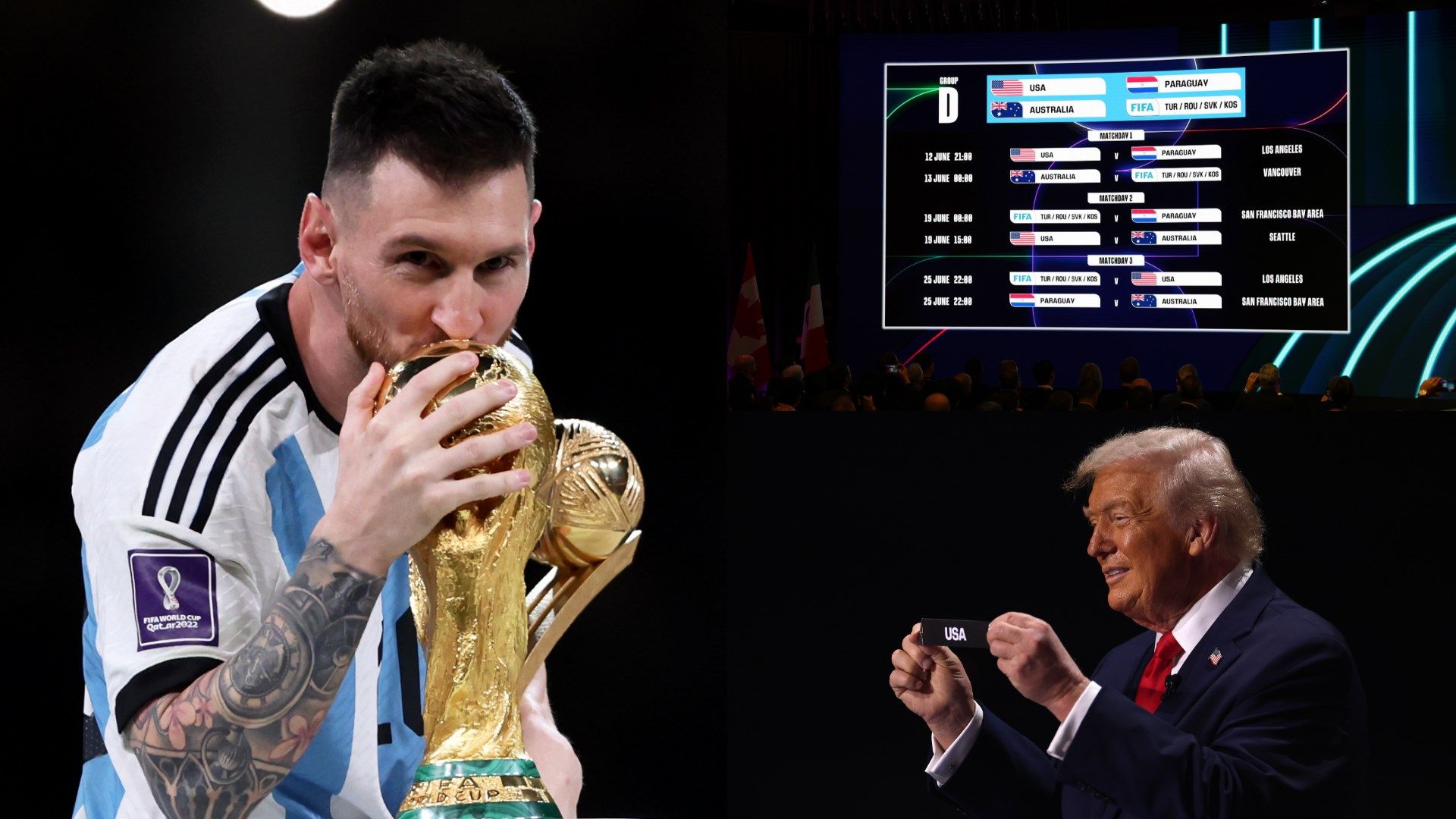
World Cup groups are decided by a draw that divides the 48 teams into 12 groups of four before the start of the tournament.
Teams are divided into four pots for the draw. The three co-hosts USA, Mexico and Canada and Fifa’s nine top-ranked teams go into Pot 1. Fifa's rankings decide the next three pots, meaning the lowest-ranked teams are all in Pot 4.
Here’s a look at how the Pots shaped up for World Cup 2026:
- Pot 1: Canada, Mexico, USA, Spain, Argentina, France, England, Brazil, Portugal, Netherlands, Belgium, Germany
- Pot 2: Croatia, Morocco, Colombia, Uruguay, Switzerland, Japan, Senegal, Iran, Korea Republic, Ecuador, Austria, Australia
- Pot 3: Norway, Panama, Egypt, Algeria, Scotland, Paraguay, Tunisia, Côte d'Ivoire, Uzbekistan, Qatar, Saudi Arabia, South Africa
- Pot 4: Jordan, Cabo Verde, Ghana, Curaçao, Haiti, New Zealand, Bosnia & Herzegovina, Sweden, Turkey, Czech Republic, DR Congo, Iraq
The draw is then made to decide the groups and also the match schedule. The three tournament co-hosts all had a special status, and their positions pre-determined, to ensure their games all take place in their own countries.
The draw then continues with teams going into the first available group, according to the draw’s rules, in alphabetical order.
What is 'seeding' in World Cup group draws?
.jpg?format=pjpg&quality=60&auto=webp&width=380) Getty Images
Getty Images
FIFA introduced a new system for the expanded World Cup 2026 which uses a tennis-style seeding style for the draw. This has been designed to ensure FIFA’s top ranked teams do not meet in the tournament until the semi-final stage. Special pathways have been designed to keep the teams apart until the last four.
FIFA’s top four ranked teams for 2026 are: Spain, Argentina, France and England. These teams are put in different parts of the draw for the knockout phase to ensure they don’t meet. This is done to maintain competitive balance in the competition.
Are there any restrictions?
.jpg?format=pjpg&quality=60&auto=webp&width=380) Getty Images
Getty Images
There were some other restrictions in the draw. Two countries from the same confederation couldn't face each other in the initial group phase. So, for example, Brazil and Argentina (CONMEBOL) couldn't be in the same group, nor could Panama and the United States (CONCACAF).
However, there is one exception relating to teams from Europe. A total of 16 teams from UEFA are in the finals, meaning it is impossible to avoid a clash. Each group therefore contains at least one, but no more than two UEFA teams.
What is a 'Group of Death'?
.jpg?format=pjpg&quality=60&auto=webp&width=380) Getty Images
Getty Images
A ‘Group of Death is’ a term that has become well known in football and is something football fans want to avoid when it comes to their team.
The term relates to being drawn in a group alongside three other strong contenders. With two teams usually only able to progress, it raises the possibility of the other two facing an early exit and the tournament losing some big teams at the first hurdle.
Some recent examples include back in 2022 when Spain faced Germany, Costa Rica and Japan. Costa Rica ended up topping the group, despite being hammered 7-0 by Spain. La Roja came second which meant an early exit for Germany and Japan.
Germany striker Thomas Muller made it clear afterwards just how damaging the early exit from the tournament was for his team.
“It's an absolute catastrophe," he told reporters. "It is unbelievably bitter for us because our result would have been enough [if Spain hadn't lost to Japan]. It's a feeling of powerlessness. If that was my last game for Germany, it has been a tremendous pleasure, thank you very much."
Another notorious Group of Death was in 1982 when three former world champions Argentina, Italy and Brazil well drawn together in a second-round group. Just one team made it through to the semi-finals, meaning disappointment for the other contenders.
Mbappe, Mane & Haaland to meet at World Cup 2026
.jpg?format=pjpg&quality=60&auto=webp&width=380) Getty Images
Getty Images
At World Cup 2026, Group I is widely seen as being one of the toughest. Kylian Mbappe’s France face a Senegal team led by Sadio Mane and Erling Haaland’s Norway. The fourth team has been confirmed as Iraq – another potential banana skin.
France boss Didier Deschamps knows his team face a tough task qualifying for the knockout phase
“It’s one of the toughest groups, if not the toughest“, he told L’Equipe. “Senegal are a competitive national team. And I won’t say anything different about Norway after their qualifying campaign. They’re one of the very best European teams. We certainly have ambition, but with the necessary humility. We need to perform well right from the start before thinking about what comes next."