
+18 | Commercial Content | T&C's Apply | Play Responsibly | Publishing Principles
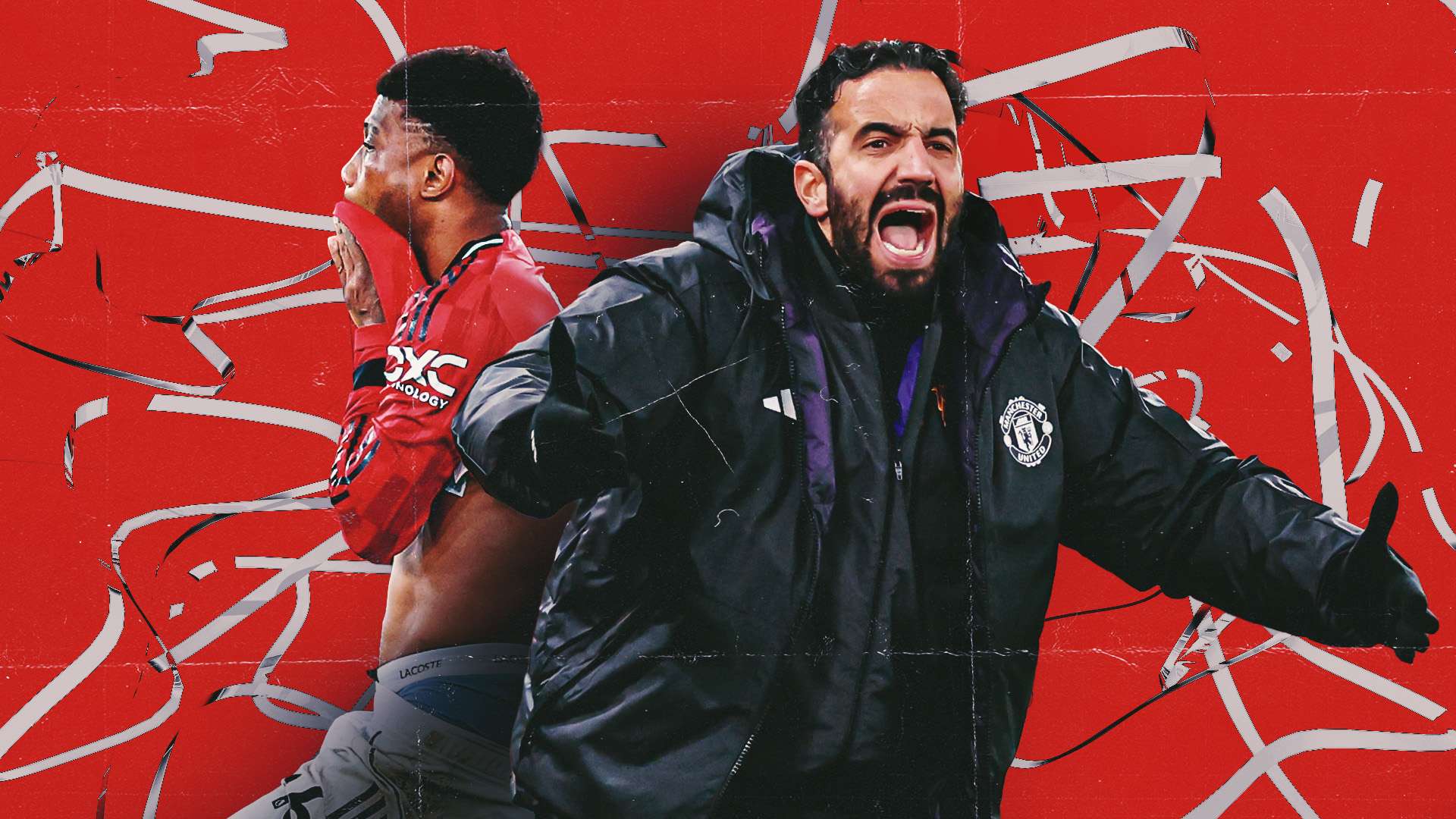
Stubborn Amorim to blame gfxGetty/GOAL

Adapt or die! Stubborn Ruben Amorim is standing in the way of Man Utd's progress with a formation that feels like a straitjacket

Amorim was typically transparent and frank in his post-match assessment, laying out his frustration at his players for not getting up for the game and wanting to take advantage of Liverpool and Manchester City's defeats, ultimately admitting that Everton deserved to win. He was even envious of the Toffees' in-fighting which led to Idrissa Gueye being sent off for confronting Michael Keane as it showed that they cared, in contrast to the apathy his team seemed to embody. "I hope my players when they lose the ball, they fight each other,” he said.

He stopped short of properly criticising the players, stressing it was his responsibility "to explain to the players how to play in every situation of the game". But it was his rigid system that was really to blame for holding the team back when they needed to adapt to the dramatic change in circumstances brought about by Gueye's farcical red card and then Everton taking the lead, giving them license to sit in a low block for the rest of the game.

The game was a picture perfect example of why Amorim is doomed to fail unless he changes course and strays from his fixed 3-4-3 formation.

  • amorim(C)Getty Images

    System exposed

    It is one thing to have a fixed formation to work with on a day-to-day basis, and quite another to stick with it when there is a huge shift in dynamic caused by an early red card. United had benefitted from an early sending off for their opponents earlier this season when Robert Sanchez was dismissed in the fifth minute of Chelsea's visit to Old Trafford. The Red Devils responded to that incident by going for the jugular, although they were also helped by Enzo Maresca hauling off three attacking players soon after.

    David Moyes, by contrast, made no changes after the red card, although he had been forced to replace the injured Seamus Coleman with Jake O'Brien a few minutes earlier. And yet despite being a man down in midfield, they managed to stifle United's threat in the middle of the park, with neither Casemiro nor Bruno Fernandes attempting a tackle in the first half. 

    With the midfield blocked off, United tried to cause damage out wide and it was there that the limits of Amorim's system, especially with the personnel he has, were exposed. Patrick Dorgu couldn't create any danger down the left flank while Noussair Mazraoui only made one promising attacking move in the first half.

  • Advertisement
  • Patrick DorguGetty

    Weak wing backs

    Amorim's solution at half-time was to bring on Mason Mount and take off Mazraoui, who was at least getting forward, so that Amad Diallo could revert to his usual position of right-wing-back and make the most of his blossoming partnership with Bryan Mbeumo. United's left side remained blunt, though, and the coach eventually took off Dorgu. 

    Amorim already had a seasoned attacking left-back on the pitch in Luke Shaw but rather than put the former England international in the position he has played all his life, he brought on the right-footed Diogo Dalot, who was ill-equipped to go round the outside. His only option was to go inside into midfield, where Everton were most comfortable.

    It was a reminder of how United also struggled to break down Nottingham Forest earlier in the month with Dalot on the left flank, leading Jamie Carragher to say the Portuguese "can't beat a man, he's not going to play a clever pass, he's not going to get a cross in". In the end, United's best opportunity in the second half against Everton came when Shaw put a cross in for Joshua Zirkzee, whose header was denied by a fine save from Jordan Pickford.

    Zirkzee's two headers in the second half were United's best efforts but they also smacked of desperation. Everton's defenders James Tarkowski and Keane were happy to deal with crosses all night, and United failed to ask enough questions of them with the ball on the floor. 

  • Luke Shaw Getty

    'Shaw not a centre-back'

    "United were so pedestrian and so negative having gone to 10 men. You've got to flood forward, but they kept this three at the back," said a perplexed Gary Neville on Sky Sports. "Luke Shaw ambled forward. Luke Shaw is not a centre-back, Luke Shaw is a left-back who can go forward, and go forward well, and actually has a good left foot. 

    "So you be the one who dominates and goes forward. He's just playing passes sideways, I thought Shaw was so disappointing. Bringing Dalot on that side and blocking that side off, Dorgu was having a tough night but putting Dalot on meant he was having to turn back on his right foot and play around. Dalot is not a left winger, he's finding himself as a left winger."

    The Shaw situation summed up the problems with Amorim's system in a game like this. Here is a player who used to thrive on bombing forward and when that was what he needed to do, he stayed within the lane Amorim had drawn for him as centre-back.

  • مانشستر يونايتدGetty Images Sport

    No plan against 10 men

    Shaw wasn't the only one that didn't know what to do. "You have to adapt to the circumstances within the game," added Neville. "It looked like they hadn't planned how to play against 10 men. It's pretty damn obvious isn't it? You shift the ball quicker, you shift it from side to side, you switch play, you stretch the pitch and make it as big as possible, you make sure you literally run the other team ragged."

    United were missing two key forwards in Matheus Cunha and Benjamin Sesko, who they signed for a combined £136m ($178m). Amorim refused to use their absences as an excuse and he will have to get more accustomed to key players going missing when the Christmas fixture pile-up begins in December, and when Mazraoui, Amad and Mbeumo go off to the African Nations Cup. Amad and Mbeumo were the only players who could be proud of their performances against Everton and they will be huge losses. 

    Every coach has to cope without key players, but most of them have the flexibility to tweak their system to suit the personnel they have at any given moment. That's where Amorim differs and it's now looking like a case of adapting or falling on his sword. The Portuguese has repeatedly said that he is more prepared to do the latter.

  • Manchester United v Everton - Premier LeagueGetty Images Sport

    Not playing to their strengths

    He has argued that the system is largely irrelevant, instead pointing to the players showing desire in some matches, such as against Liverpool and Chelsea, but not in others. But players also feel energised when they are encouraged to play to their strengths. And Amorim's system does not allow for that. 

    "I don't understand how you can stick with something so steadfastly in a situation like that," said Carragher. "It's one of those moments where I think a lot of people will really question the manager on the back of that defeat. They'll look at the players, and we know the players should do better, but the manager will take a lot of the blame for tonight."

    The question is whether the blame will be enough for Amorim to change course. While his system might have worked for him at Casa Pia, Braga and Sporting CP, it is not working after one year at United. 

  • Manchester United v Everton - Premier LeagueGetty Images Sport

    Formation feels like a straitjacket

    Their inability to beat a wily, yet still limited, Everton team at home with a man advantage wiped away all the belief stored up from their winning streak in October, as well as the positivity that came from the recoveries from behind to get away draws at Forest and Tottenham. 

    It also demonstrated how far they need to go to get back to where they want to be. Amorim was open about that, declaring that his team are "not even near the point that we should be to fight for the best positions in the league." 

    But he was wrong when he said they needed to be "perfect" to win games. United fans are not asking for perfection, they are just asking for a little common sense, some imagination when an opponent is sent off. And unless he is ready to leave the straitjacket of his formation, even for 70-odd minutes, then they will not get any closer to being where they need to be.