
+18 | Commercial Content | T&C's Apply | Play Responsibly | Publishing Principles
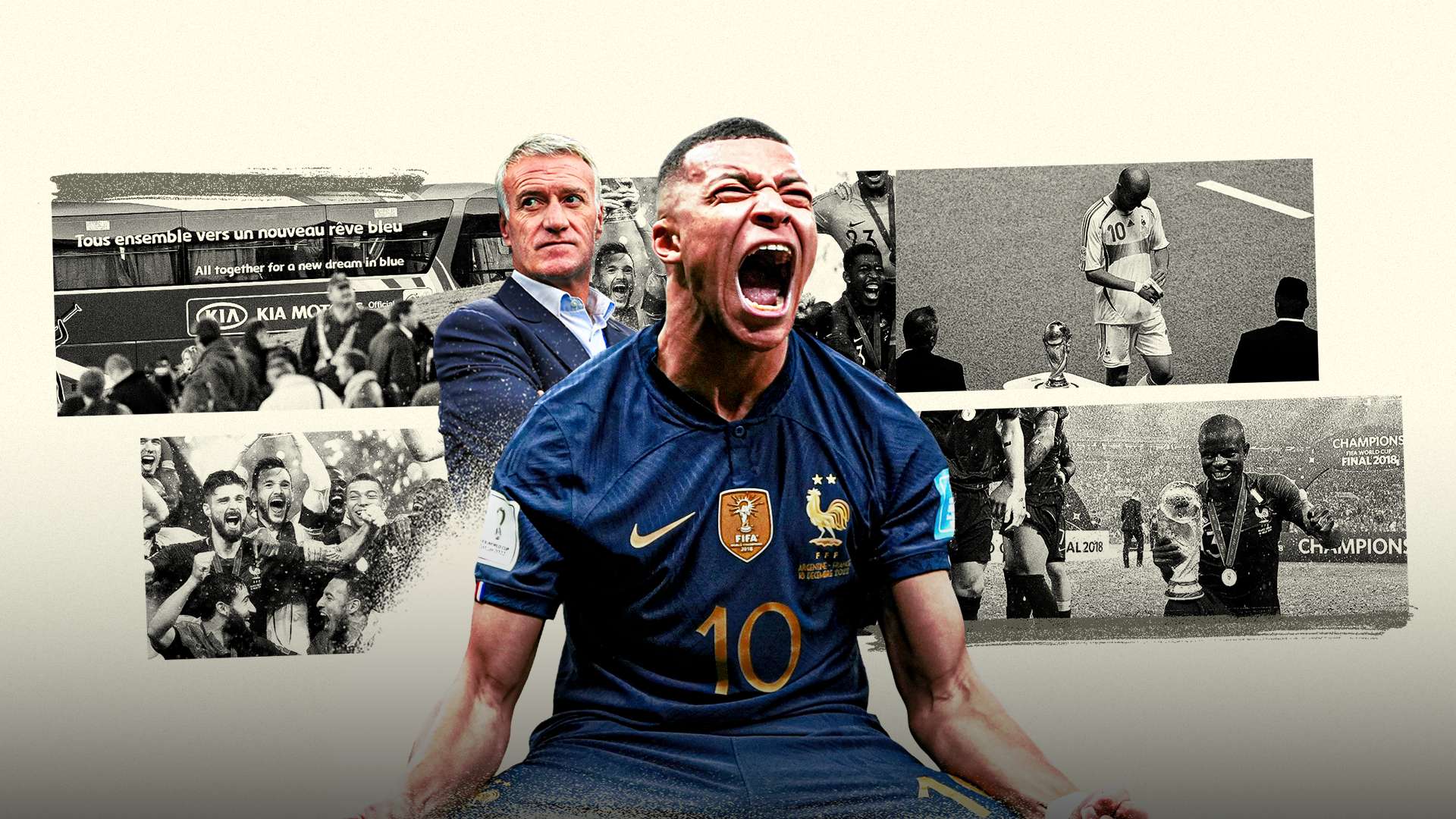
France Legacy GFXGetty/GOAL

LEGACY: From Berlin to Doha - how France learned resilience at the World Cup

The final whistle. In Berlin on July 9, 2006, it rings out like the death knell of Greek tragedy. It confirms the fall of a god, Zinedine Zidane, and the brutal end of a golden era. The image is frozen in time: a red card, an empty stare, a trophy brushed but never touched.

Sixteen years later, on December 18, 2022, in Doha, another final whistle sounds. This one concludes defeat, certainly, but heroic defeat, almost victorious in its panache. It doesn't seal an ending; rather it confirms the existence of a dynasty and the crowning of a new king, Kylian Mbappe, the author of an astonishing hat-trick.

Between these two World Cup finals, France lived through one of modern international football's most dramatic odysseys. A complete cycle of death and rebirth, from absolute shame to eternal glory. It's the story of a national team that, after hitting rock bottom, meticulously rebuilt its soul, purged its demons and forged a new identity that was more resilient and pragmatic. A legacy defined no longer by the brilliance of a solitary genius, but by the unshakeable strength of the collective.

  • TOPSHOT-FBL-WC2006-MATCH64-ITA-FRA-CARDAFP

    Fall of the titans

    The 2006 World Cup adventure didn't begin with an explosion but a murmur of anxiety. France, ageing and lacking inspiration, scraped through the group stage with two draws, provoking immense doubt in their title credentials.

    This team was saved from becoming a shipwreck by the providential return of veterans Claude Makelele, Lilian Thuram and, above all, Zidane. Emerging from international retirement a year earlier, his return was perceived as messianic. 

    "God exists and he's returned to the French team," declared Thierry Henry, but this phrase revealed a structural flaw, the team's almost total dependence on a single man.

    The final at Berlin's Olympiastadion was the perfect stage for the maestro's ultimate performance. In the seventh minute, Zidane opened the scoring with an audacious Panenka penalty, an outrageous gesture encapsulating his genius and absolute confidence. France dominated, and Italy defender Marco Materazzi would later acknowledge, without equivocation, Les Bleus' superiority that evening. In extra-time, Zidane planted a powerful header that Gianluigi Buffon miraculously deflected. This was the moment the dream should have become reality.

    Instead, in the 110th minute, Materazzi found himself on the ground. The incident that caused him to be there occurred away from the ball, a verbal provocation about Zidane's sister. The response was lightning-fast, animalistic, a violent headbutt to the Italian's chest. The red card was brandished; the image of Zidane walking head bowed past the trophy as he returned to the dressing room became iconic as part of a tragic defeat. Deprived of their guide, the team collapsed psychologically and fell on penalties.

    The reaction, a state of national shock, was immediate. This act didn't destroy Zidane's legend in France, it rather added a layer of human complexity that made his legend even more powerful. But for the French team, the consequences were profound. ‘The Zidane Generation’ was over. The departure of the only man capable of holding the edifice together created a gaping power vacuum. Nobody was prepared to inherit the torch, and the seeds of Knysna were sown on the Berlin pitch.

  • Advertisement
  • FBL-WC2010-FRA-TRAINING-EXPEL-LETTERAFP

    Implosion

    The post-2006 period was one of slow and painful erosion. Euro 2008 was a fiasco; elimination at the first hurdle with just one goal scored, concluded by manager Raymond Domenech's surreal live television marriage proposal minutes after defeat to Italy. Qualification for the 2010 World Cup, meanwhile, was tainted by Henry's notorious handball in the play-off against Ireland. This was therefore a team in a crisis of legitimacy that landed in South Africa.

    After an insipid draw with Uruguay and defeat to Mexico, the sporting crisis was eclipsed by an institutional one. At half-time in the Mexico match, a violent altercation erupted between Nicolas Anelka and Domenech. The insults, reported on the front page of L'Equipe with devastating precision, lit the touch paper, and the French Football Federation (FFF) decided to expel Anelka from the squad.

    On June 20, 2010, French football wrote its darkest chapter. At the Knysna training ground, the players refused to leave their bus. The curtains were drawn as, outside, cameras from around the world filmed a surreal scene.

    Fitness coach Robert Duverne, furious, hurled his stopwatch and had to be separated from captain Patrice Evra. Domenech, humiliated, was forced to read out to the press a statement written by the players. It was a total breakdown of institutional authority, an unprecedented act of defiance where millionaire players mutinied in the middle of a World Cup.

    First-round elimination was a mere formality, and France returned home in shame. A parliamentary inquiry was launched – a rare occurrence for a sporting matter - and the French team became a global laughing stock, a symbol of dysfunction and selfishness. The trauma would mark the French collective psyche for years. What happened at Knysna transcended sport; it was the bankruptcy of an entire system.

  • Spain v France - UEFA EURO 2012 Quarter FinalGetty Images Sport

    Impossible renaissance

    Laurent Blanc inherited a team in ruins. Appointed urgently to succeed Domenech, the 1998 world champion was tasked with purging toxic elements and restoring a semblance of dignity.

    He began with a strong gesture, insisting that none of the Knysna protagonists would be recalled. But Blanc quickly faced another storm: The ‘quota scandal’. Revelations suggested the FFF had considered limiting the number of dual-nationality players in training centres, a sensitive debate that shook the foundations of French football, supposedly a champion of diversity.

    Euro 2012 in Ukraine and Poland became the passing exam. France, weakened by the loss of key players, managed to reach the quarter-finals. But defeat to Spain, reigning world champions and twice European champions, revealed the project's limits.

    Blanc had steadied the ship without steering it towards the summit. His record was respectable but insufficient. France needed a man capable not just of extinguishing fires, but of rebuilding foundations.

  • ENJOYED THIS STORY?

    Add GOAL.com as a preferred source on Google to see more of our reporting

  • FBL-WC2014-FRA-JPN-FRIENDLYAFP

    The architect

    In July 2012, Didier Deschamps was appointed France manager. The choice seemed almost inevitable. World champion in 1998 and European champion in 2000 as captain, Deschamps embodied leadership and a winning mentality. But he was also a divisive figure. A former defensive midfielder with utilitarian play, he'd long been mocked, notably by Eric Cantona who dubbed him ‘the water carrier’, the worker who does the dirty work without shining.

    Yet it was precisely this worker mentality, this ego placed in service of the collective, that made Deschamps the ideal profile for post-Knysna France.

    Deschamps immediately imposed his vision that group cohesion trumped everything. No untouchable stars, no leniency with deviant behaviour. He didn't seek the beautiful football prized by certain purists. He built solid teams that were difficult to beat and capable of both suffering and adapting. His pragmatism earned him criticism, but he didn't care; only results mattered.

    The 2014 World Cup in Brazil was Deschamps’ baptism of fire. France, rejuvenated and full of ambition, impressed with attacking play in the group stage. Karim Benzema was finally at the peak of his powers in the blue shirt, supported by the vigour of young talents like Antoine Griezmann and Paul Pogba. But in the quarter-final against Germany, France fell. Disillusionment was sharp, but the assessment encouraging. Momentum had been created.

  • Portugal v France - Final: UEFA Euro 2016Getty Images Sport

    Test of resilience

    Euro 2016, hosted in France, represented a golden opportunity, but also a formidable trap. Media pressure was crushing, and the entire country expected a title on home soil.

    Deschamps managed the squad with an iron fist. He excluded undisciplined players like Hatem Ben Arfa and Benzema, the latter embroiled in the Mathieu Valbuena sex-tape blackmail scandal that dominated French headlines. The manager prioritised stability over individual brilliance.

    The team's run was controlled until the final. France successively eliminated Ireland, Iceland and, crucially, Germany in the semi-final. The Stade de France vibrated, but the final against Portugal turned to nightmare. Cristiano Ronaldo departed injured in the first half, yet it was Portugal who snatched victory in extra-time through an Eder goal. Disappointment was immense after France's third final defeat in the space of 10 years.#

    But unlike 2006, this defeat didn't trigger collapse. The team had shown mental strength and resilience. The foundations laid by Deschamps held firm, and this capacity to absorb blows without disintegrating was the fruit of his relentless work on group cohesion. France was ready for what came next.

  • TOPSHOT-FBL-NATIONS-FRA-NEDAFP

    Apotheosis of pragmatism

    The 2018 World Cup in Russia was Deschamps' masterpiece. His approach, often criticised for lacking aesthetics and branded ‘ugly’, proved ruthlessly effective.

    France abandoned ball possession (just 49 percent on average, ranking them 20th in the tournament) in favour of a compact defensive block, designed to eliminate space and launch devastating counter-attacks. This system was tailored for his players: the tireless work of N'Golo Kante and Blaise Matuidi, Pogba's vision, Olivier Giroud's pivot play, and above all the devastating pace of Griezmann and young prodigy Mbappe.

    The knockout run was a model of tactical management: Controlled chaos against Argentina (4-3); control against Uruguay (2-0); iron discipline against Belgium (1-0) and clinical efficiency in the final against Croatia (4-2).

    This victory belonged to several men, including Deschamps, the chief pragmatist who silenced his critics by proving his obsession with building a team that was “very difficult to beat" was correct, and Mbappe, the emerging superstar who exploded onto the world stage. But above all, it was the collective's victory.

    The symbol was Giroud. Essential to the system, he didn't score a single goal in the tournament in a sacrifice that would have been unthinkable for the individualists of previous generations.

    The 2018 triumph wasn't merely sporting victory, it was an ideological victory. The revenge of collective over individual, proof that a united and disciplined team could soar higher than a collection of disunited talents. It was the ultimate revenge for Knysna.

  • FBL-WC2022-EUR-QUALIFIER-FRA-KAZAFP

    Managing new status

    The 2018 triumph wasn't an accident. It was the fruit of an exceptional development system, whose jewel is the National Football Institute at Clairefontaine, located in the Paris region. This training and development centre has become a global reference.

    The FFF's philosophy, focused on developing technically complete, tactically intelligent and versatile players, has created an unparalleled talent pool. This explains how France can afford to lose several world-class players like Pogba, Kante or Benzema just before a World Cup and still reach the final.

    If 2018 revealed a prodigy, subsequent years confirmed the advent of a monarch. Mbappe, France's youngest World Cup goal-scorer and history's second-youngest (after Pele) to score in a final, progressed from revelation to undisputed leader. His hat-trick in the 2022 World Cup final, almost single-handedly forcing extra time, definitively cemented his status as heir to the greats.

    The Deschamps era cannot be recounted, however, without the Benzema saga. Following the sex-tape affair involving Valbuena in 2015, Deschamps made the bold decision to dispense with his most talented striker, prioritising squad balance. In a pragmatic plot twist, he recalled Benzema for the Euros in 2021, acknowledging his exceptional level at Real Madrid, but the striker suffered an injury just before the 2022 World Cup and left the squad in controversial circumstances amid contradictory versions of events that created fresh controversy.

    This saga illustrates the central paradox of Deschamps' management: Adaptive pragmatism where principles can be circumvented if victory is at stake.

  • Argentina v France: Final - FIFA World Cup Qatar 2022Getty Images Sport

    Full circle

    The 2022 World Cup marked the twilight of the world champion generation. Post-tournament international retirements of stalwarts like Hugo Lloris and Raphael Varane, followed later by Giroud, officially closed the ‘Griezmann Generation’. Simultaneously, the competition confirmed the next wave's assumption of power. Players like Aurelien Tchouameni established themselves as pillars, ensuring smooth transition and the perpetuation of excellence.

    The 2022 final against Lionel Messi's Argentina was the perfect counterpoint to Berlin. Trailing 2-0 and completely outclassed for 80 minutes, France didn't sink. Unlike 2006's team, which collapsed after losing their leader, 2022's squad, galvanised by an extraordinary Mbappe, orchestrated one of the most spectacular comebacks in finals history. This resilience, this visceral refusal of defeat, is the ultimate hallmark of the Deschamps era. It's the mental fortitude forged in Knysna's inferno and in Euro 2016's tears.

    Deschamps' final assessment is that of an architect. He took charge of a team in moral decomposition that had become a national disgrace, and transformed it into a global powerhouse. One world title, two other finals and a Nations League triumph, his record places him in the pantheon of the greatest international managers. He won't be remembered as a philosopher of beautiful football, but as a builder of winning machines.

    History seems destined to come full circle. Deschamps has announced he'll leave his post after the 2026 World Cup, and to succeed him, one shadow looms, that of Zidane. The hypothesis is so natural that Deschamps himself has validated it. The symmetry would be perfect: The man whose tragic exit in Berlin initiated this 16-year cycle of chaos and reconstruction is today best placed to inherit the stable dynasty that emerged from the ashes he'd left behind.

    Deschamps' greatest legacy may not be the second star, but the institutionalisation of resilience. He replaced a fragile culture, dependent on a genius' moods, with collective DNA where the capacity to suffer and fight back has become second nature. It's this quiet strength he'll bequeath to his successor, so that the era of Les Bleus can continue.

0