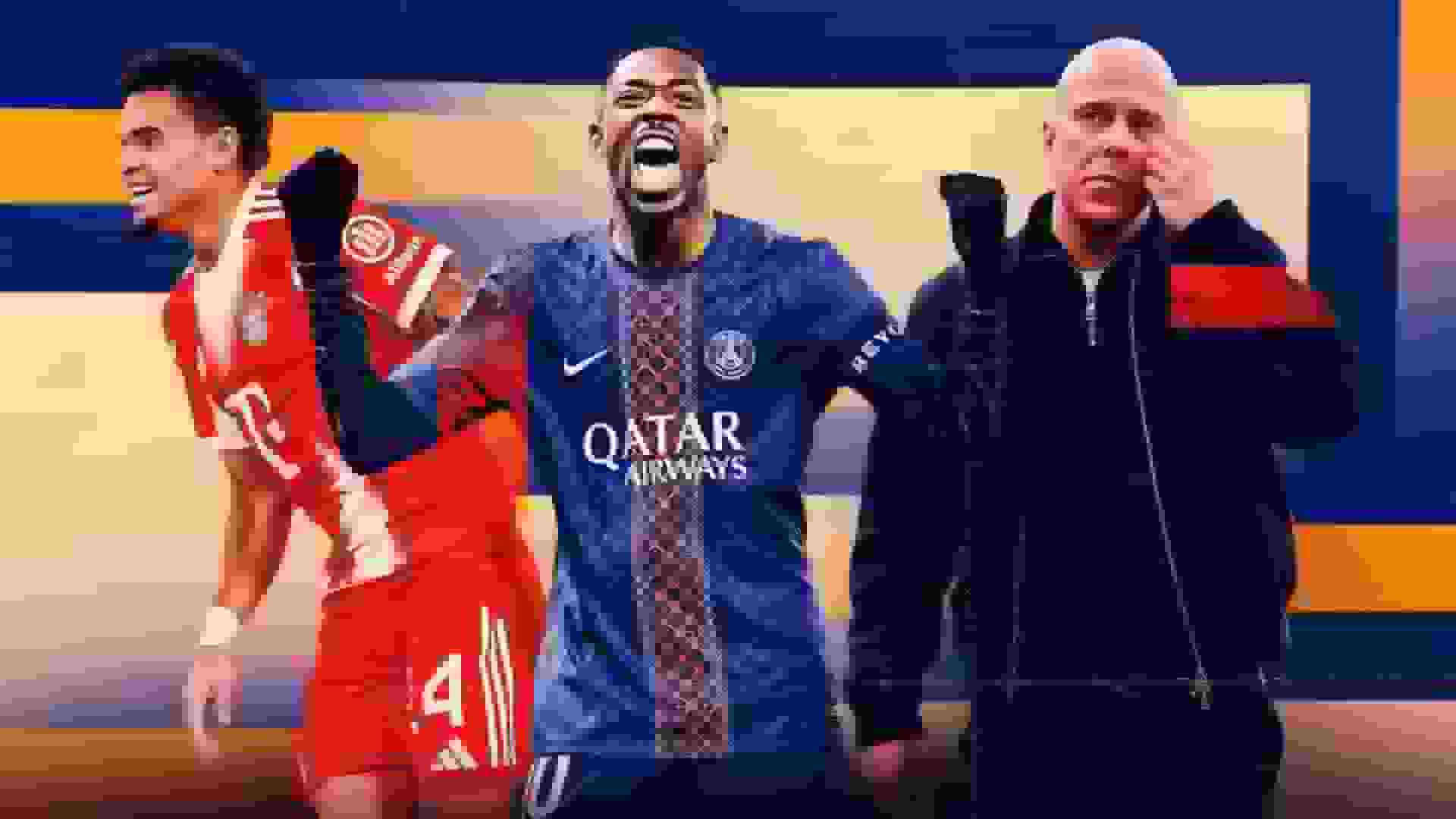

Waldemar Anton has impressed with his consistency, and Borussia Dortmund's win over Elversberg offered another look at the qualities Jürgen Klopp admires. Could a Bayern Munich star now be in danger of losing his place in the Germany squad?
Three takeaways from Borussia Dortmund's 2-1 (0-0) win over SV Elversberg: faith in Felix Nmecha pays off, while a much-discussed incident brings up the objectionable word of the ninth Bundesliga matchday.
Waldemar Anton shows why Klopp is impressed: Is he overtaking a Bayern Munich star?
When Germany coach Jürgen Klopp discussed the second squad of his still-young tenure during the week, his comments on the centre-backs caught the eye. "Those two were clear choices for me," he said. He meant Waldemar Anton and Malick Thiaw, rather than Jonathan Tah and Nico Schlotterbeck, who had recently been the established pair in the Germany team.
Anton, the 30-year-old Borussia Dortmund defender, and Thiaw, the Newcastle United player five years his junior, had partnered each other in both previous internationals, against Serbia (2-0) and in Greece (0-0). "They did incredibly well, you simply have to say that," Klopp said of Anton and Thiaw before explaining why they suited his approach.
"Centre-backs must, first and foremost, defend, of course. That is the most important part of their job. But to play a certain kind of football, they also have to embrace that approach. In other words, if we want to press high but the lads only feel comfortable when they can touch the edge of their own penalty area, we have a problem," Klopp said. Anton and Thiaw had given him the brave defending he wants.
Related Topics


On Saturday afternoon, Elversberg sat deep for long spells while looking to counter-attack, and Anton again showed those qualities. He had done the same over 180 minutes for Germany against Serbia and in Greece, and has done it for months at BVB.
Borussia Dortmund: Anton shows the qualities that particularly impress Klopp
Anton repeatedly stepped out of the back four to stop Elversberg's counter-attacks before they developed. His timing and anticipation matched his one-on-one defending. When he stayed back as the last line of defence, he made sound decisions and produced important blocks.
In possession, Anton also fits Klopp's vision of a bold back line. He finds team-mates in space with clever vertical passes that take opponents out of the game and move Dortmund's attack forward.
 Getty Images
Bayern Munich's Tah has shown plenty of times that he, too, will take risks as a defender. But the partnership of Tah and Schlotterbeck, which had been established before the World Cup and before Schlotterbeck's injury, is not guaranteed to start at the finals in North America.
Tah is no longer an undisputed starter at Bayern this season, and Min-Jae Kim has taken his place in the team for one or two important matches. Anton also has a stronger understanding with Schlotterbeck, his Dortmund team-mate, who appears certain to start. They know each other well. Could the Dortmund pair now start together for Germany against Serbia on Friday?
Borussia Dortmund match-winner: Kovac's faith in Nmecha pays off
After receiving a yellow card for a tactical foul just over 20 minutes into the game, Felix Nmecha had to be careful when dealing with Elversberg's quick transitions. Another tactical foul could have brought a second yellow card.
At half-time, Sky asked Dortmund assistant coach Robert Kovac whether Nmecha should come off because of that risk. "I think he's intelligent enough to judge that," replied the brother of head coach Niko Kovac.
Nmecha repaid that faith after the break. In the 55th minute, Fabio Silva created the chance and Nmecha finished from around 18 metres, beating SVE goalkeeper Nicolas Kristof with a low shot into the near corner.
A quarter of an hour later, Nmecha added his second with another fine finish, this time from around 25 metres. The Germany international's two goals helped the second-placed side to a hard-fought 2-1 win, an important result in their long-distance contest with leaders Bayern Munich.
Felix Nmecha's importance to Borussia Dortmund: "He makes his team-mates better"
Kovac's decision to keep Nmecha on paid off. At the post-match press conference, the Croatian also praised the impact the 26-year-old had made beyond his two goals. "With his presence, his dynamism, his technique," he was immensely important to BVB, the Croatian explained. "He can resolve many situations so quickly with the way he turns his body. That makes his team-mates better."
Nmecha is only just entering what Kovac calls his "peak-performance age", and the coach believes there is "still room for improvement". Borussia had already felt the impact of his absence in the five league games he missed through injury last season. "You could see then that our play was a little sluggish," Kovac recalled. "With him, we have a completely different dimension. That's why I'm glad he's here."
 Getty Images
Although Nmecha has had the odd dip in form this season and looked a little tired at times, Kovac sees him as too influential to do without. "In terms of talent and technique, he is one of the best midfielders in the world," Dortmund sporting director Ole Book said on Sky after the win over Elversberg. "And when he adds finishing like he did today – he certainly has that shot in him – there aren't many who are better."
BVB goalkeeper Gregor Kobel claimed a small share of the credit for Nmecha's second goal, which flew into the net at 124 km/h. "That's Felix, what can you say? A world-class player," the Swiss goalkeeper said in an interview with Borussia's YouTube channel, adding with a grin: "Maybe he hits them like that because I always push him so hard in training."
The objectionable word of the matchday: "contact pattern"
Elversberg captain Lukas Pinckert injured his ankle in one of the most-discussed incidents of this Bundesliga matchday and had to come off in the 37th minute against Borussia Dortmund.
Referee Harm Osmers was right not to show Dortmund's Daniel Svensson a red card, though. The Swede caught Pinckert on the ankle with his studs showing, so the so-called "contact pattern" pointed to a red card under the rules. But using that pattern as the decisive test for a red card, a trend since the introduction of VAR, ignores the dynamics of incidents like this. There was no suggestion of malicious intent from Svensson.
Had Pinckert been carrying the ball, passed it and then been caught by Svensson after the ball was long gone, the challenge would have merited a red card. Here, Svensson was trying to reach a pass from Carney Chukwuemeka with his left foot and direct it into the penalty area. The BVB left-back slid in, and he had a genuine chance of reaching the ball.
Pinckert darted in and poked the ball away. Within hundredths of a second, Svensson's attempt to reach the ball caught Pinckert instead. The Swede could not pull out, and the injury to the Elversberg player is deeply unfortunate. But what could Svensson have done? With no intent and given the circumstances, it was a foul that could merit a yellow card, not a red.
 Getty Images
Rewatch the incident in slow motion and the "contact pattern" makes the ankle contact look like a red card. A view that ignores the build-up, though, cannot be the basis for deciding whether a player should be sent off.
World Cup winner Mats Hummels made a similar argument in January, when Svensson received a red card for a similar challenge in Dortmund's Champions League match at Tottenham Hotspur. "It's unfortunate, but that's how it's being refereed at the moment. For me, it's not a red card. It's a classic still-frame red card that, when you look at how the incident develops, doesn't justify a sending-off," Hummels said as a pundit on Prime Video.
Hummels' assessment applies to Saturday's incident too. In the Sky studio, two former professionals disagreed over the decision. "Svensson doesn't see Pinckert at all. He misses the ball by two centimetres; he wants to play the ball. He sees neither the opposing player nor anything else; he just wants to play the ball […] It's a combination of circumstances, these are things that happen in football," said Dietmar Hamann, who agreed with Osmers' decision not to show a red card. Patrick Helmes disagreed.
"The contact pattern couldn't be clearer, and the risk of injury couldn't be greater. I agree with you, Didi, that he didn't mean to do it. But there were lots of things I didn't mean to do, and I still got them wrong," said former Germany striker Helmes. Hamann, another former Germany player, responded: "You've already disqualified yourself by using the term 'contact pattern'."
Osmers later told Sky that, having seen the footage, he could have shown a red card under the current rules. He might have done so had VAR sent him to the monitor. Patrick Hanslbauer did not intervene from the Cologne VAR centre, and that was the right call.