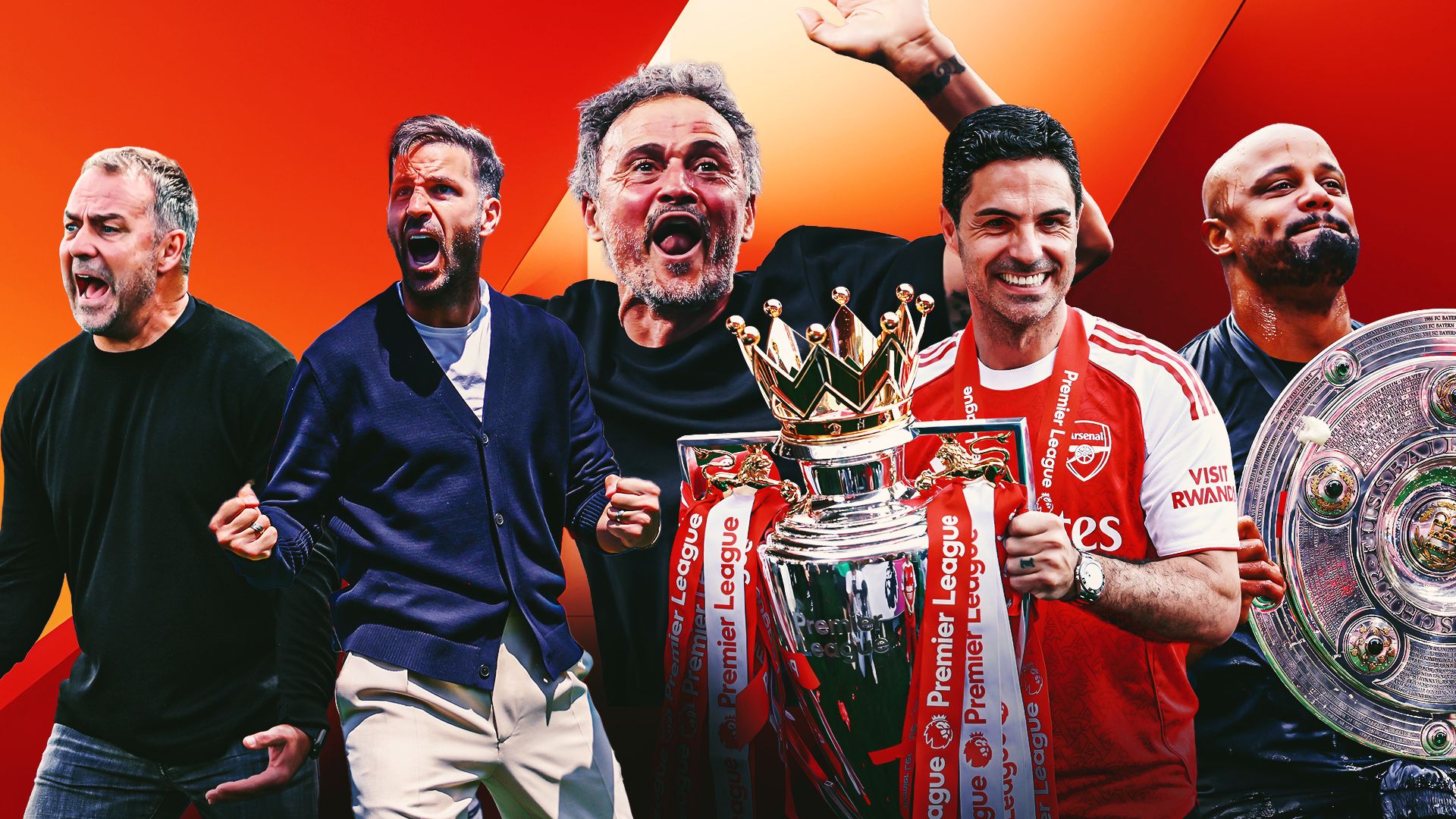
The suspicion was that the Premier League title race was about to take a very dramatic turn after Manchester City drew to within two points of an increasingly nervy Arsenal on Saturday. However, the Gunners responded in the best possible fashion by routing north London rivals Tottenham the following day to keep their bid for a first championship success since 2004 very much on track.
Though the Premier League took a week off to allow for the FA Cup, there were still plenty of storylines to follow within England, while title races around the rest of Europe continue to take plenty of twists and turns.
Celtic have announced Brendan Rodgers has left his role as manager with immediate effect. The 52-year-old has departed Celtic Park following Sunday's 3-1 defeat against Hearts which has left them eight points adrift of the Scottish Premiership leaders. He has been replaced on an interim basis by Martin O’Neill, who returns for a second spell after previously managing the club between 2000 and 2005.
We're two months into the season now, and it feels like things are starting to take shape around Europe. Some title races are looking like they will be closer than others, with some surprise contenders in the mix, while other presumed challengers are beginning to struggle, casting doubt on the futures of their managers and star players.
Hearts strengthened their Scottish Premiership title credentials with an emphatic 3-1 victory over champions Celtic on Sunday afternoon. An own goal from defender Dane Murray and strikes from forwards Alexandros Kyziridis and Lawrence Shankland helped Derek McInnes’ side record a statement victory which has sent shockwaves across Scottish football.
Manchester United, often simply referred to as "United," are one of the most iconic and successful football clubs in the world, based in Old Trafford, Greater Manchester, England. The club was founded as Newton Heath LYR Football Club in 1878 by the Lancashire and Yorkshire Railway depot at Newton Heath. The team changed its name to Manchester United in 1902 and moved to its current home, Old Trafford, in 1910.
Famous players
Manchester United have been home to some of the greatest footballers in history. Sir Bobby Charlton, a World Cup winner with England in 1966, is arguably the most iconic figure in the club's history. Other legendary players include George Best, known for his flair and skill, and Eric Cantona, who brought a winning mentality to the club during the 1990s. More recent stars like Cristiano Ronaldo, Wayne Rooney, and Paul Scholes have also contributed significantly to the club's success.
Honours
Manchester United are one of the most decorated clubs in English football, having won a record 20 Premier League titles (formerly the First Division). They have also lifted the FA Cup 12 times, the League Cup five times, and the UEFA Champions League three times. The club's dominance in English football was particularly evident during the 1990s and early 2000s under manager Sir Alex Ferguson.
Managers
Sir Alex Ferguson is undoubtedly the most successful manager in Manchester United's history. He spent 26 years at the club, leading them to an unprecedented era of success. Before Ferguson, managers like Matt Busby and Wilf McGuinness played crucial roles in shaping the club's identity. More recent managers, including David Moyes, Louis van Gaal, and José Mourinho, have faced the challenge of maintaining the club's high standards.
Stadium
Old Trafford, often referred to as the "Theatre of Dreams," is one of the most famous stadiums in the world. With a capacity of roughly 75,000, it is among the largest football stadiums in the United Kingdom. The stadium has hosted numerous major matches, including UEFA Champions League finals and FIFA World Cup matches.
Location
Manchester United are based in the city of Manchester, which is located in the northwest of England. The club's home ground, Old Trafford, is situated in the Trafford borough. Manchester is a major industrial city with a rich footballing heritage.
Owners
In February 2024, British billionaire Sir Jim Ratcliffe's company, INEOS, acquired a significant 25% stake in Manchester United. This acquisition granted Ratcliffe sporting control over the club, placing him in a position to influence key decisions related to its operations.
Ratcliffe has already made a substantial financial commitment to Manchester United. His large investments demonstrate his dedication to the club's success and his willingness to provide the necessary resources for its growth.
Frequently asked questions
Quando è nata la Roma?
Il 7 giugno 1927 Alba Audace, Roman e Fortitudo Pro Roma si unirono in una sola società per dare battaglia ai club del nord e del centro-sud: naque così la Roma.
Chi è il presidente della Roma?
Dan Friedkin, imprenditore e produttore cinematografico americano, è il presidente della Roma. La società giallorossa è di proprietà della società The Friedkin Group.
Come si chiama lo stadio della Roma?
La Roma gioca le partite interne allo Stadio Olimpico, inaugurato nel maggio 1953 con il nome di Stadio dei Centomila. Nel 1960 assunse il nome attuale dopo l'assegnazione delle Olimpiadi a Roma.
Qual'è la capienza dell'Olimpico?
La Roma può ospitare 70.634 spettatori allo Stadio Olimpico cittadino. Solo San Siro, impianto di Inter e Milan, ha più posti a sedere in Italia.
Quanti Scudetti ha vinto la Roma?
La Roma ha vinto tre Scudetti nel corso della sua storia. Il primo è arrivato nel 1943, mentre il secondo nel 1983. L'ultimo titolo giallorosso risale al 2001.
Quante coppe europee ha vinto la Roma?
La Roma ha vinto una sola coppa europea, la Conference League del 2022. La Coppa delle Fiere conquistata nel 1961 non è invece considerata dall'UEFA, al contrario della FIFA.
Quanti trofei ha vinto la Roma?
La Roma ha vinto 16 trofei nella sua storia, considerando anche la Coppa delle Fiere. Il record è rappresentato dalla Coppa Italia, conquistata in ben 9 occasioni.
Perché la Roma gioca in giallorosso?
La Roma prende i colori giallo e rosso dal Gonfalone del Campidoglio, ovvero lo stemma della città. In alcune stagioni il colore rosso è stato più chiaro o il giallo più brillante.
Perché il simbolo della Roma è una lupa?
La Roma ha scelto la lupa come simbolo in virtù della lupa capitolina, che secondo la leggenda avrebbe accudito Romolo, fondatore della città, e suo fratello Remo.
Chi ha segnato più goal nella storia della Roma?
Francesco Totti è il capocannoniere della Roma di tutti i tempi. Dal 1992/1993 al 2016/2017 l'ex capitano giallorosso ha segnato ben 307 goal.
Chi ha giocato più partite con la Roma?
Oltre ad essere il massimo marcatore di sempre, Francesco Totti detiene anche il record di partite giocate con la Roma. In totale il 'Pupone' è sceso in campo in 786 gare con i giallorossi.
Come è soprannominata la Roma?
I giocatori della Roma sono i giallorossi, mentre la squadra è chiamata principalmente la Lupa o la Magica. I calciatori vengono anche chiamati capitolini in virtù della capitale Roma.
Perché la Roma è chiamata la Magica?
Non c'è un vero e proprio motivo per cui la Roma è chiamata la magica, se non per rimarcare l'amore per il club giallorosso. Il soprannome è nato tra la fine degli anni '70 e l'inizio degli anni '80.
Quale allenatore ha più panchine con la Roma?
Lo svedese Nils Liedholm è l'allenatore più presente nella storia della Roma. In totale ha guidato i giallorossi per 439 partite, vincendo uno Scudetto e tre Coppa Italia.
La Roma è mai retrocessa in Serie B?
La Roma è retrocessa in Serie B una sola volta nella sua storia, al termine dell'annata 1950/1951. Un anno dopo, la squadra giallorossa tornerà in Serie A, in cui milita ininterrotamente da allora.