+18 | Commercial Content | T&C's Apply | Play Responsibly | Publishing Principles
Zinedine ZidaneGetty Images

Translated by

Zidane enters the minefield: three questions awaiting an answer

The French Football Federation didn't just change the man in the dugout when they appointed Zinedine Zidane as national team technical director. They signalled the start of a new era for Les Bleus.

Fourteen years under Didier Deschamps, one of the most successful managers the team has ever known, have come to an end. In their place comes a project led by a coach who has never worked at international level, yet who built one of the greatest eras in Real Madrid's history.

Quick results and another trophy won't be enough. Zidane faces three key questions. How does he preserve Deschamps' legacy? Can he carry his winning philosophy from Real Madrid into international football? And will four years away from the touchline since 2021 hurt his chances of success?
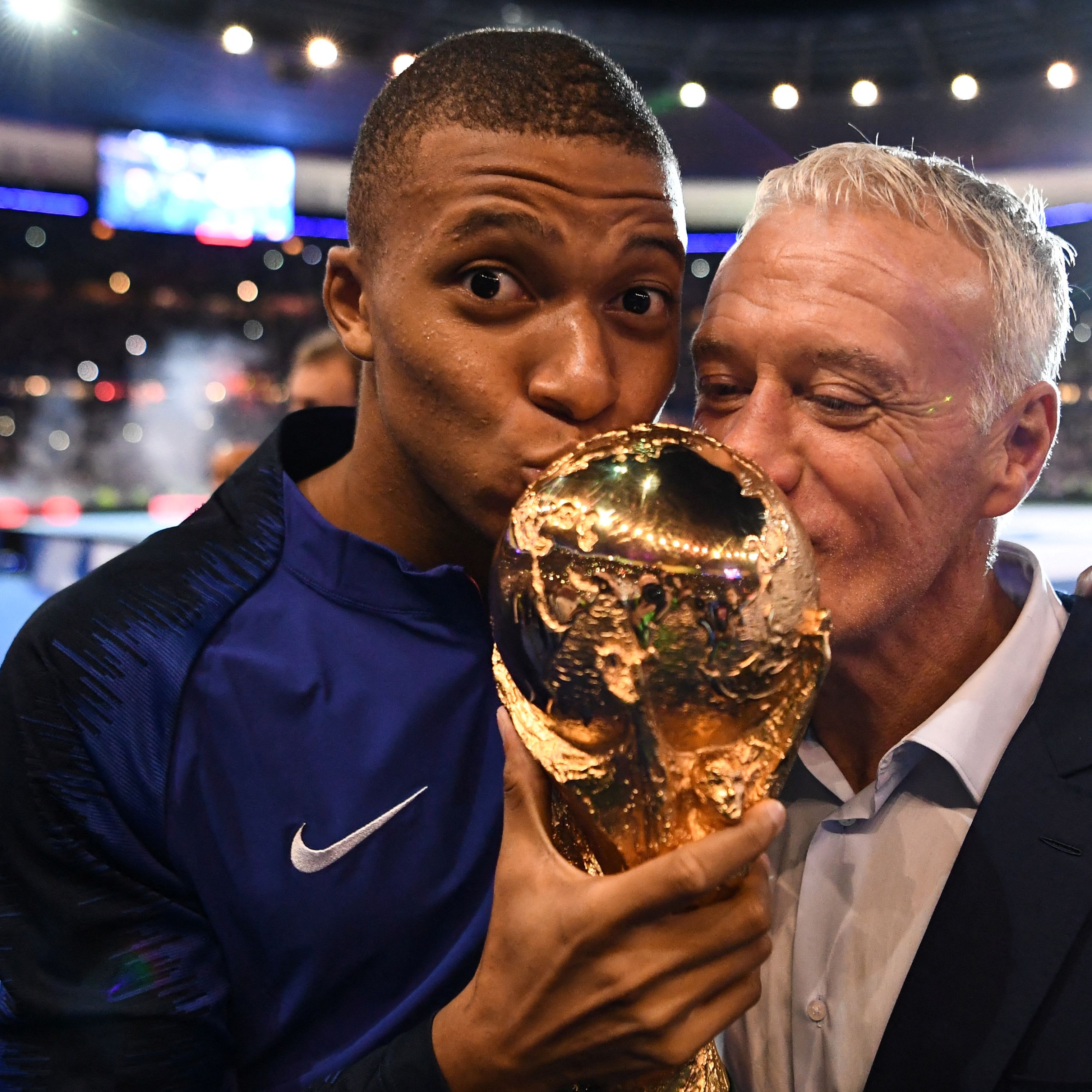
  • Mbappé Deschamps 2018 World Cup Getty Images

    Deschamps leaves behind a ready-made team, but also a heavy legacy

    Rarely does a new manager begin his mission with a national team that possesses this level of quality and stability. Over 14 years, Deschamps did not merely create a golden generation. He established a competitive culture that has become part of the French national team's character.

    He won the 2018 World Cup title, reached the final of Euro 2016 and the 2022 World Cup final, then the semi-final of the 2026 World Cup, a record that keeps France ever-present in the latter stages of major tournaments.

    The true value of what Deschamps has left behind does not lie in the titles alone. It lies in building a system capable of competing regardless of how the names change.

    Since the retirement of Ribéry and Benzema at different periods, through the emergence of Mbappé, then the rise of a whole generation of Camavinga, Tchouaméni and Olise, the national team has maintained its balance.

    Here begins the real challenge facing Zidane. He does not inherit a team in need of rebuilding, but a team accustomed to competing for every title.

  • Advertisement
  • GOAL ITALY Deschamps FranciaGetty GOAL

    The realism school VS the flexibility school

    Deschamps has taken plenty of flak for his "pragmatic" style. Time and again, though, he has shown that tournament football is a different beast from the league game.

    The former France manager built everything on three constant pillars: "an organised defensive block that reduces the spaces between the lines, quick transition from defence to attack, and exploiting individual quality in the final third".

    France never chased the ball. They chased control of the match. In many of the biggest games Deschamps handed possession to the opponent and took control of the spaces and the tempo in return, a trait that showed clearly against Argentina, Belgium, Germany and England across different tournaments.

    The approach handed the national team huge defensive stability. Yet it sometimes stopped them from squeezing everything out of the attacking riches at their disposal.

    If Deschamps belongs to the school of discipline, Zidane belongs to the school of flexibility. One of the most common myths about the French manager is that he leans on a fixed style of play.

    In truth, Zidane tied himself to principles rather than a formation. Across his two spells with Real Madrid he played 4-3-3, 4-4-2 and 4-2-3-1 without the team ever losing its identity.

    Four main elements shaped his philosophy: "controlling the midfield, giving players the freedom to make decisions, changing the tactical formation according to the opponent, and managing matches rather than imposing a single style".

    That is why many analysts have branded him "a coach who adapts to his players, not a coach who forces his players to adapt to him".

  • FBL-EUR-C1-DORTMUND-REAL MADRIDAFP

    What could Zidane bring from Real Madrid to France?

    Zidane's success with Real Madrid was not built on theoretical ideas alone, but on applying them practically against the strongest teams in Europe.

    First: flexibility of the tactical set-up

    Zidane's changes to the style of play never betrayed an absence of identity. They showed a man with multiple solutions.

    Expect him to lean on more than one system with France inside a single match, shaped by the opponent and the state of the scoreline.

    Second: control of midfield

    If Kroos, Modric and Casemiro were the key to Real Madrid's success, France today boast players capable of performing similar roles.

    Aurelien Tchouameni gives the team defensive balance. Eduardo Camavinga provides the ability to break the press and transition with the ball.

    Michael Olise, meanwhile, can play the roaming playmaker between the lines. That variety hands Zidane options many international coaches never had.

    Third: managing the stars

    This was perhaps Zidane's greatest strength in Madrid. He was not the best tactical coach in the world, but he ranked among the best at managing big personalities.

    Somehow he kept the harmony in a dressing room that housed Ronaldo, Ramos, Modric, Marcelo, Benzema, Kroos and Bale.

    France will demand the same, packed as they are with stars of great standing.

  • ENJOYED THIS STORY?

    Add GOAL.com as a preferred source on Google to see more of our reporting

    Add as preferred source on Google
  • Real Madrid Unveils New Signing Kylian MbappeGetty Images Sport

    The "new Ronaldo" project

    One player stands to see his role transformed by Zidane's arrival above all others: Kylian Mbappé. Deschamps deployed the France captain as a winger or a forward with defensive duties to fulfil.

    Zidane looks set to hand him far greater attacking freedom. Think back to how Cristiano Ronaldo operated at Real Madrid.

    Ronaldo was never tied to a single position. He drifted constantly between central and wide areas, arriving in scoring zones at just the right moment.

    Expect Zidane to grant Mbappé that same licence while cutting his defensive workload, preserving his energy for finishing inside the box.

    The upside is more goals. The trade-off is heavier defensive responsibility for the midfielders and wingers tasked with covering behind him.

  • FBL-FRA-ZIDANE-FFFAFP

    Does a prolonged absence represent a risk?

    All of Zidane's successes came with Real Madrid. The French national team represents an entirely different challenge. At club level, a coach works with his players every day. Managing a national side means training camps that last no more than a few days every few months.

    Complex tactical detail matters less than clarity of ideas and ease of implementation. An international coach cannot buy the players he needs either. He must build his system around the elements available to him. Zidane's success will hinge on how well he can simplify his philosophy without losing it.

    Consider, too, that Zidane stepped away from coaching for almost five years. Football changed noticeably in that time. High pressing grew more intense. Data and digital analysis became essential to decision-making, and the methods of building play developed significantly.

    This absence raises a legitimate question: can Zidane still keep pace with the developments? The answer will not come in his first press conference. It will show in the details on the pitch.

    History, though, grants the French coach an important advantage. During his time with Real Madrid, he proved he does not rely on a single style. He is adept at evolving and adapting to different circumstances.

  • FBL-FRA-ZIDANE-FFFAFP

    A start that leaves no room for mistakes: so will the identity change?

    Zidane will play his first official tests against Turkey, then Belgium, then Italy. Three matches that will quickly determine the shape of the new project.

    The French national team does not grant its coaches the luxury of time. Nor does the French media treat Zidane as a novice coach, but rather as a legend from whom success is expected from day one.

    Any early stumble will immediately revive the comparisons with Deschamps, while a strong start could give the project enormous momentum.

    A complete tactical revolution looks unlikely. The most realistic scenario is that Zidane retains the most important thing Deschamps left behind, namely defensive discipline, while adding elements the team has lacked in recent years, such as effective possession, tactical flexibility, and greater freedom for the attacking talents.

    In other words, we may see a team that keeps its solidity but becomes more capable of imposing its personality, rather than settling for reacting.

    Zinedine Zidane does not begin his project with the French national team from scratch, but from a summit built by Didier Deschamps over 14 years.

    Success will depend on his ability to achieve a rare equation in modern football: respecting the legacy without falling captive to the past, and presenting a new identity without sacrificing stability.

    Combine his tactical flexibility, his experience in managing stars, and the mental toughness he acquired during his years at Real Madrid, and the French national team could enter a new era no less successful than the Deschamps period, and perhaps more convincing at the technical level.