
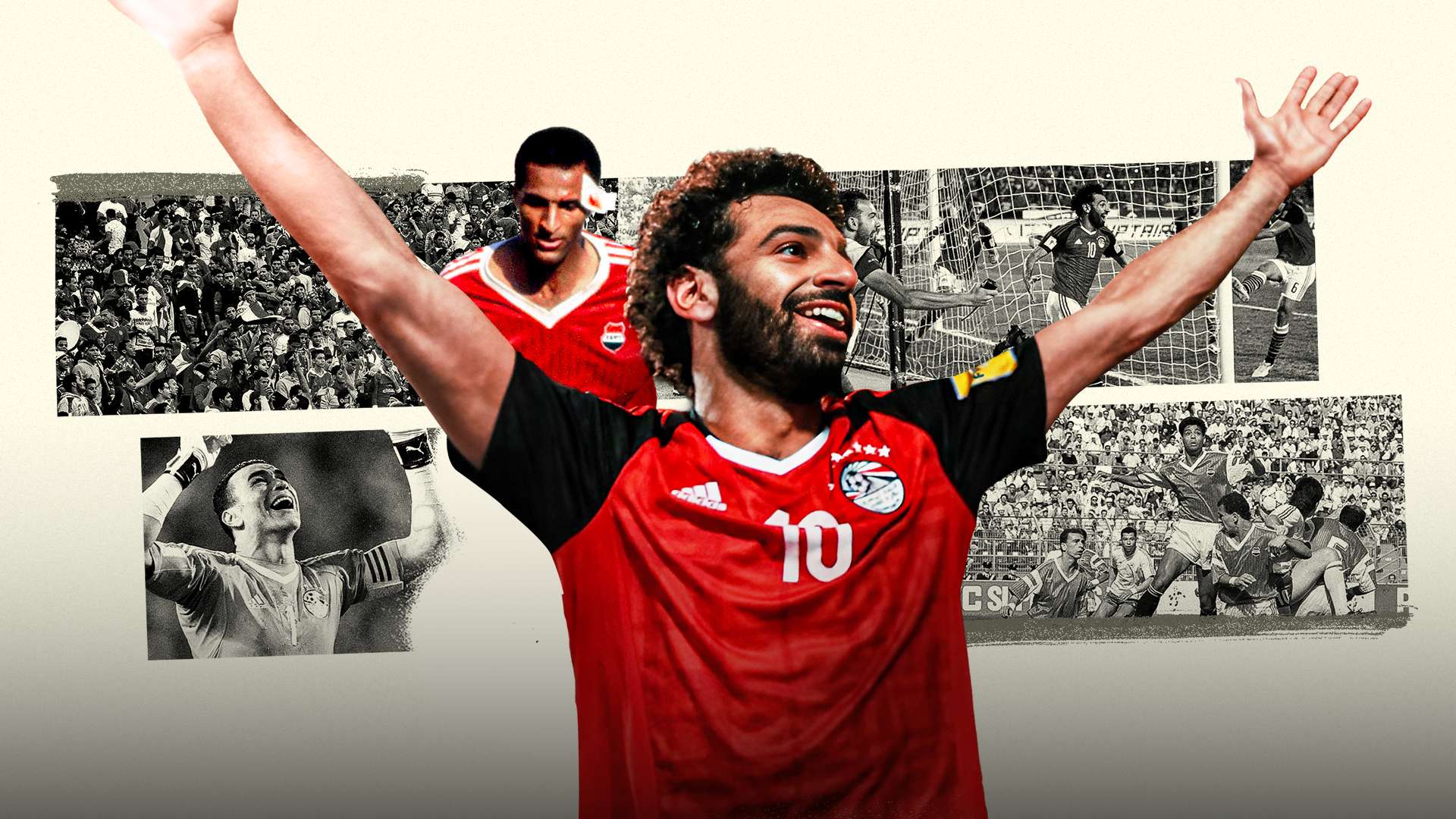
From the first cry of joy in Rome in 1934, to the last tear that fell in Russia in 2018, from the dusty pitches of Cairo’s streets to the floodlights of the world’s grandest arenas; this is Egypt’s World Cup story...
 Getty/GOAL
LEGACY: Egypt's pursuit of an endless World Cup dream
 Getty Images
Back where they belong
After that first cry came a long silence. Wars erupted, and the sound of guns drowned out those of the game. While the nation was busy rebuilding itself, Egyptians followed the World Cup solely via newspapers.
Generations of players kept emerging - Saleh Selim, Taha Ismail, Hassan Shehata and Mahmoud El Khatib among them - and in Africa, Egypt were champions. But the World Cup remained distant, like a star you could see but never reach.
But in 1990, after 56 years of absence, the Pharaohs finally returned to the World Cup. Under the captaincy of Mahmoud El Gohary, Egypt wrote a new chapter in its sporting history.
The qualifiers were tough, but the goal Hossam Hassan scored against Algeria allowed the team to break through its glass ceiling. That November night, when the streets overflowed with people, flags waved from every balcony, and chants filled the sky, was unforgettable.
In June 1990, Egypt returned to Italy - specifically Palermo - to face down the European champions, the Netherlands. The first half ended goalless, but in the 58th minute, Wim Jonk scored for the Dutch after a cross from the great Marco van Basten. But then came the unforgettable 83rd minute, when Hossam Hassan was pulled down inside the box, and the referee pointed to the spot.
Magdy Abdelghany stepped up, took a breath, and struck hard… Goal! The commentator screamed, “Goal for Egypt!” Years later, that moment would become both a point of pride and humour, as Abdelghany continued to remind fans of it in every interview, almost as if it were Egypt’s only footballing achievement.
But at that moment, it was more than a goal; it was a bridge from the past, from Fawzi to Abdelghany, from one generation to another. The match ended 1-1, but in Egyptian hearts, it felt like victory.
 Getty Images
'The wall of Palermo'
In their second match, Egypt faced Ireland. The game was full of tension, sweat, and shouting, but the Egyptian defence stood firm, goalkeeper Ahmed Shobeir saving every ball as if his life depended on it.
This match lives in infamy thanks to Shobeir's deliberate and provocative time-wasting tactics. Many football fans around the world linked what the Egypt goalkeeper did in this match to FIFA's subsequent introduction of the back-pass rule. In any case, the match ended in a goalless draw, though it felt like a victory.
The world began to ask, ‘Who are these Africans fighting like lions?’, while the media dubbed them ‘The solid Egyptian team’.
Then came England, a tough match where Egypt were under constant pressure, and resulted in a narrow 1-0 loss. But the team did not reflect on it as a defeat. As El Gohary put it, “We’ve planted the seed today… Someone will harvest it tomorrow.”
 AFP
AFPAnother long absence
But then, silence again. Years of failed attempts, of near misses in qualifiers. Egypt continued to rule Africa with numerous Cup of Nations triumphs, but the World Cup door stayed shut.
Generations passed, but the gate never opened. In 2010, they were so close, losing a play-off against Algeria in Sudan. The entire nation wept, but Egypt’s dream didn’t die - it just waited for a new hero to rekindle it...
 Getty Images
The boy who revived the dream
Mohamed Salah. A boy from the small village of Nagrig, carrying the dreams of millions. From Al Mokawloon to Basel, Chelsea to Fiorentina, Roma to Liverpool, every match meant something, every goal told a story.
In the 2018 World Cup qualifiers, Salah was the hero. His goals revived hope; his magic made people believe again. And on one unforgettable night in the Borg El Arab Stadium, Salah turned that belief into reality
Heading into stoppage time, Egypt were locked at 1-1 with Congo. Commentator Medhat Shalaby’s voice rose with every attack: “Give us something, ya akhi!” Then, in the 94th minute, Trezeguet was fouled. Penalty! Shalaby screamed: “Allahu Akbar!”
Salah picked up the ball, placed it on the spot, smiled faintly, and scored. The stadium erupted, the noise shaking Alexandria. People flooded the streets as children cried from joy. After 28 years away, Egypt were going back to the World Cup.
 AFP
AFPPain in Kyiv
One month out from kick-off in Russia, Ukraine’s capital, Kyiv, lit up for football’s greatest night: Real Madrid vs Liverpool in the Champions League final. All eyes were on Salah, his ‘Egyptian King’ chant heard throughout the city ahead of kick-off. Cameras followed him while commentators praised his record-breaking Premier League season. This was to be his night.
Then, in one moment midway through the first half, everything fell apart. A tangle with Sergio Ramos left Salah on the ground, clutching his shoulder, grimacing in pain. He couldn’t get up. His face turned from agony to tears as he was substituted.
In Cairo, there was silence. In cafes, screens were frozen, mouths open in disbelief. Children who had danced minutes earlier now sat still. It was as if all of Egypt fell with Salah.
Weeks later, Salah returned, injured but unbroken, to play in the World Cup, telling the world: “Bodies may fall… But dreams never do.”
 Getty Images Sport
Miserable return
At Russia 2018, the Pharaohs were back after 28 years. But things did not get off to the best start.
Salah and his sore shoulder were only on the bench as Egypt began their campaign against Uruguay. Despite that, they defended stoically, fought hard and looked likeliest to win until falling behind in the 89th minute. The spirit shown, however, suggested this would not come to define their tournament
'When Salah returns, everything will change,' was a common refrain ahead of Egypt’s second match, against the hosts. Salah was named to the starting line up, and stood smiling ahead of kick-off. His body, though, was still hurting.
Egypt’s icon scored from the penalty spot in Saint Petersburg, but the team were already three goals in arrears at that stage. Their tournament was over with a game to spare.
Salah scored again in Egypt’s final group match, against Saudi Arabia, but defeat arrived all the same. The Pharoahs were sent home with no points to show for their efforts.
 AFP
AFPFresh disappointments
After Russia, Egypt’s football story entered its hardest chapter. The same generation of players returned home to host AFCON 2019 with hopes sky-high. But joy was postponed, as Egypt crashed out in the last 16 against South Africa in an exit that stunned millions.
Two years later, in Cameroon 2021, in difficult conditions, Egypt fought again. Their performances weren’t the best, but the spirit was different. Salah led a team that played with heart, as the Pharoahs bounced back from losing to Nigeria in their opening match to knock out the Ivory Coast, Morocco and Cameroon on the way to reaching the final against Senegal.
For the third time in the tournament, Egypt were taken to penalties. This time, though, Salah never got to take his kick, the shootout settled in Senegal’s favour before he could step up to the spot.
Weeks later, the same two teams met again, this time with World Cup qualification for 2022 on the line. Again, the tie went to penalties. This time, though, Salah would get his opportunity. He looked calm and confident amid the lasers that flashed across his face from the stands. But when he struck the ball, it soared over the crossbar and into the night’s sky.
Egypt froze in disbelief. The dream of another World Cup vanished in a single heartbeat. But even then, faith remained, because dreams built over a century don’t fall in one night.
 Getty Images
New chapter
Then came the 2026 qualifiers. This time, though, Salah was not alone. Around him was a new generation who had grown up watching him rise, fall, and rise again. They saw him not as a superstar, but as an older brother.
The team’s spirit had changed, too. From the first match against Djibouti, it was clear that something was different. Egypt were organised, hungry and united. Salah was still scoring, but he had Omar Marmoush and Ahmed Sayed, AKA Zizo, dazzling alongside him.
Coach Hossam Hassan paced the touchline, shouting passionately: “Press! Don’t back down!” He wasn’t just coaching, however - he was living every moment. Hassan restored a long-lost identity. The fear was gone, as young players who once watched Salah on television were now passing him the ball on the pitch.
Match after match, Egypt remained unbeaten. Of their 10 qualifiers, they won eight while drawing the other two to top their group with calm confidence. At full-time of the final qualifier, Hossam smiled quietly from the touchline. The first mission was complete. The players, meanwhile, celebrated modestly, as if saying, ‘The real work starts now’.
And now, all eyes turn to the World Cup. Hassan is already planning, and Salah has promised the fans: “This time, it won’t just be about taking part.”
ENJOYED THIS STORY?
Add GOAL.com as a preferred source on Google to see more of our reporting