
+18 | Play Responsibly | T&C's Apply | Commercial Content | Publishing Principles
Guatemala v Canada - Gold Cup 2025: QuarterfinalsGetty Images Sport

From 'Maplepressing' to being a mentor and sometimes agent - The 101 on Jesse Marsch and look inside the American coach's vision for Canada at World Cup

For as intense as his soccer can be, Jesse Marsch is a calm man. Canada’s head coach for the 2026 World Cup, the first men’s World Cup on home soil, Marsch has instilled belief and a style of play within his team unlike ever before.

His soccer is ferocious, demanding, fast and punishing, while also remaining defensively sound. Yet, as much as controlled chaos defines his tactical outlook, his personality away from the pitch could not be calmer.

When he isn't coaching the national team, the 52-year-old lives near Pisa, Italy, where he, his wife, Kim, and their three children have settled after soccer and a passion for travel brought them around the world throughout the 2010s.

He spends time in Canada and, of course, has other stressors like anyone else. Kim is nearing the end of five years of breast cancer treatment and could enter remission as soon as this summer. Still, gardening helps ground him outside of soccer and other pressures.

In many ways, that calmness manifests itself in his role with Canada. His passion for life reflects in his coaching, while the mindful approach needed to grow a garden mirrors his interactions with players. That same meticulousness also reflects the demands he places on them.

All of that will be on display this summer. His brash personality and measured approach, which can sometimes get him into hot water, will be under an even brighter spotlight as Canada prepare to co-host a World Cup, especially after he signed a contract extension through 2030 ahead of the tournament.

Here, GOAL dives deeper into Marsch as a man, coach, agent, and mentor, while also examining expectations for this summer and beyond.
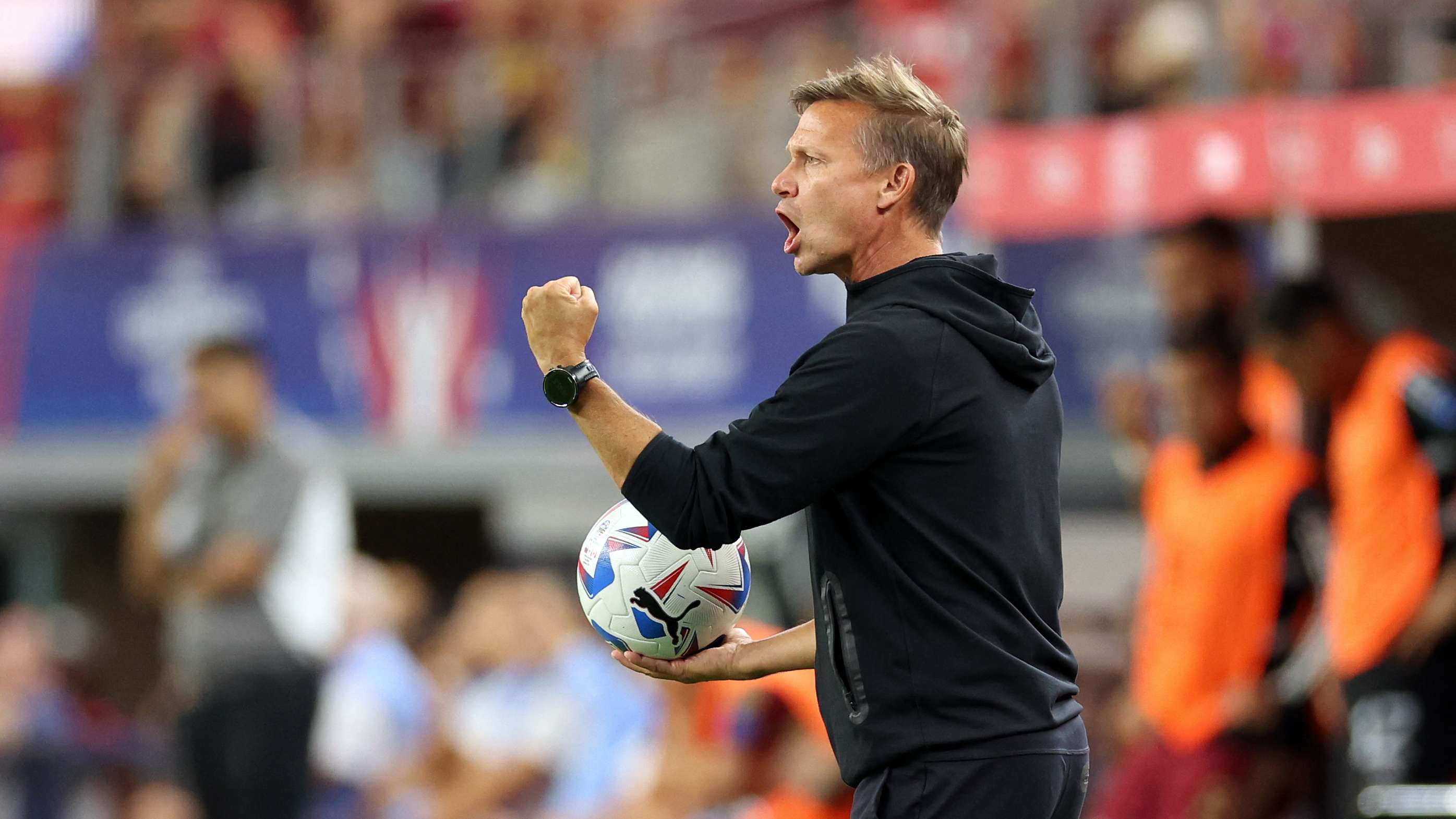
  • FBL-COPA AMERICA-2024-VEN-CANAFP

    The American coach who became a Canadian soccer icon

    Marsch might not be Canadian, but you could be fooled by the way he flips between English and broken French in press conferences and the way he speaks about his experiences, both as national team manager and previously as CF Montreal’s first MLS head coach.

    His approach has endeared him to the Canadian public, with no moment standing out more than when he defended Canada’s sovereignty during a February 2025 press conference ahead of the Concacaf Gold Cup, amid President Trump’s threats to annex Canada as the United States’ 51st state.

    “As an American, I'm ashamed of the arrogance and disregard that we've shown one of our historically oldest, strongest and most loyal allies," Marsch said at the time, capturing global headlines. "With Canada, I’ve found a place that embodies for me the ideals and morals of what not just football and a team is, but what life is, and that's integrity, respect and the belief that good people can do great things together."

    Afterward, he added that he “couldn’t be prouder” to be Canada’s manager and that he was proud to lead a group from so many backgrounds, with many on the national team being first- or second-generation immigrants embraced by Canadian soccer and society.

    Those words elevated his national reputation after he led Canada to the 2024 Copa América semifinal in his first months at the helm, supercharging the passion he would later lean on while guiding the team toward the 2026 World Cup.

  • Advertisement
  • FBL-COPA AMERICA-2024-ARG-CANAFP

    Intensity and 'maplepressing'

    Marsch is as personable as they come, but he also knows how to run a brutal training session.

    It’s commonplace for Canadian players to admit that Marsch’s sessions are harder than their club practices, with the manager pushing tempo and intensity to foster an energetic style of play.

    When he took over, the approach was first known as Red Bull soccer, defined by a high-pressure, high-intensity style built to capitalize on opponents and force defensive mistakes.

    Since then, it has evolved into the 'Maplepress', Canada’s standout 4-4-2 system, which relies heavily on transitional moments in attack and shifts into a narrower defensive shape out of possession, all tied together by a skilled box-to-box midfield double pivot.

    It’s the Red Bull press with some maple syrup mixed in. In some ways, it can be chaotic. Imagine a Jägerbomb and maple syrup crossover. That’s how Canada play under Marsch.

    In this tactical setup, Canada can defend in two solid blocks of four, with those blocks wide enough to clog the wings while remaining compact centrally to prevent the field from being stretched.

    In midfield, that places significant responsibility on the double-pivot duo of Stephen Eustàquio and Ismael Koné, two of Canada’s best box-to-box midfielders, while also demanding intense pressing from wingers Ali Ahmed and Tajon Buchanan. Up top, the system suits Jonathan David well, while Cyle Larin and Promise David trail Tani Oluwaseyi in pressing ability, despite offering a more significant goal threat recently.

    This relentless pressure can wear players down, making fitness a major factor in team selection. It can also limit Canada’s scoring opportunities when opposing teams clog the midfield blocks, preventing Canada from creating chances in dangerous areas, a concern heading into this summer.

    With a system that thrives in transition, the 'Maplepress' gives Canada the balance needed to compete with some of the world’s best teams. In Marsch’s first few months, that translated into strong performances against the Netherlands, France and Argentina, along with a run to the Copa América semifinal. More recent highlights include a dominant 3-0 win over Romania in September and a scoreless draw with Colombia in November.

    Those demands will not change at the World Cup, even with injury concerns surrounding Alphonso Davies and other key players, along with the demanding climates.

    GOAL asked Marsch whether there would be any change to that approach this summer.

    “Are you crazy?” he said, as this writer sank back in his chair. “Our team is clear. Every player, every player is clear what we do, how we do it, and we’re going to be us.”

  • Venezuela v Canada - CONMEBOL Copa America USA 2024Getty Images Sport

    Marsch, the mentor

    Marsch is methodical. He’s a teacher, a father and a former player. To him, the process and approach are just as important as the final product. While he realizes he cannot hand modern young players a full book to read, he has selected more than 50 passages to reinforce certain messages with his players.

    Liverpool’s Dominik Szoboszlai was one of his first subjects. Marsch hoped to open Szoboszlai’s mind to new ideas and purposeful learning during their time together at Red Bull Salzburg. It took time, but Szoboszlai eventually adjusted after initially questioning the purpose of the passages, and that approach has since influenced both the player’s development and Canada’s squad culture.

  • ENJOYED THIS STORY?

    Add GOAL.com as a preferred source on Google to see more of our reporting

  • Jesse Marsch New York Red BullsGetty

    Marsch’s personal touch

    As much as the methodical approach has worked from a soccer perspective, Marsch has also opened his doors to players during some of the toughest moments of their lives. For winger Liam Millar, that support proved pivotal when the manager invited him and his family to Italy for a period of rest while he dealt with depression during lengthy injury recoveries in 2024 and 2025.

    Millar relaxed while his wife and children spent time at the pool and in the garden, allowing the family an opportunity to reconnect. Few coaches would step up in that way, but Marsch’s initiative played a critical role in Millar’s journey back toward the World Cup, as well as his prominent role during Hull City’s 2025-26 EFL Championship campaign, which ended in Premier League promotion.

    “Jesse was amazing with me. The second my (2024 ACL) injury happened, he called me and told me he'll do everything in his power to make sure I get everything right with the best doctor, the best everything,” Millar told GOAL in March. “He invited my family to his house, and obviously, I’m not going to turn down his invitation, so we went to his house with my kids and my family and had exactly what we needed.

    “We were on his beautiful estate in the mountains. Things can be so chaotic, but we went for dinner, he was great with my kids, and it gave me a good perspective on the team, on myself and everything.”

    Millar will likely be a role player off the bench at the World Cup, but he is one of several players to benefit from Marsch’s personable approach. Beyond Millar, the likes of Cyle Larin, Ali Ahmed, Ismaël Koné and several others have benefited from Marsch helping them find the best possible club situations to elevate their personal and sporting prospects.

    “I’ve enjoyed this work; it’s been busy... Maybe I should have become an agent instead of a football coach, but this is something that I care about. I want to see these guys put themselves in situations to succeed,” Marsch said in January, when Larin and Ahmed moved to the English Championship. “Most of our guys now are really conscious about making calculated decisions on what’s best for their career.”

  • FBL-COPA AMERICA-2024-ARG-CANAFP

    World Cup expectations

    The expectations for Marsch’s Canada vary widely ahead of the 2026 World Cup. For hardcore supporters tuned into the injury-riddled but talented squad, reaching the round of 16 seems like a realistic possibility. At the same time, casual fans see a country that has lost all six of its previous men’s World Cup matches and may not expect anything different.

    The reality likely falls somewhere in the middle, which is also where Marsch’s expectations appear to stand.

    With the progress and tactical identity he has instilled, combined with the talent and recovery timelines of key players, the knockout stage should be the goal. That likely means securing four points, a realistic target given Canada’s group-stage opponents. Winning the group and remaining in Vancouver for the knockout rounds would exceed expectations, but so would advancing to the round of 32 or round of 16 regardless of location.

  • Jesse Marsch, CanadaImagn

    The future is set

    Marsch’s future appears set. He is Canada’s head coach through the 2030 World Cup cycle after signing a deal before the tournament to remain in the role for another cycle. While it was bold for Canada to offer him a new contract before the World Cup, the agreement had been in the works for months and reflects confidence in his approach and progress beyond simply this summer’s results.

    Over the past two years, Marsch has helped transform Canadian soccer at multiple levels and is expected to continue doing so as player pathways expand through the Canadian Premier League and other avenues, creating more talent for him to work with.

    Regardless of the World Cup outcome, Marsch and Canada appear mutually beneficial, and he now has significant influence over the program’s future direction.

    Will he coach club soccer again? At 52 and still brimming with infectious energy, it remains possible. So does the possibility that he finishes his coaching career with Canada. As for the USMNT head coaching role he once seemed destined for, that no longer appears likely.

    “I believe Canada has tremendous potential with this generation of players and look forward to seeing the development of soccer across the country,” Marsch said. “I’m thrilled to make a longer-term commitment here, helping develop this program for years and continuing to push this group to the highest level.”