+18 | Play Responsibly | T&C's Apply | Commercial Content | Publishing Principles
World Cup GOAT GFXGetty/GOAL

Lionel Messi, Pele and the top 10 World Cup players in tournament history - ranked

But who are the best of the best, the cream of the World Cup crop? Which players have illuminated the game's grandest stage like no other? We're talking about the iconic figures that have left an indelible mark on not just one World Cup - but multiple editions.

Below, GOAL attempts the impossible by ranking the top 10 players in the tournament's history, a task so tough that even now we're still wondering whether we were really in our right minds to leave out the likes of Garrincha, Vava, Jairzinho, Romario, Paolo Rossi, Paolo Maldini, Lothar Matthaus, Uwe Seeler, Michel Platini, Bobby Moore, Johan Cruyff and Mario Kempes!...

  • TOPSHOT-FBL-WC-2014-MATCH64-GER-ARGAFP

    10Miroslav Klose (Germany)

    Is Miroslav Klose one of the very best players of all time? No, absolutely not. At club level, Klose was always a very good forward, but never really a great one - even if he's something of a legend at Lazio.

    At international level, though, Klose was a different beast, an unselfish striker who still scored freely. Indeed, the German scored 71 times in 137 appearances for his country. Remarkably, 16 of those goals arrived at World Cup finals, which saw the 2006 Golden Boot winer usurp Ronaldo as the tournament's all-time leading goalscorer at Brazil 2014.

    Rather fittingly, Klose took outright possession of the record in Germany's sensational 7-1 demolition of the Selecao in Belo Horizonte - on the same evening he became the first man to play in four consecutive World Cup semi-finals.

    In terms of consistency, Klose really was something else, and he couldn't have hoped for a better end to his remarkable international career, as he bowed out after helping his country beat Argentina in the 2014 final.

    Obviously, his historic tally has now been equalled by Lionel Messi - but he has no issue with that, as he describes himself as a "big fan" of the Argentine "genius".

    Still, while Klose was never in that class of player, he was, as Gary Lineker pointed out, incredible in the air (he scored five headed goals in the 2002 World Cup alone!) and a supreme "poacher" who nearly always delivered for his country. Indeed, Germany never lost a game in which Klose scored!

  • Advertisement
  • CUP-FR98-BRA-FRA-ZIDANE-DJORKAEFF-2AFP

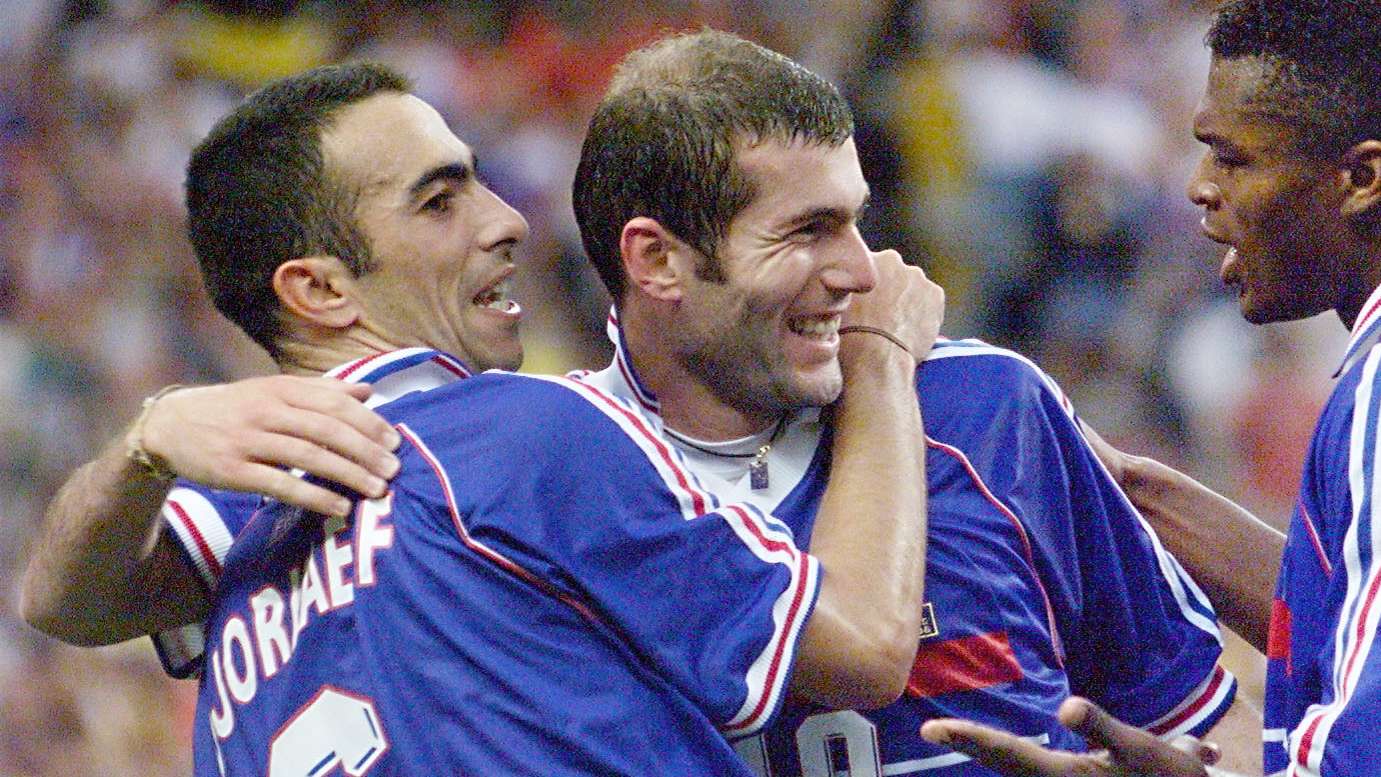
    9Zinedine Zidane (France)

    One of the most compelling characters in football history, Zinedine Zidane was as elegant as he was volatile, the quintessential flawed genius. Nowhere was this duality better demonstrated than at the World Cup.

    Zidane's finals debut in 1998 was every nearly brought to a premature end by a senseless red card in the group stage for stamping on Saudi Arabia's Fuad Anwar, but France made it to the quarter-finals without him and the attacking midfielder went on to effectively win the World Cup for the hosts by netting twice in the shock final rout of Brazil.

    Les Bleus' sensationally fell at first hurdle four years later in Japan and South Korea, and Zidane had to be talked out of international retirement to participate in his country's 2006 campaign.

    "What I am going to say may sound over the top, but it's the truth: God exists and he has returned to the France team," Thierry Henry enthused ahead of the tournament in Germany.

    Zidane's performances were certainly divine, but after leading France to the final with one show of his effortless excellence after another, the red mist descended upon him again in Berlin, where he was sent off for arguably the most famous headbutt in human history, on Marco Materazzi, who insulted the Frenchman's sister.

    Zidane later explained, "My passion, temper and blood made me react." But his vision, finesse and decisiveness made him a deserving winner of the tournament's Golden Ball.

  • KYLIAN MBAPPE FRANCEGetty Images

    8Kylian Mbappe (France)

    Kylian Mbappe has never won the Champions League or the Ballon d'Or, and he's still only 27 years of age. However, the French forward's status as a World Cup legend is already beyond dispute.

    At his first finals in Russia in 2018, Mbappe was named Young Player of the Tournament after scoring four times during France's triumph, including once in the final, thus becoming the first teenager to do so since Pele in 1958. "Welcome to the club," the Brazil icon wrote on social media. "It's great to have some company."

    Four years later, Mbappe joined another exclusive club, previously the sole reserve of Geoff Hurst, by scoring just the second hat-trick in a World Cup final. It wasn't enough to claim a second consecutive title, but it did earn Mbappe the Golden Boot and take his overall tally in finals alone to four - more than any other player in the tournament's history.

    Having now kicked off his third campaign with a double against Senegal, Mbappe has moved to joint-fourth on the all-time scorers' list after netting 14 goals in just 15 appearances at the finals, meaning he's almost certain to break that record, too, sooner rather than later.

  • ENJOYED THIS STORY?

    Add GOAL.com as a preferred source on Google to see more of our reporting

  • SOCCER-WORLD CUP 74-WEST GERMANY-NETHERLANDSAFP

    7Gerd Muller (Germany)

    Gerd Muller was simply the greatest goal-poacher the game has ever seen. The Bayern Munich legend was lightning-quick over the first five yards and, despite being short and stocky, he was incredible in the air.

    More importantly than anything else, though, Muller had the keenest of goal-scoring instincts, making him the ultimate penalty-box predator. Indeed, Franz Beckenbauer admitted that he was glad he spent almost his entire club and international career playing alongside Muller, rather than against him, because even he could never contain his compatriot in training.

    Muller had a ridiculous strike-rate for Germany (69 goals in 62 games) and what's remarkable is that he was just as prolific in the World Cup.

    In 13 appearances across two tournaments, the squat striker scored 14 times, including the winner in the 1974 final against the Netherlands, as Germany triumphed on home soil.

    "I've scored better goals," Muller admitted later, "but the most important was the one that made us world champions." And sealed his status as a World Cup icon.

  • WC2002-GER-BRA-CAFU CUP-KISSAFP

    6Cafu (Brazil)

    In Italy, Cafu became known as 'Il Pendolino' (a high-speed train), which was just the perfect moniker for a right-back who seemed to spend the entire 90 minutes of every game going up and down the sideline. Sir Alex Ferguson even once joked that the Brazilian must have had two hearts to be able to sustain his remarkable work-rate.

    Cafu was certainly a freak of nature, and a source of inspiration to an entire generation of right-backs, who sought to emulate his remarkable ability to effectively serve as an additional winger while never neglecting his defensive duties.

    The seemingly indefatigable and universally liked Cafu went to four World Cups in total - and played in a record three finals. He didn't actually start the 1994 decider, but came off the bench early on following an injury to Jorginho and played his part in Brazil keeping a clean sheet that led their penalty shootout win over Italy.

    However, by the time France '98 rolled around, Cafu was widely regarded as the best attacking right-back in the world, and although the Selecao were beaten in the final by the hosts, Cafu claimed his second World Cup - and his first as captain - after Brazil beat Germany 2-0 in Yokohama.

    It was the crowning moment of Cafu's career and, in one of the most memorable images in the tournament's history, he towered above everyone else as he lifted the trophy while standing perilously on top of the podium and thought to himself "Mission: accomplished".

  • FOOTBALL-WORLD CUP-GERMANYAFP

    5Franz Beckenbauer (Germany)

    Glenn Hoddle once said that "the mark of a great player is the ability to be just as effective playing through different eras". He was talking about Franz Beckenbauer, who played in three consecutive World Cups at a time when the game was undergoing great change - and shone in all three tournaments because he was at the forefront of that change.

    'Der Kaiser' was the multi-talented midfielder who was moved into defence and if not invented the role of the sweeper, then became its greatest exponent.

    Beckenbauer played a pivotal role in West Germany finishing as runners-up at the 1966 World Cup, scoring four times on the way to the final, and was also on target in a famous win over England in Mexico four years later. However, his campaign is best remembered for the fact that he finished 'The Game of the Century' with his dislocated arm in a sling because he refused to leave the field afterGermany had already made their two allocated substitutions during their epic semi-final loss to Italy.

    And so, while neutrals all across the globe were devastated to see Johan Cruyff and the rest of the Netherland's 'Total Footballers' end up on the losing side in the 1974 World Cup final, nobody could argue that Beckenbauer didn't deserve to finally get his hands on the trophy after West Germany's 2-1 win over the Dutch in Munich. He was, as Karl-Heinz Rummenigge put it, "the perfect player", a versatile footballer of both style and substance.

  • Brazilian forward Ronaldo celebrates after scoringAFP

    4Ronaldo (Brazil)

    Why Ronaldo suffered a convulsive fit before the 1998 World Cup final remains a mystery. What we do know, though, is that it would have been a very different game had the Brazil striker been in the right mental and physical state to play in Paris.

    At the time, there was no more feared forward in football. 'O Fenomeno' really lived up to his nickname, he was like nothing we'd ever seen before, a striker blessed with the explosive speed and athleticism of a sprinter, as well as scintillating skills of a winger. Consequently, while he was a shadow of his usual self in Brazil's 3-0 loss to France, Ronaldo was still named the tournament's best player on the back of a string of sensational displays.

    Funnily enough, he missed out on the 2002 Golden Ball, which bizarrely went to Oliver Kahn, but the tournament in South Korea and Japan was all about Ronaldo's redemption, with Brazil's No.9 scoring eight times in seven games, including twice in the final.

    "I'm slowly realising just what happened," the centre-forward said after missing almost four years of relentless injury issues. "My happiness and my emotions are so great that it's difficult to understand. I've said before that my big victory was to play football again, to run again and to score goals again. But this victory, for our fifth world title, has crowned my recovery and the work of the whole team."

  • TOPSHOT-WORLD CUP-1986-ARG-ENGAFP

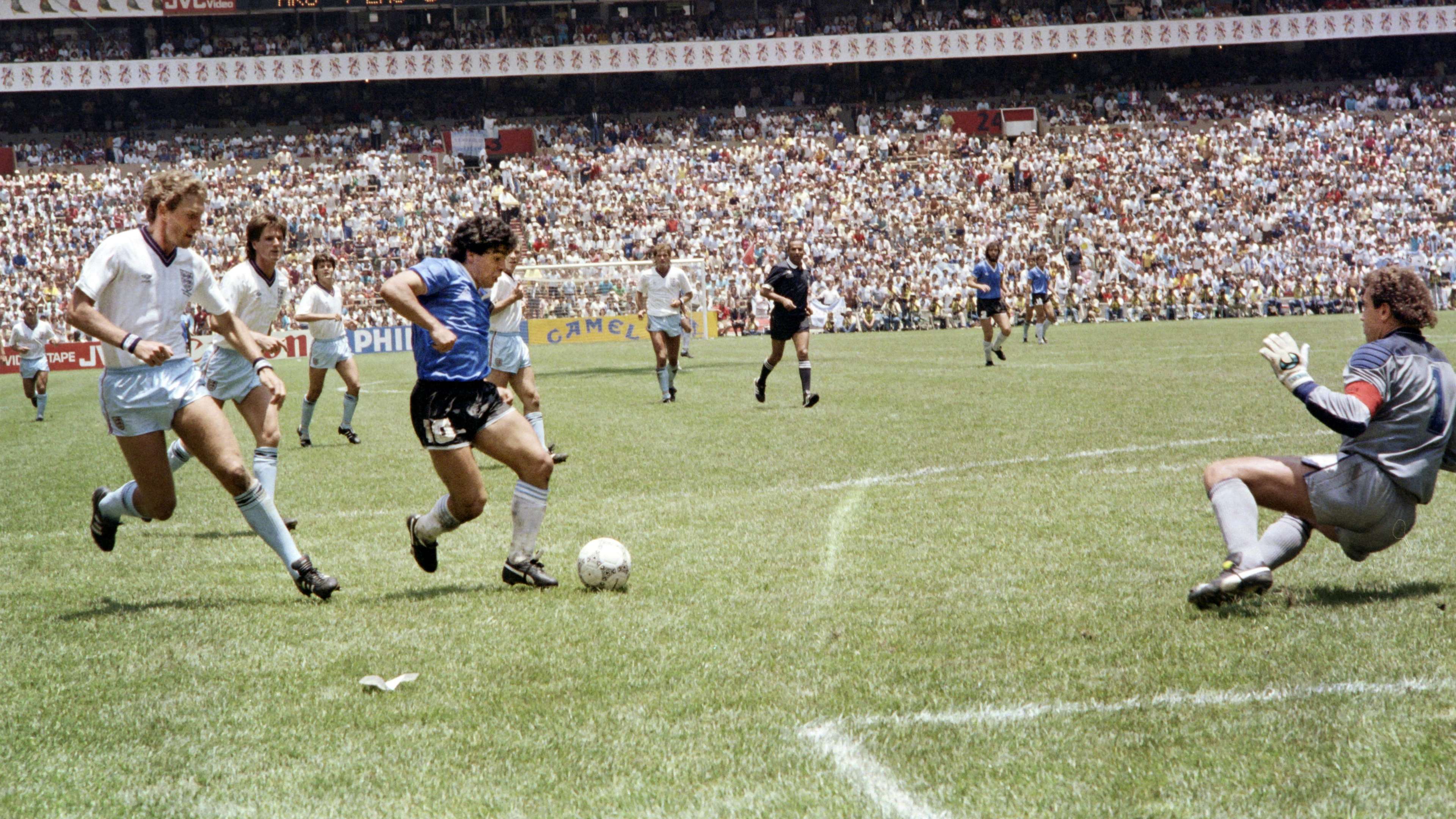
    3Diego Maradona (Argentina)

    Nobody has dominated a World Cup like Diego Maradona in 1986. The most naturally gifted player the game has ever seen was at the peak of his powers and, more importantly than anything else, fully focused on football.

    Maradona, who lived a notoriously hedonistic lifestyle in Naples, spent months getting himself in peak physical condition for Mexico '86, as he looked to make amends for a traumatic campaign in Spain four years previously, when he was sent off in Argentina's final game of the second group stage, against Brazil, after being subjected to one brutal foul after another across his five appearances.

    There was simply no stopping Maradona in Mexico, though. Argentina scored 14 goals on their way to winning their second title - their captain was directly involved in 10 of them. Of course, it was his quarter-final double against England that defined Maradona, who scored one goal with 'The Hand of God' - and another with his own left foot.

    Maradona's World Cup legacy would be later tarnished by failing an anti-doping test at USA '94, and he remains one of the most divisive figures in football. However, his status as a World Cup great simply cannot be questioned. Maradona's entire career was, to paraphrase his former team-mate Jorge Valdano, him against the world, and, in Mexico 1986, he won.

  • FBL-WC-2022-MATCH64-ARG-FRA-TROPHYAFP

    2Lionel Messi (Argentina)

    For more than 15 years, Lionel Messi produced a level of sustained excellence that separated him from other players in football history. However, his status as the greatest of old time continued to be questioned because he'd yet to win a World Cup. Messi had gone close in 2014, when he was presented with the Golden Ball but not the trophy he craved above all others, as Argentina suffered an agonising extra-time loss to Germany in Rio de Janeiro.

    It, thus, seemed as if Messi's window of opportunity had closed after his country's last-16 loss to France at Russia 2018. However, four years later in Qatar, a 35-year-old Messi defied Father Time by producing the greatest individual World Cup campaign since Diego Maradona in 1986.

    After saving Argentina from an embarrassing first-round elimination, he went on to become the first player in history to score in the group stage, last 16, quarter-finals, semi-finals and final. He was also named Player of the Match in every round in the knockout stage, making his second Golden Ball (also a record) a formality.

    Messi was fully expected to walk away from the international arena after effectively completing football in Qatar thanks to Argentina's penalty shootout success over France, but he's returned for a sixth finals appearance and has already moved level with Miroslav Klose at the top of the tournament's all-time scoring list, meaning there's now a very real chance that the game's GOAT could soon climb to the top of this illustrious list.

  • Pele Brazil Italy 1970 World Cup finalGOAL

    1Pele (Brazil)

    Who else could be No.1 - for now, at least - then the man known as 'The King'?! Pele is the only player in history to have been a part of three triumphant World Cup campaigns, and although he only played a minor role in Brazil's World Cup win in 1962 due to injury, he was the star of the show in both 1958 and 1970.

    Pele was just 17 years of age when he lifted the Jules Rimet trophy in Sweden, where he forced his way into the Selecao's starting line-up before exploding in the knockout stage, scoring the winner against Wales in the quarters, a historic hat-trick in the 5-2 defeat of France in the last four, and a brace in the final win over the host nation. Just Fontaine actually won the tournament's Golden Boot, with a record 13 goals, but the France forward later admitted, "When I saw Pele, it made me feel like I should hang up my boots."

    Twelve years later in Mexico, Pele painted his masterpiece, as arguably the finest international team in football history swept all before them thanks to the genius of their talismanic No.10, who scored four times in total, including once in an iconic 4-1 win over Italy in the final.

    "I told myself before the game, 'He's made of skin and bones just like everyone else,'" Azzurri defender Tarcisio Burgnich later revealed. "But I was wrong."