+18 | Play Responsibly | T&C's Apply | Commercial Content | Publishing Principles
Legacy Spain 3 GFXGetty/GOAL

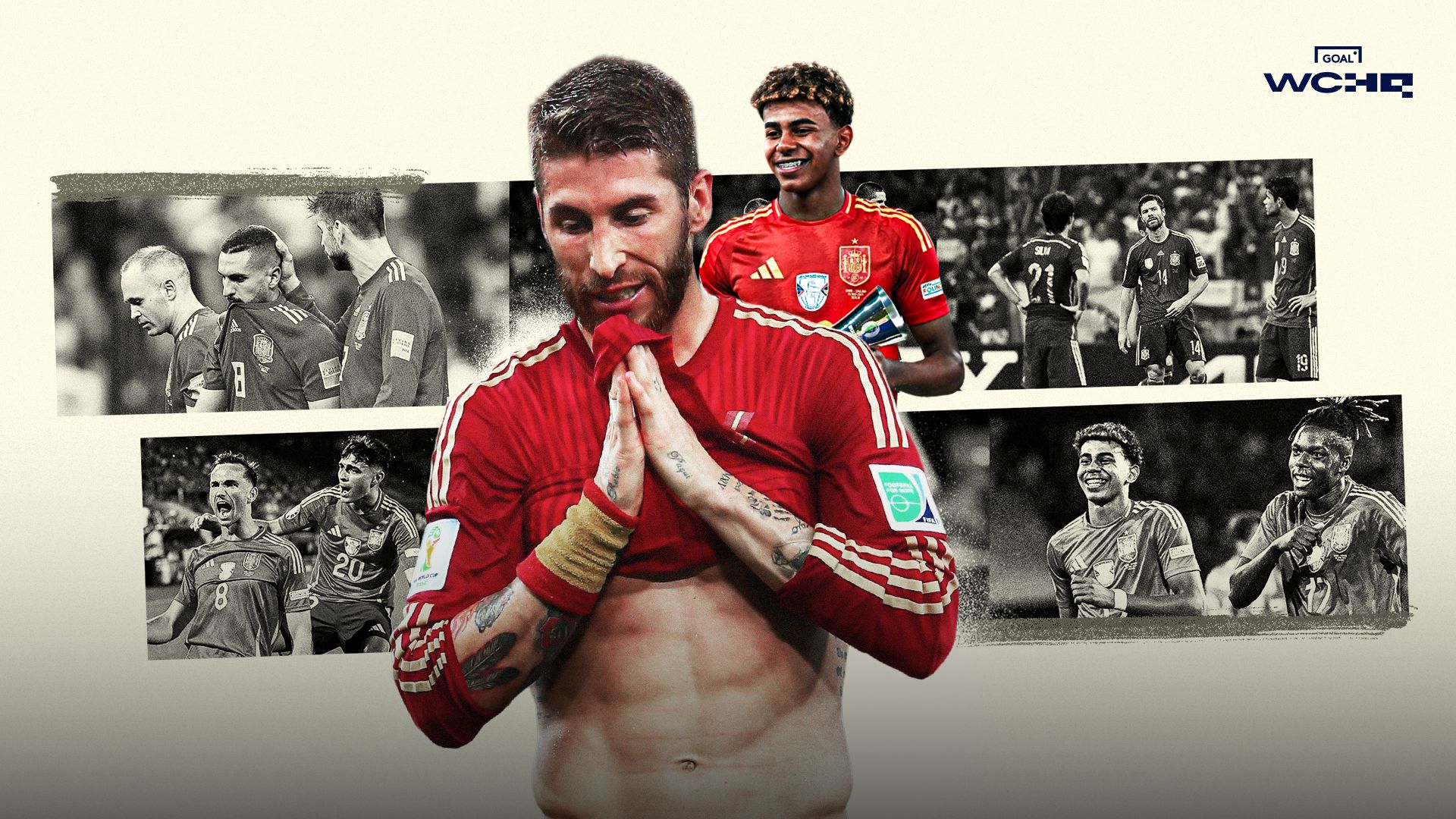
Spain's dramatic fall from grace - before the remarkable resurrection of La Roja's World Cup hopes

After finally reaching the mountain top in 2010, Spain has experienced a deep decline in its World Cup performances, and is out to redeem itself in 2026.

Throughout its history, Spain was always considered a national team that was missing something. They could never quite take the definitive step towards establishing themselves as an international powerhouse. In major tournaments, La Roja always ended up going home dealing with a lot of regret - and uncomfortable questions over their mentality.

The Spanish jersey had been worn by legends such as Alfredo Di Stefano, Paco Gento, Ricardo Zamora, Raul Gonzalez and Fernando Hierro, among others, and although their names are engraved in gold letters in football history, they all failed to lift the World Cup. It wasn’t until the beginning of the 21st century that La Roja's golden era began...

  • Spain's midfielder Andres Iniesta (C) raAFP

    Sustained success

    Spain's unprecedented run of success in the international arena began at Euro 2008, when a team led by Luis Aragones defeated Germany in the final to lift the continental title for the first time in 44 years. The next step for a generation full of talent that included Iker Casillas, Carles Puyol, Sergio Ramos, Andres Iniesta, Xavi Hernandez, David Villa and Fernando Torres was the 2010 World Cup in South Africa.

    The path to glory was far from straightforward for La Roja, who lost to Switzerland in their opening match before edging epic battles in the quarter-finals and semi-finals against Paraguay and Germany, respectively, to reach the final against the Netherlands.

    Soccer City in Johannesburg witnessed a dramatic tournament-decider on July 11, 2010, as Casillas confirmed that his place as one of the best goalkeepers in history by stopping a key one-on-one against Arjen Robben before Iniesta scored an emotional extra-time winner as La Roja were crowned world champions for the first time ever.

    There was simply no stopping Spain during this period and they successfully retained their European Championship title in 2012. However, their triumph in Poland and Ukraine also surprisingly signalled the end of an era.

  • Advertisement
  • Back to their old ways

    One of the laws of life is that everything that goes up, must come down, and although it was evident that this would happen to Spain sooner or later, their fall came sooner than anyone expected.

    The Iberians dramatic dip in form came in one of the most legendary stadiums in the world, the Maracana, where La Roja were routed by a Neymar-inspired Brazil in the 2013 Confederations Cup final.

    Even still, nobody would have predicted then that Vincente del Bosque's men would be eliminated in the group stage of the World Cup the following year. And the crazy thing was that they were gone by matchday two, with Spain thrashed by the Netherlands in their opening game before being finished off by Chile in their second outing.

    Such an embarrassingly early exit came as a desperately bitter blow for La Roja, as several legends subsequently waved goodbye to make way for a new generation who carried on their shoulders the heavy burden of trying to emulate the achievements of those that had come before them.

    There were just so many questions: Could Spain really find a worthy successor to Casillas? Would anyone be able to fill the void left by Puyol in defence? And what possible chance was there of another Iniesta or Xavi being unearthed?

  • Spain v Chile: Group B - 2014 FIFA World Cup BrazilGetty Images Sport

    Failure after failure

    Despite the uncertainty surrounding La Roja, Spanish clubs continued to flourish in continental competition, with Barcelona and Real Madrid winning Champions Leagues, and Sevilla pretty much making the Europa League their own.

    However, the national team struggled to shake off its Brazil 2014 hangover. Two consecutive eliminations in the round of 16 at Russia 2018 and Qatar 2022 made it clear that what Del Bosque’s players had produced at South Africa 2010 would not be easy to replicate.

    The foundation of the golden generation had been Pep Guardiola’s spectacular Barcelona team and its famous tiki-taka style. Consequently, Spain’s decline coincided with the Catalan coach's departure from Camp Nou at the end of the 2011-2012 season.

    It was clear at that stage that Spain would need something special to propel them back towards the summit of world football. Perhaps inevitably, the missing X-factor emerged from La Masia, where Iniesta, Xavi and Puyol had all learned their trade.

    However, even by the outrageous standards of Barcelona's academy, Lamine Yamal represents a unique talent.

  • ENJOYED THIS STORY?

    Add GOAL.com as a preferred source on Google to see more of our reporting

  • Spain v France: Semi-Final - UEFA EURO 2024Getty Images Sport

    Renewed hope

    April 29, 2023, is a date Spaniards will not forget, as it was that day when Xavi, one of the symbols of Spain’s golden era and at that time coach of Barcelona, handed Yamal his professional debut.

    The teenager's playing style recalled that of Lionel Messi, as Yamal faced down defenders without fear and seemed to carry the ball as if it were glued to his left foot. A generational talent of that calibre is rarely seen, and both Barcelona and Spain felt fortunate to have him in dark times.

    A little more than a year after his professional debut, Yamal was a key player for Spain as they restored themselves to their former glory at Euro 2024, where they defeated England in the final. A new jewel moulded at La Masia was leading an exciting new crop of players including Nico Williams, Unai Simon, Mikel Oyarzabal, Pedri, Gavi, and Marc Cucurella.

    Is it right to put the pressure of an entire country at the magical feet of a young man who has not yet turned 20? Probably not, but Yamal, with his incredible performances on the pitch, has shown that he can handle it - and much more.

    Although it’s too early to make the comparison, such a young player carrying an entire nation on their shoulders is not something we’ve seen since a 17-year-old Pele helped Brazil win the 1958 World Cup.

    Yamal undoubtedly has the talent required to take the World Cup by storm, and has demonstrated that he can produce on big stages, too. But to become a world champion, you need something more.

    Does Yamal possess the leadership qualities that Spain need? If not, can any of his team-mates take on that role for him? Although this new generation has plenty of quality and is one of the best national teams on the planet, it is not comparable to that of 2010.

  • Spain v Serbia - International FriendlyGetty Images Sport

    The weight of history - and expectancy

    Before Euro 2008, Spain’s history was full of near-misses and devastating defeats, but with the flipping of the script at the beginning of the 21st century, the expectations for the national team changed too. Now, the world expects them to be protagonists and title contenders in every tournament that they participate in.

    The Spanish gaze is fixed on North America, where the 2026 World Cup will be held in the United States, Mexico, and Canada. The mission remains the same: to be champions. Will it be easy? Of course not. Are they capable of achieving the feat again? Undoubtedly so.

    However, there is no shortage of credible challengers. Lionel Messi's Argentina are defending champions. Cristiano Ronaldo will spearhead an outrageously talented Portugal team. Kylian Mbappe and France are more than capable of reaching a third consecutive final. Carlo Ancelotti is capable of getting the best out of Brazil. England, with Thomas Tuchel at the helm, are threatening to finally end their major trophy drought, and even though Germany are not at their best, they remain a dangerous opponent.

    Of course, the 'dark horses' seen in previous editions cannot be ruled out either. Morocco made history in Qatar and will be hoping to do so again in North America, Japan are once again a team to keep an eye on, while the co-hosts will all be confident of springing a surprise or two - particularly the U.S. and Mexico.

    After three consecutive finals failures, though, Spain will also have to overcome the weight of history - as well as the burden of being many people's favourites. Much will obviously depend on that lethal left foot of Yamal, who dreams of lifting the most prestigious prize in football as a teenager - just like Pele and Mbappe before him.

    The World Cup could be his crowning glory, the moment he establishes himself as the best player on the planet by ending a wait for a second star that nobody thought would last this long back in 2010.