+18 | Play Responsibly | T&C's Apply | Commercial Content | Publishing Principles
Legacy Morocco GFXGetty/GOAL

LEGACY: Morocco's World Cup journey - from the Mexican desert to glory in Qatar

This is a story of lions who never knew surrender, of men who carried Morocco’s flag to the farthest corners of the earth and made the whole world remember their nation’s name. It began in the Mexican desert in 1970 and soared into the skies of Qatar more than half a century later.

Football is not just a game; it’s a mirror to life itself. It is dreams, ambitions, and the pride of an entire nation. Morocco became the first Arab team in history to reach a World Cup semi-final, but their story goes far beyond that; through five World Cups, each writing a new chapter in Morocco’s history, each one leaving a scar or a smile on the heart of every fan of the Atlas Lions.

  • Morocco 1970Getty Images

    Planting the seed

    In 1970, something happened that had never happened before: Morocco became the first African team to qualify for the World Cup through official qualifiers as the continent’s sole representative following the boycott of the 1966 tournament.

    In Morocco’s first-ever appearance on the world stage, their inexperience was obvious, losing 2-1 to West Germany and 3-0 to Peru. European newspapers wrote, "Morocco came to participate, not to compete", but the team retained its dignity.

    In the final match against Bulgaria, Maouhoub Ghazouani scored a beautiful goal to secure a 1-1 draw. Morocco’s players danced on the pitch, the first African team to earn a point at the World Cup.

    Only a few thousand Moroccans were in the stands, but their voices filled the stadium. Millions, meanwhile, celebrated back home in the streets. Morocco planted the seed of African hope that day, telling the world to never underestimate them again.

  • Advertisement
  • Morocco 1986Getty Images

    Making a statement

    Sixteen long years of waiting, of dreams and hope. And once again, in 1986, destiny brought Morocco back to Mexico, as if fate wanted them to reclaim what had left behind.

    The team’s Brazilian coach, Jose Faria, embraced Islam and became ‘Mahdi Faria,’ while King Hassan II even granted him Moroccan citizenship.

    Morocco were placed in a tough group with England, Poland and Portugal, and the European media ignored the north Africans completely in their tournament previews. The luxury hotels, meanwhile, were reserved for ‘big teams’, while Morocco were placed in modest lodgings. They were not to be humiliated, however, and instead used it as motivation.

    Morocco’s first match against Poland ended 0–0. How could an African side hold the Europeans?! The world was shocked. Then followed another 0–0 against England, as Morocco’s goalkeeper, Badou Zaki - the soon-to-be African Player of the Year - was a wall of steel in repelling the Three Lions.

    The Spanish press labelled the group as ‘The Group of Sleep’ because there were so few goals. But in the final match, the Atlas Lions awoke. Portugal, who had beaten England and mocked Morocco before the match, were a divided team and quarrelling over bonuses. Morocco, by contrast, were united, hungry and proud.

    In the 19th minute, Abderrazak Khairi scored. Then, eight minutes later, he repeated the trick. In the 62nd minute, Krimau added a third. 3-1! For the first time, Morocco had scored three goals in a World Cup match, and in topping the group, they became the first African team to ever reach the last 16. Morocco erupted in celebration. People danced, sang, and cried tears of joy.

    Next came West Germany, one of the strongest sides in the world, and for 85 minutes, Morocco fought with everything they had. Zaki made impossible saves while Aziz Bouderbala almost scored. Then, five minutes from the end, Lothar Matthaus struck with a free-kick, and Morocco’s dream ended.

    At full-time, the fans inside the stadium, including those supporting Germany, stood to applaud Morocco. They had earned the world’s respect. The Times of London declared: "Morocco changed the face of African football." They may have lost by a goal, but they were never defeated.

  • Morocco 1998Getty Images

    Cruel exit

    After another 12 years away, Morocco returned to the World Cup in 1998, with the tournament taking place in France, a nation that was a home to many Moroccan immigrants. Morocco even had a French coach, Henri Michel, but they were drawn into a brutal group with defending champions Brazil, as well as Norway and Scotland.

    The Atlas Lions drew 2-2 with Norway thanks to beautiful goals by Abdeljalil Hadda and Salaheddine Bassir, but lost 3–0 to a Brazil team who were simply too strong.

    Then came the final game against Scotland, where Morocco played with courage and fire to win 3–0. Bassir scored twice while Hadda added the third as Moroccan fans filled the stands, waving flags and singing with pride.

    Morocco were sure that they had qualified for the knockout rounds, but fate had other plans. At the same time in Marseille, Norway were playing Brazil, and while Morocco were already celebrating in Saint-Etienne, in the 83rd minute, Norway equalised. Then, five minutes later, disaster for the Atlas Lions, as a very soft penalty was awarded to Norway which they scored. 2–1; Morocco were out.

    Morocco’s players were already happily exchanging shirts with the Scots, unaware of what had played out elsewhere in their group. When the news eventually reached them, coach Michel kicked the bench in anger. Players, fans and the whole nation broke down in tears.

    Morocco had scored five goals yet were eliminated because of one controversial penalty in another match. Brazil midfielder Leonardo said: “I feel sorry for Morocco. They played beautiful football. It’s sad.”

    Yes, it was cruel, but Morocco returned home proud. King Hassan II welcomed the team and granted manager Michel the Moroccan citizenship he had requested.

  • ENJOYED THIS STORY?

    Add GOAL.com as a preferred source on Google to see more of our reporting

  • Morocco fans 2018Getty Images

    Out of the wilderness

    Then, for 20 years, Morocco vanished from the World Cup. Entire generations grew up never seeing their national team on the global stage.

    Every four years, Moroccans watched others play, sometimes cheering for Arab or African teams, but their hearts always ached for their own. Some began to lose hope.

    Then came 2018, in Russia. After two decades, Morocco were back, and the hope was alive again. They fought bravely against Iran, Portugal and Spain, but lost all three matches by a solitary goal. So close, yet not enough.

    Destiny, though, was saving something bigger. In the desert of Arabia, in Qatar, Morocco were about to make history…


  • Morocco v Portugal: Quarter Final - FIFA World Cup Qatar 2022Getty Images Sport

    The miracle

    Ahead of the first World Cup ever held on Arab soil, Walid Regragui, Morocco’s young coach, took charge just three months before the tournament. Everyone said it was an impossible job; he had too little time to pull off such a big task. But Regragui told his players: "Anyone who doesn’t believe we can win the World Cup will not come to Qatar."

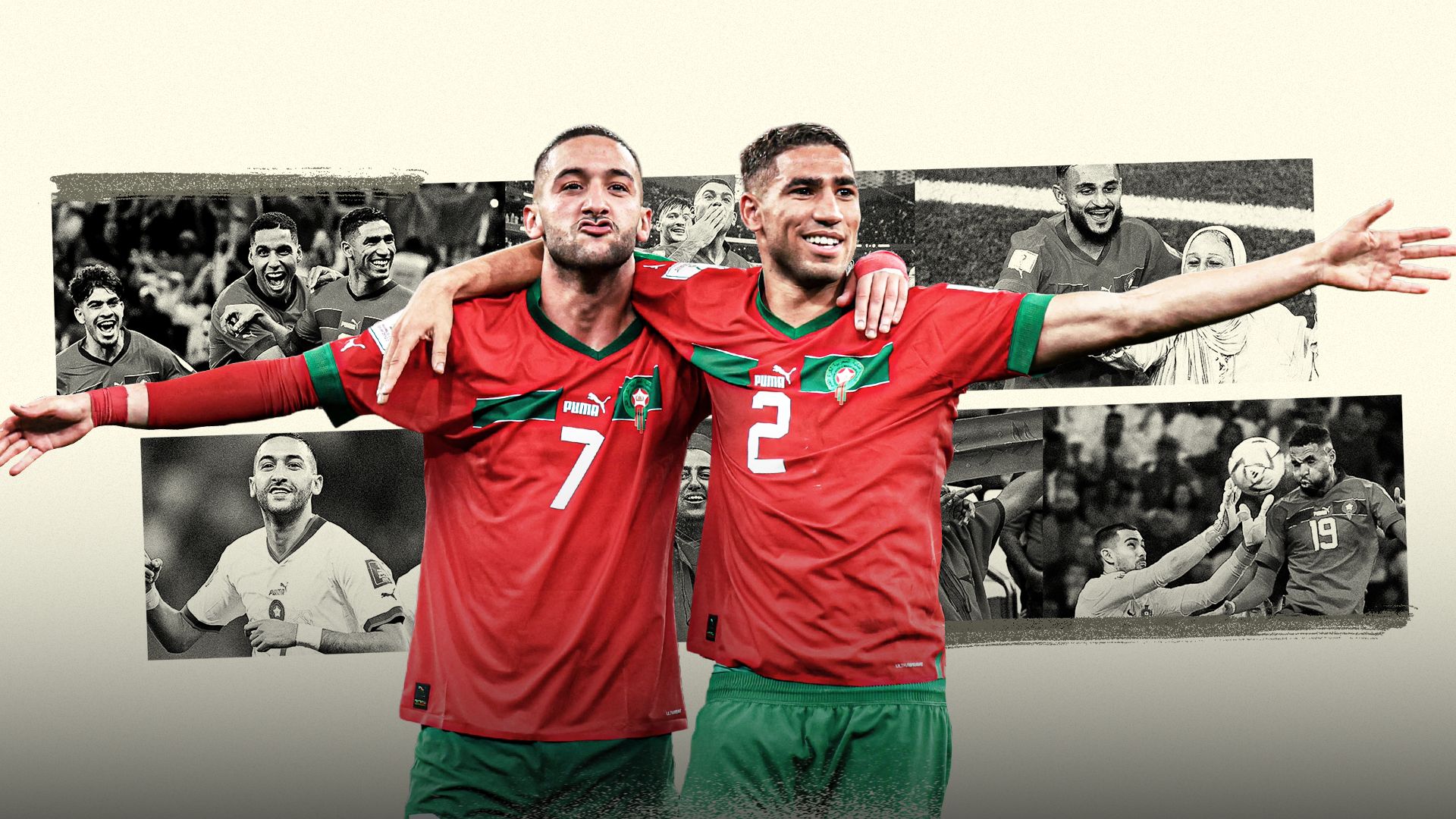
    He gathered together stars of the European game, such as Hakim Ziyech, Achraf Hakimi and Noussair Mazraoui, and combined them with young talents from the Mohammed VI Academy. One team, one heart.

    Placed into Group F alongside the beaten finalists from 2018, Croatia, the second-ranked team in the world, Belgium, and a resurgent Canada, few expected Morocco to make much of an impact. And so it proved in their first match, a 0-0 draw with Croatia.

    Then the miracle began, with a 2-0 win over Belgium. The Arab world exploded in celebration. In Egypt, in Saudi Arabia, in Jordan, in the Emirates - everyone cheered for Morocco. They backed that up with a 2-1 win over Canada, topping the group again, just like 1986. But this time, the Atlas Lions weren't done.

    In the last 16, they would face the mighty Spain, the 2010 world champions who had already put seven goals past Costa Rica in the group stages. But Morocco fought for 120 minutes, earning a 0-0 draw. Then came penalties; Pablo Sarabia hit the post while Yassine Bounou, Morocco’s phenomenal goalkeeper, became a legend, saving from Carlos Soler and Sergio Busquets. Spain didn’t score a single spot-kick, and Hakimi sealed victory with a cheeky Panenka.

    Morocco: the first Arab nation ever to reach the World Cup quarter-finals. The entire Arab world celebrated, from Cairo to Beirut, from Riyadh to Amman, millions filled the streets. The Burj Khalifa was lit up in Morocco’s colours in a show of unity, pride and shared glory.

    Next up were Cristiano Ronaldo’s Portugal, but Morocco weren’t afraid. Regragui told his men: "You are not less than them - you are better than them. Go and prove it."

    In the 42nd minute, Youssef En-Nesyri rose high into the air and scored a majestic header. That proved enough for another historic victory, as Africa had its first World Cup semi-finalist.

    After the match, winger Sofiane Boufal danced with his mother on the pitch in a moment of pure humanity, love, and pride that transcended sport. Morocco may have lost 2-0 to France in the semis as injuries took their toll, but they left with their heads held high while the world saluted them.

  • moroccoGetty Images

    Eternal legacy

    From the deserts of Mexico in 1970 to the sands of Qatar in 2022, from Africa’s World Cup debut to the continent’s first semi-final, Morocco have never been just another participant on the global stage.

    The Atlas Lions learned that dreams never die, even if you have to wait 36 years for them to materialise. They learned that the small can defeat the mighty when they believe. They learned that defeat is not the end; you may lose a match or exit a tournament, but Morocco never surrenders.

    They go again in 2026, ready to rewrite more history.