
Are you 24 or older?

Help us verify your age by providing an honest response. This site contains gambling advertising for 24+.

Age-restricted content

You’re not old enough to view betting content. You’ll be redirected to the homepage.

alt
imago-sport-1082443677.jpgIMAGO / Laci Perenyi

A questionable decision that could make you a cult hero? A frustrating job is surprisingly appealing at Bayern Munich

Nino Duit
Translated by
  • After a spell without a club and some very difficult years in Liverpool, Berlin and Newcastle, Loris Karius (33) became a No. 1 again at Schalke 04. He has since emerged as a promotion hero and is now among the Bundesliga's best goalkeepers. 

    Hoffenheim's Oliver Baumann (36) could overtake Eintracht Frankfurt icon Karl-Heinz Körbel as the Bundesliga's record appearance-maker. He needs another 71 appearances.

    Bernd Leno (34) is Fulham's undisputed first-choice goalkeeper, playing in the best league in the world and living in one of its most exciting cities. His run is impressive: Leno has not missed a second of Fulham's last 160 Premier League matches.

    Strong performances for Augsburg recently earned Finn Dahmen (28) a place in the Germany national team. 

    All four are being touted as potential new back-up goalkeepers at Bayern Munich. Why on earth would any of them give all that up to sit on the bench in Munich? Bayern's illustrious history offers a few reasons why that seemingly questionable decision might pay off.
  • Butt's autumn turns to spring at Bayern Munich

    imago-sport-5947109.jpgIMAGO

    Manuel Neuer's era in Munich will, in all likelihood, end next summer. His long-standing understudy Sven Ulreich (38) is also likely to retire alongside the 40-year-old veteran. Bayern have lined up Jonas Urbig (23) as their new first-choice goalkeeper, and he has regularly stood in with assurance for the now highly injury-prone Neuer for almost two years.

    Bayern Munich last faced a comparable situation in 2008, when Oliver Kahn departed. The Titan's designated successor was already at the club then, too. Like Urbig, Michael Rensing was gradually prepared to take over. By the time he did, he had made 44 competitive appearances, more than Urbig has to date. Those included a Champions League quarter-final against AC Milan and a UEFA Cup semi-final against Zenit St. Petersburg. Rensing became first choice at 23, the age Urbig is now. Then he buckled under the pressure and lost his place to Hans Jörg Butt.

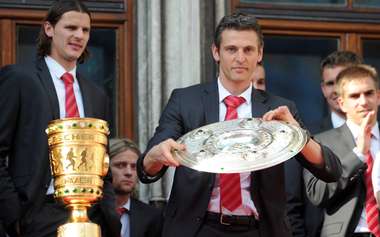
    Butt joined Bayern Munich as an experienced back-up in 2008, aged 34, after Kahn's retirement. He had already played for the national team and appeared in a Champions League final with Bayer Leverkusen in 2002. Butt sensed one last hurrah. Late in his career, he unexpectedly found himself in the Bayern goal and provided a dependable last line of defence during the magnificent 2009/10 season under Louis van Gaal.

    On the way to the Champions League final, which Bayern ultimately lost to Inter Milan, Butt even converted a crucial penalty against Juventus. Bayern ended the season with the double. To cap it all, Butt made Germany's squad for the 2010 World Cup and played in the third-place match. Had he stayed at Benfica Lisbon, he would not have achieved any of that. Butt finally gave up his place to a certain Manuel Neuer in 2011.

  • Parallels between Rensing and Urbig

    Nothing currently suggests Urbig will suffer the same fate as Rensing. He seems impressively composed, performs well even when called upon at short notice and speaks in interviews almost as calmly, and with as many stock phrases, as Neuer.

    A young goalkeeper taking over at Bayern Munich still faces risks and uncertainties. Form could dip, or a serious injury could strike. Suddenly, Baumann, Karius, Leno or Dahmen could be on the pitch for an important Champions League match. That is something they will no longer achieve with Hoffenheim, Schalke, Fulham or Augsburg.

    Butt is just one of several examples. Probably no experienced German goalkeeper who has joined Bayern Munich as a back-up in the past 30 years has regretted his decision.

    FC Bayern München v RB Leipzig - Bundesliga 2026/27Getty Images
  • More trophies than appearances

    imago-sport-1076251727.jpgIMAGO

    Bernd Dreher arrived in Munich in 1996, aged 29, as Bayer 04 Uerdingen's first-choice goalkeeper. His approachable manner made him a popular cult figure. He was also involved in one of the most tragicomic incidents in Bundesliga history. In 1999, Dreher replaced the injured Kahn against Eintracht Frankfurt, only to tear his own cruciate ligament three minutes later. Bayern had used all their substitutions, so Michael Tarnat had to go in goal.

    Dreher retired in 2003 and became a goalkeeping coach at Bayern Munich. Injuries to other players prompted his return to action in 2005, and he spent another three years in the first-team squad. At 40 years and 198 days, he became the oldest Bundesliga player in the club's history. Neuer overtook him only two weeks ago. Dreher ended his Bayern Munich playing career with 15 appearances and 19 trophies.

    Tom Starke followed a similar path. In 2012, aged 31, he gave up his position as Hoffenheim's first-choice goalkeeper for a place on the bench in Munich. Bayern persuaded Starke to carry on after he initially retired in 2017, and he stepped in assuredly during a run of injuries. "I don't know how old he is," said Javi Martinez. "He looks 50 but plays like he's 28. He's a role model for young goalkeepers."

    Like Dreher, Starke, nicknamed "Krake", took on other roles at the club while still playing, initially as a goalkeeping coach in the youth set-up. After retiring in 2018 (12 appearances, 15 trophies), he spent time on the coaching staffs of Niko Kovac and Julian Nagelsmann. He remains the goalkeeping coordinator at the campus to this day.

    That role also brings Starke into contact with Dreher, who now coaches the so-called Bayern Munich World Squad. Top talent Maycon Cardozo is among the players to have come through the project. Butt also continued to work for Bayern Munich after retiring, though he voluntarily stepped down as head of the youth department after a short time. 

  • "Zunullreich" becomes Bayern Munich's "man of the year"

    Bayern are keen to keep Ulreich involved in the future, too. As a back-up goalkeeper, he has had a career almost as remarkable as Butt's. Ulreich, previously VfB Stuttgart's first-choice goalkeeper, moved to the Munich bench in 2015 at the age of 26, to widespread disbelief. But as Neuer became increasingly injury-prone, Ulreich went on to make an impressive 104 competitive appearances to date. In the 2017/18 season, he delivered consistently good performances for months in Neuer's absence and earned the nickname "Zunullreich". Germany coach Joachim Löw said he was "in contention for the 2018 World Cup in Russia", while Bayern patriarch Uli Hoeneß even hailed him as "man of the year".

    An error in the semi-final against Real Madrid contributed to Bayern's narrow Champions League exit and brought Ulreich's season to a painful end. Neuer was fit again in time for the World Cup, and Ulreich returned to the Bayern Munich bench. In 2019, he finally made the national-team squad. After the treble in 2020, Ulreich moved to Hamburger SV as their first-choice goalkeeper. But he apparently soon missed the Munich bench too much. After one season, he was back.

    Since then, he has cemented his status as a cult figure among the fans, above all through his passionate support off the pitch. One moment a verbal altercation with an opposing assistant coach, the next a red card while on the bench. And, of course, there was his legendary cry of "wanker" towards Bayer Leverkusen manager Simon Rolfes in 2024. The DFB fined Ulreich €20,000. The fans chanted "Freedom for Ulle" and wrote on a banner: "DFB, you Rolfes – Ulle, one of us".

    imago-sport-1085535439.jpgIMAGO
  • Back-up goalkeeper at Bayern? Surprisingly appealing

    Young talents from the club's youth set-up, such as Rensing, Thomas Kraft and Christian Früchtl, eventually left in search of more playing time. So did ambitious reserves such as Pepe Reina and Alexander Nübel, who played little but at least earned handsomely. The experienced German goalkeepers, by contrast, all seemed to enjoy their time in Munich. Some even agreed to carry on despite plans to retire, while Ulreich returned.

    A goalkeeper of that calibre who joins Bayern Munich has a chance of appearing in the occasional big match. He might also earn a DFB call-up, a Champions League trophy, cult status among the fans and a job at one of the world's best clubs after his playing career. The seemingly frustrating job of back-up goalkeeper at Bayern Munich is surprisingly appealing.