
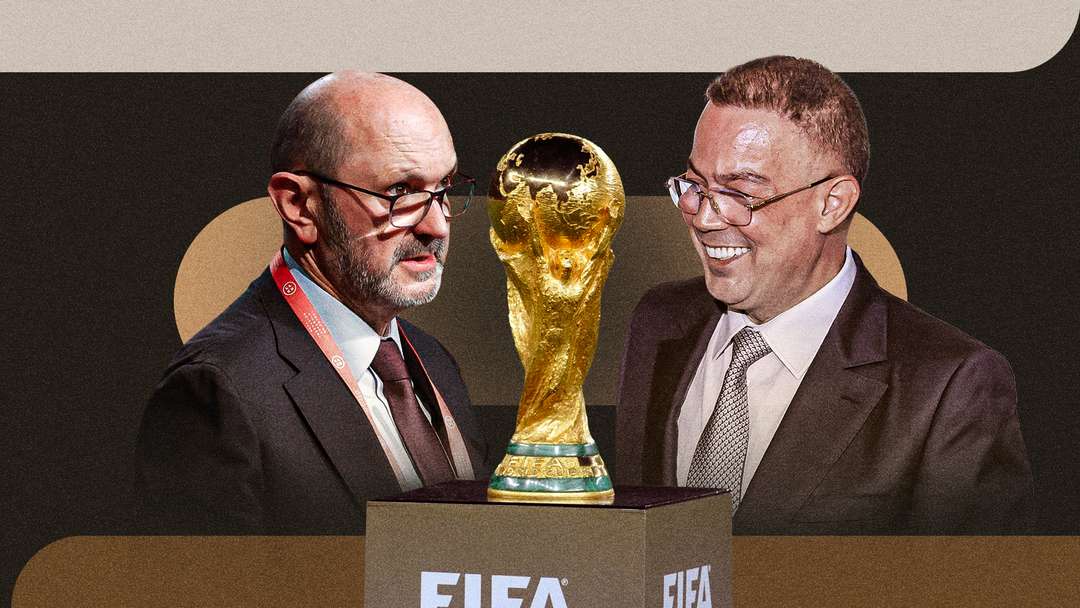
The battle between Morocco and Spain to host the final has intensified, with politicians from both countries now joining the fray.
Hafid Derradji tackled the issue in an article for the newspaper "Al-Quds Al-Arabi". Spain has its arguments and credentials, he stressed, but hosting the largest number of matches does not automatically grant it the right to stage the final. Morocco has its project and ambition, he added, yet building a massive stadium guarantees it nothing either.
The text of the article was as follows:
The race to host the 2030 World Cup final has taken on sporting, political and symbolic dimensions. It has become the focus of a battle of statements, reassurances and calculations, the latest being a declaration from Spanish Prime Minister Pedro Sánchez that Spain would host the largest number of World Cup matches and stage the final at the Santiago Bernabéu. His words dragged the issue back to the forefront and raised a question: is Madrid talking about settled facts, or voicing a Spanish ambition that FIFA has yet to decide? All the while, Morocco is counting on a vast stadium project awaiting construction in Casablanca, with a capacity of up to 115,000 spectators.
Some read Sánchez's new remarks as a message of reassurance to the public, and a reminder to FIFA and Morocco that Spain carries the greatest weight in an organising file that was originally a joint bid, before Morocco joined with the agreement of Spain and Portugal.
The partnership, though, turned into a contest to host the final. It became a wager on priority, international standing, influence and relationships within global football institutions, alongside technical readiness, organisational experience, stadium capacity and the ability to accommodate fans and keep them safe. These are the cards Spain and Morocco are playing in a battle that remains open to every possibility.
Related Topics
What was once simply the 2030 final has grown into something beyond football, a competition over influence and international image. Political calculations have crept into the sporting contest. Should Morocco win it, after Sánchez's reassurances, the impact on Spanish public opinion would be enormous.
Victory would hand Morocco a huge accomplishment, crowning a long investment path in sporting infrastructure that follows its success in staging many events. A Spanish win, by contrast, would vindicate the historical and organisational logic at the root of the joint file. Spain launched the joint bid with Portugal first, then Morocco, who joined on an initiative from Gianni Infantino.
FIFA has already denied any agreement or promise to grant Morocco or Spain the honour of organising the final. The decision, it stressed, will come at the appropriate time based on purely technical data, away from wishes and statements here and there.
All it has confirmed is that Spain, Portugal and Morocco will host 101 matches, with three celebratory games staged in South America to mark the centenary of the World Cup. The 2030 edition, it insists, is no mere three-nation tournament but an exceptional historic occasion, 100 years on from the first World Cup.
"The final is more than just 90 minutes"
The final, then, will be more than 90 minutes to crown a champion. It will be a symbolic showcase for the country, the city and the stadium that hosts it.
Spain has its arguments and credentials, but hosting the largest number of matches does not automatically grant it the right to organise the final. Morocco has its project and ambition, yet building a massive stadium guarantees nothing. The decision rests in FIFA's hands, not on the reassurances of this official or the statements of that one.
Will the final, then, reward Spain for its footballing history and organisational experience? Will it crown Morocco's ambition and its massive sporting project? Or will FIFA surprise everyone with a different criterion altogether?
The question posed most forcefully is not who deserves the final in media discourse, but who can present the most convincing file by the criteria FIFA adopts.
The strange thing is this. Alberto Núñez Feijóo, leader of the opposition People's Party in Spain, floated a controversial idea: Spain should withdraw entirely from hosting the tournament if FIFA refuses to grant it the final. It was an attempt to ratchet up a Spanish position that looks more hardline and more insistent than Morocco's, which prefers to focus on racing the stadium to completion, the project with which it is tempting FIFA and the whole world, while Infantino keeps playing the final card in his electoral campaign for a new term.
