Are you 24 or older?

Help us verify your age by providing an honest response. This site contains gambling advertising for 24+.

Age-restricted content

You’re not old enough to view betting content. You’ll be redirected to the homepage.

alt
Manchester United v Manchester City - Premier League 2026/27Getty Images Sport

Translated by

Mareska's grip and Carrick's freedom: two contrasting secrets governing the Manchester derby

The objectives may be similar, the distances close, and the desire to reclaim a place at the summit shared. Yet the path to success is not always the same. That is precisely what comes to the fore ahead of the meeting between City and United in the eagerly anticipated Manchester derby, where the contest is not only about what will happen on the pitch, but about the philosophy each side brings to the field of play.

Less than five miles separate the two clubs' headquarters, and both share the ambition of returning to compete for the top of the Premier League. The similarity stops just about there. On a tactical level, the two teams are heading in different directions. Manchester City rely on a rigid structure built on precise positioning and disciplined movement, while Manchester United under Michael Carrick give their players greater freedom to make decisions and move as the match develops.

The world's best teams often adopt similar ideas, especially when it comes to possession, control, and interchanging positions. Last season's Champions League final between Paris Saint-Germain and Arsenal proved the point. Both teams leaned on the same tactical principles, controlling the ball and swapping positions while holding their basic structure together.

The Manchester derby offers a different model. Maresca wants every player to hold the position that serves the system. Carrick prefers to hand his players greater freedom to move and decide for themselves.

  • Pep Guardiola and Enzo MarescaImago-Images

    Control versus freedom: two philosophies on one pitch

    Maresca clearly belongs to the school of thought shaped by his former mentor Pep Guardiola. Little wonder, then, that ball control and cutting out randomness sit among the most important pillars of his approach.

    The Italian has always likened football to chess, where each piece moves according to its position and its relationship with the rest. That is where his reliance on "positional play" comes from, handing every player a clear role and position throughout the various phases of the game.

    Reducing the area of uncertainty lies at the heart of Maresca's thinking. The more the players know about their team-mates' positions and expected movements, the faster they make decisions and the more stable the system becomes.

    Carrick's approach is not devoid of positional principles, but he does not afford them the same status they hold in Maresca's philosophy. The Englishman prefers to give some of his players the freedom to read the match rather than always tying them to predetermined positions and movements.

    Look at how he handles the young midfielder Kobbie Mainoo. Carrick took care not to burden him with a vast amount of instructions, offering only simple guidance on positioning while trusting him to make his own decisions.

    Here the fundamental difference emerges. Maresca wants the player to know where he should be before the ball reaches him. Carrick wants him to read the situation and then decide where to move.


  • Advertisement
  • Michael Carrick Man Utd GFXGetty/GOAL

    How is Carrick building the United system?

    Manchester United's flexibility doesn't mean chaos. The team plays to a clear set of rules, and those rules give the freedom its framework.

    Both centre-backs hold their positions throughout the build-up phase. The deepest midfielder takes charge of helping the ball out from the back, either by moving alongside his midfield partner or by dropping into the defensive line to form a temporary back three with the two centre-backs.

    Drop into that back three, and the other midfielder stays in the heart of the pitch, handing United an extra option to play through the middle.

    Full-backs start from their natural positions out wide during the build-up before pushing forward, their timing dictated by the winger ahead of them. Sometimes one hugs the touchline to stretch the pitch while the other tucks into a deeper space.

    Higher up, the number 10 and the striker occasionally drop back to form a fluid attacking pair, one that switches positions and keeps posing problems for the opposition defence.

    None of this happens by accident. Every movement serves a tactical purpose. When the defensive midfielder drops to make a back three, United can outnumber teams that press with two forwards. That gives them ways to beat the press rather than lumping it long.

    Against a team defending in a narrow shape, the full-backs turn into a key weapon for stretching the pitch. Players out wide force the opponent into an awkward decision: stay compact in the middle, or step out to track the full-back?

    Chase the flanks, and space opens up in the middle right in front of United's players.

    Here's the paradox. Carrick's men don't shy away from playing through the middle even when it's packed. That congestion can be part of the plan. Drawing the opponent towards the ball creates bigger gaps on the flanks, and it leaves United better placed to win the ball back the instant they lose it.

    So attacking flexibility ties directly into the counter-press. The closer United's players are to the ball when they lose it, the quicker they can win it back.


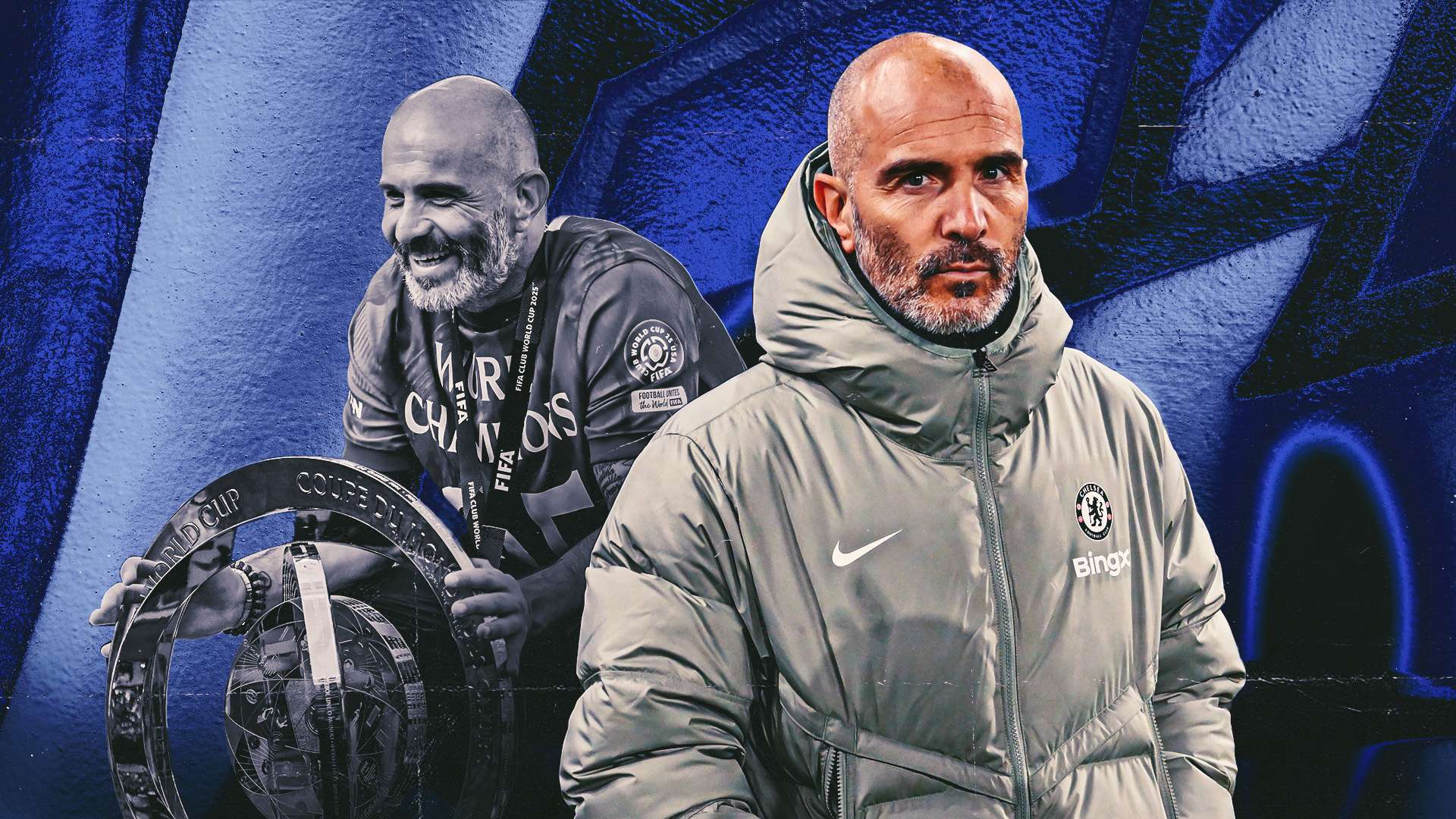
  • Enzo Maresca Chelsea GFXGOAL

    Carrick gives his players freedom, while Maresca sets the boundaries

    Carrick's philosophy becomes clearer with players who can make a difference from more than one position. If Bruno Fernandes or Cunha judge that the best move is to drift towards the flank and get closer to the ball rather than stay deep, they have the freedom to do it.

    Opposition defenders now face a genuine dilemma. Let the player roam and United can build a numerical advantage near the ball and slip the press. Track him instead, and that movement opens up space elsewhere for another United player to exploit.

    United become a side that is hard to read. The final decision is not always fixed. It hinges instead on how the players interpret the situation, according to "BBC Sport".

    Maresca sees freedom from a completely different angle. In previous comments the manager explained that, for him, freedom does not mean a player can go everywhere, because that descends into chaos. It means a player can do what he sees fit in the position where he receives the ball. That sums up City's philosophy.


  • ENJOYED THIS STORY?

    Add GOAL.com as a preferred source on Google to see more of our reporting

    Add as preferred source on Google
  • Michael Carrick Man Utd 2:1Getty/GOAL

    Order first VS freedom with rules, not chaos

    Manchester City's players occupy specific zones in possession, dictated by the shape the team adopts, whether the build-up takes the form of 3-2-5 or 3-1-3-3.

    Predictable to the opponent, perhaps, but that doesn't make it easy to stop. The player knows where his team-mate is. He knows the space he is supposed to move into, and he knows the options that will open up in front of him after the next step.

    Such details knit the system together, sparing the player from inventing a new solution from scratch every time.

    After the match against Coventry, Maresca pointed to the limited time Iliman Ndiaye had spent training with the team, which at certain moments led him to move the wrong way or take up the wrong position.

    That incident shows just how much the details matter in a system built on positioning. Yet the approach carries a major advantage too. Even when the opponent knows what's coming, sheer speed of execution can be enough to thwart it.

    Carrick, by contrast, needs to find a way to give his players freedom without the team dissolving into a group of individuals moving with no connection. That is why United appear to lean on a set of shared principles every player understands.

    Chief among them is gathering around the ball to lure the opponent in, then quickly finding the player in the free space. The team also builds triangles across different areas of the pitch to escape pressure. As one player prepares to receive, his team-mate begins moving to become the next passing option.

    The key is that these triangles don't appear in predetermined places. They form according to how the players read the moment. This is what separates United from City: the two teams share a tactical language, but Carrick's players enjoy greater freedom to decide where and when to use it.

  • Manchester United v Manchester City - Premier LeagueGetty Images Sport

    Who holds the advantage?

    There is no single perfect recipe for football, so you can't say Maresca's style is right and Carrick's is wrong, or vice versa.

    A rigid approach gives the team stability and speed in executing ideas, and it lets the system function even when some players change. But too much adherence to positions can squeeze the space for individual creativity.

    Flexibility hands creative players more room to make an impact. The trade-off is that it demands a high degree of harmony, trust and understanding, and those things cannot be built overnight.

    Bruno Fernandes is perhaps the best example of what United gain from that freedom. His level rose noticeably after Carrick arrived, and he went on to be crowned Player of the Season in the Premier League.

    Manchester City, by contrast, have faced questions over the best way to unlock Rayan Cherki's talent, especially as Guardiola preferred the player to stay in the areas between the lines and close to Erling Haaland rather than drop too deep to receive the ball.

    Maresca adopted the same idea. He explained that there is a plan for every match, and that Cherki can drop into his own half to help control the tempo, but once the ball reaches the opponent's half he must be in the place that lets him create danger.

    The Manchester derby, then, pits two different schools of tactical thinking against each other. One believes the system gives players real freedom. The other sees the player as needing space to make decisions so the team becomes harder to predict.

    The biggest question remains. Will the system Maresca imposes prevail, or the freedom Carrick is betting on?

    The answer won't be found in the meeting room or on the coach's board. It will come on the pitch, when the small details begin to make the difference.