
Lionel Messi Legacy GFXGetty/GOAL

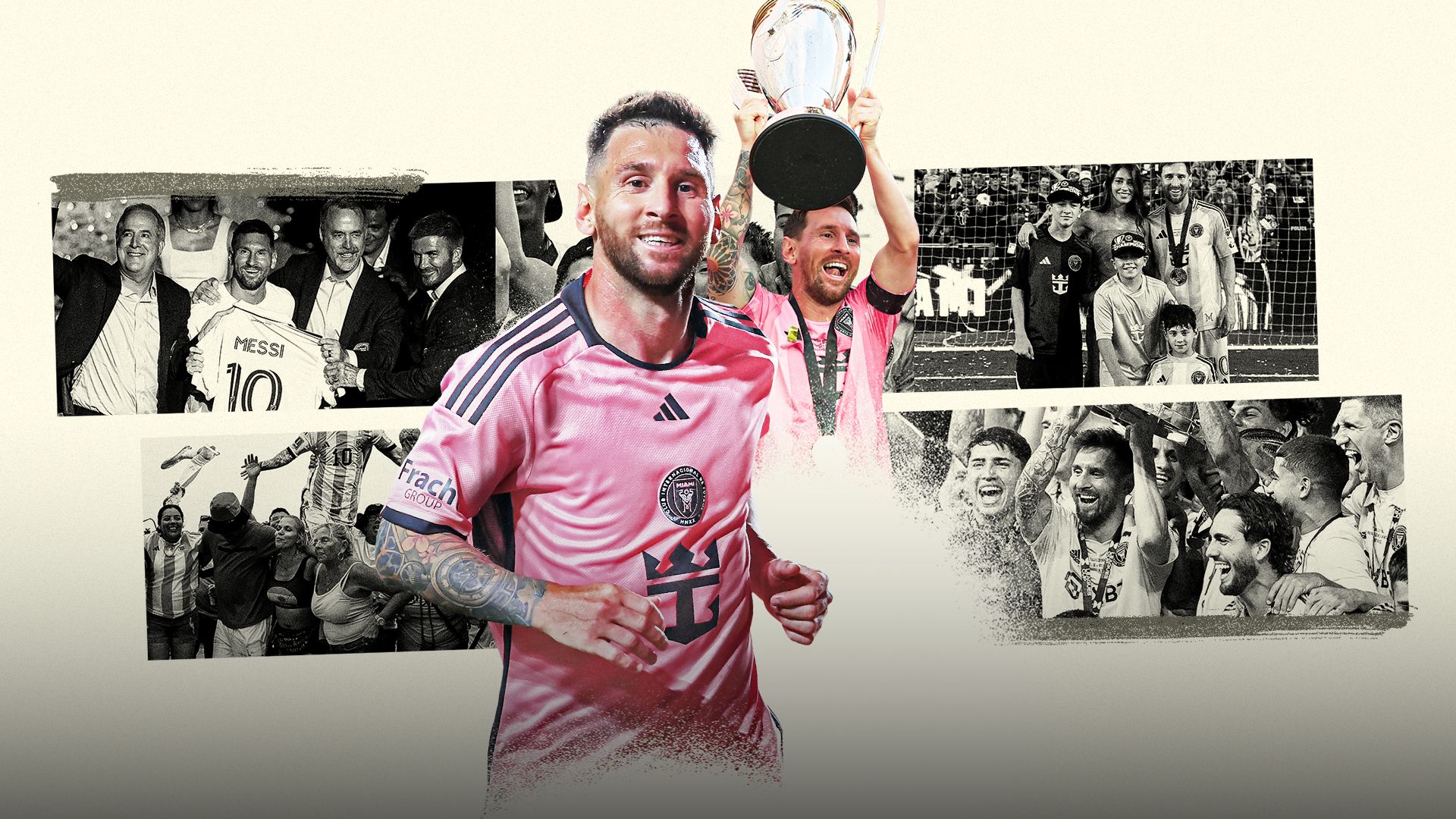
LEGACY: Messi-mania - How World Cup winner Leo cracked America ahead of 2026 swansong

The sun beats heavily over the highway that borders the DRV PNK Stadium. It’s noon in Fort Lauderdale and the air vibrates as if someone had placed an invisible iron over the asphalt. Cars drive by with loud music, many with sky-blue and white flags stuck to their windows. On the nearby walls, Lionel Messi’s murals are already part of the landscape: One shows him wearing Inter Miami’s pink jersey, another in the sky-blue and white Argentina shirt lifting the World Cup. Reggaeton plays in the bars, where it’s enough for someone to mention the word ‘Messi’ for a smile, a comment, or a ‘Vamos Argentina!’ to appear. This is Miami.

It’s the place where borders melt. Where a Venezuelan can sell Argentine empanadas to a Colombian while, on the screen in the back, Messi decides a match against Orlando City. But since the No.10 arrived, something changed in the city.

Soccer, that sport that for years had been merely an immigrant curiosity, has become part of everyday language. ‘It’s Messi’s city,” many say without irony, because what the Argentine captain has generated in South Florida has no precedent.

His arrival at Inter Miami not only revolutionised MLS, it transformed the sports identity of an entire region. Pink jerseys sold out within hours. Ticket prices jumped from $30 to over $400. Flights from Buenos Aires to Miami increased 25 per cent during the first months of his stay.

But the most impressive thing is the symbolic phenomenon: Lionel Messi, the boy born in Rosario who conquered the world, found in the United States a second footballing homeland. And that detail, that familiar environment, that emotional territory, could be key for him succeeding again at the 2026 World Cup.

  • Inter Miami CF v Vancouver Whitecaps FC - Audi 2025 MLS Cup FinalGetty Images Sport

    'Messi changed our lives'

    The 2026 World Cup will be unlike any other. For the first time, it will be played across three countries - the United States, Mexico, and Canada - though the heart of the tournament beats in the giant of the north. And if everything goes as expected, Argentina will play one of their matches in Miami.

    Messi knows these fields, the fast grass, humid nights, comfortable stadiums, enthusiastic yet respectful crowd, and he’s played on them with Inter Miami and adapted them to his game. He knows the internal trips, the distance between venues, the schedules. He knows how his body reacts in those conditions. At 39, the age he will turn during the World Cup, such details can be decisive.

    ‘The American Messi’ isn’t a marketing invention. It’s the natural evolution of a player who, after winning everything, looked for a place where he could keep enjoying football without the weight of European demands. In Miami he found that; a setting where football blends with everyday life, where training ends and sunset waits just a few metres from the sea.

    “Messi changed our lives,” says a club employee while arranging balls on the training field. “Not only the team’s. The city’s. Football’s. Everyone’s.” And he’s right. Because Messi didn’t come to the U.S. to retire; he came to expand, to open a new chapter, to become a bridge between Latin and U.S. football, between epic and spectacle.

  • Advertisement
  • Leagues Cup 2023: Cruz Azul v Inter Miami CFGetty Images Sport

    Fever pitch

    The night that Messi debuted with Inter Miami, the city froze. It was July, and the heat stuck to the body like a blanket. In the stadium, the cell-phone lights formed a pink constellation. Messi stepped onto the field, touched the ball twice, and in the final minute took a free-kick that nestled in the top corner.

    David Beckham cried. Antonela, Messi’s wife, smiled. And the crowd, an eclectic mix of Argentines, Cubans, Hondurans, Americans and tourists, understood they were witnessing something unrepeatable. Since then, ‘Messi-mania’ has taken on the dimensions of a social phenomenon.

    Youth soccer academies grew 60% in the area. Argentine bars open earlier when Miami play. Supermarkets sell mate and Argentina jerseys. Even the most reluctant Americans began following MLS games.

    But the most powerful thing is the emotion Messi creates. In the stands, entire families travel from other states just to see him. Children cry when they watch him train. Adults who had never set foot in a soccer stadium now sing ‘Muchachos’ in badly pronounced English. It’s a mania, yes, but also a feeling of redemption.

    Messi, who was so often accused of ‘not feeling’ the Argentine jersey when he was young, found in Miami the perfect synthesis: A city that adores him without asking anything in return, that celebrates him simply for existing. And that connection could be the drive that accompanies him in 2026, when the world once again revolves around a ball.

  • FBL-WC-2022-MATCH64-ARG-FRA-TROPHYAFP

    Tailor-made

    Everything seems aligned: the calendar, the logistics, the narrative. If football were a movie, this would be the perfect final act. Because the U.S. won’t just be a World Cup host in 2026, it’ll be the grand stage for the closing of an era. And Messi, who has already won everything a player can win, will arrive with more than trophies. He’ll arrive with belonging. 

    Argentina will be the most watched team, but for Messi the context will be different. He’ll play in stadiums he already knows, like Hard Rock Stadium in Miami or Atlanta’s Mercedes-Benz Stadium, before crowds that revere him. He won’t be a visitor or a foreigner; he’ll be, in a way, local, and that carries enormous weight.

    Miami’s climate resembles Rosario’s in summer: humid heat, constant sweat, afternoons that seem to melt. U.S. fields, with their even grass and impeccable facilities, favour his slow, controlled, precise style. Domestic travel is comfortable, hotels familiar. Everything that can become an obstacle in a World Cup - adaptation, timing, unfamiliar surroundings - here becomes an ally. And there’s the emotional factor of the crowd.

    In every Argentina match in the U.S., the stands will be painted sky-blue and white. Not only by traveling Argentines, but by millions of Latinos who feel Messi as their own. Mexicans, Colombians, Venezuelans, Guatemalans; all under the same symbolic flag. In a country where immigration is identity, Messi represents something universal, the idea that talent can conquer any border.

  • ENJOYED THIS STORY?

    Add GOAL.com as a preferred source on Google to see more of our reporting

  • FBL-USA-MIAMI-MESSIAFP

    Surrendered to football

    For decades, the U.S. looked at soccer from afar. It considered it just another show, never quite understanding the passion it sparked elsewhere. But with Messi’s arrival, something changed. Suddenly, families began organising their weekends around Inter Miami games.

    TV networks broke audience records. Local media, once led by baseball or basketball, now dedicate their front pages to soccer. The Messi effect not only elevated MLS, it also redefined the country’s relationship with the sport. Today, the U.S. is the market that sells the most Argentina jerseys outside South America. And in Miami’s parks, American kids practice free-kicks, trying to imitate Messi’s left foot.

    That’s the context awaiting 2026, a country that no longer sees soccer as foreign, but as part of its new cultural identity. And at the centre of that transformation, a 170-centimetre-tall player born in Rosario.

  • Messi ArgentinaGetty Images

    Last dance

    Sometimes football feels like cinema. Some scripts seem written with a dramatic sense that defies coincidence. Messi’s in America is one of them.

    Think about it: The best player in the world, in the twilight of his career, moves to Miami, a global icon of a sport trying to conquer the Americas. Three years later, the World Cup is held right there, in the stadiums he’s already conquered, before crowds that adore him, with the champion’s aura still glowing at every step. Coincidence? Hard to believe.

    Maybe it’s football’s way of giving Messi back everything he gave it. One last chance to enjoy himself, to close his story without pressure, without debts, without needing to prove anything. Just being himself. By then, it won’t matter if he’s 39 or if his body doesn’t respond as before. What will matter is the context. The inspiration. The feeling of being home.

  • TOPSHOT-FBL-ESP-USA-FRA-KSA-INTERMIAMI-BARCELONA-MESSIAFP

    Full circle

    When the World Cup begins, Miami will be boiling. Messi murals will cover every corner, bars will be full, beaches dyed with Argentine flags. And at some moment, perhaps one July evening, with the orange sky over Hard Rock Stadium, the captain will step onto the field, look around, and understand that everything was meant to be this way. 

    Messi, the Rosario boy who crossed the ocean to conquer Europe, who returned home to embrace glory in Qatar, and who now lives among palm trees and beaches, will welcome the world to his new home.

    The 2026 World Cup will be, in part, his tribute. A stage built to measure, a celebration of his legacy. And perhaps, just perhaps, the final chapter of the most beautiful story football has ever told. Because sometimes perfect endings do exist, and this seems to be one of them.


  • Inter Miami CF v Vancouver Whitecaps FC - Audi 2025 MLS Cup FinalGetty Images Sport

    Lasting impact

    Perhaps, though, the most fascinating part of this story isn’t what happens on the field, but off it. Because while U.S. soccer grows at astonishing speed, Messi has become a figure that transcends any jersey. In a country used to mass-producing idols, he represents something different: authenticity. The man who didn’t need to shout or provoke to be loved. The one who conquered the most demanding audience on the planet not by selling a persona, but by showing humanity.

    In Miami, Messi isn’t just Inter’s footballer; he’s a neighbour, a father taking his kids to school, a man seen in a café, a guy who smiles shyly when recognised on the street. That naturalness, so rare in the age of total marketing, is what sealed his bond with the North American public. “He’s an extra-terrestrial who behaves like a human,” a U.S. journalist once said, and maybe that’s the most accurate definition.

    In a culture that celebrates grandiose, Messi embodies the miracle of simplicity. His presence has already changed the perception of soccer in the U.S., but his cultural influence is just beginning. Nike and adidas compete to capitalise on his image, soccer schools multiply their enrolments, and the media place him in the same symbolic league as Michael Jordan or Tom Brady. But there’s one thing that sets him apart: Messi doesn’t belong to a single country or generation, he belongs to the world.

    And if the 2026 World Cup ends up being his last great performance, it will also consecrate that universal idea, that talent, when expressed with humility, can unite cultures, languages, and passions. Perhaps, in a few years, when people talk about the growth of soccer in the U.S., they’ll draw a dividing line: Before Messi and after Messi. Because his arrival didn’t just bring goals, it brought a new way of seeing the game. More emotional, more intimate, more human.

    When the ball starts rolling in 2026, many will remember that kid who crossed the ocean seeking a chance in Barcelona. But they’ll understand the story didn’t end there, but here, in this country where football became a shared language thanks to him. ‘The American Messi’ won’t be just another stage of his career, it will be the final synthesis; the man who brought his art to a place where football was still learning to dream, and turned it into a real passion.

    Because if Lionel Messi proved anything over 20 years of magic, it’s that the ball can change continents, but the wonder remains the same. And now, that wonder speaks with an American accent.