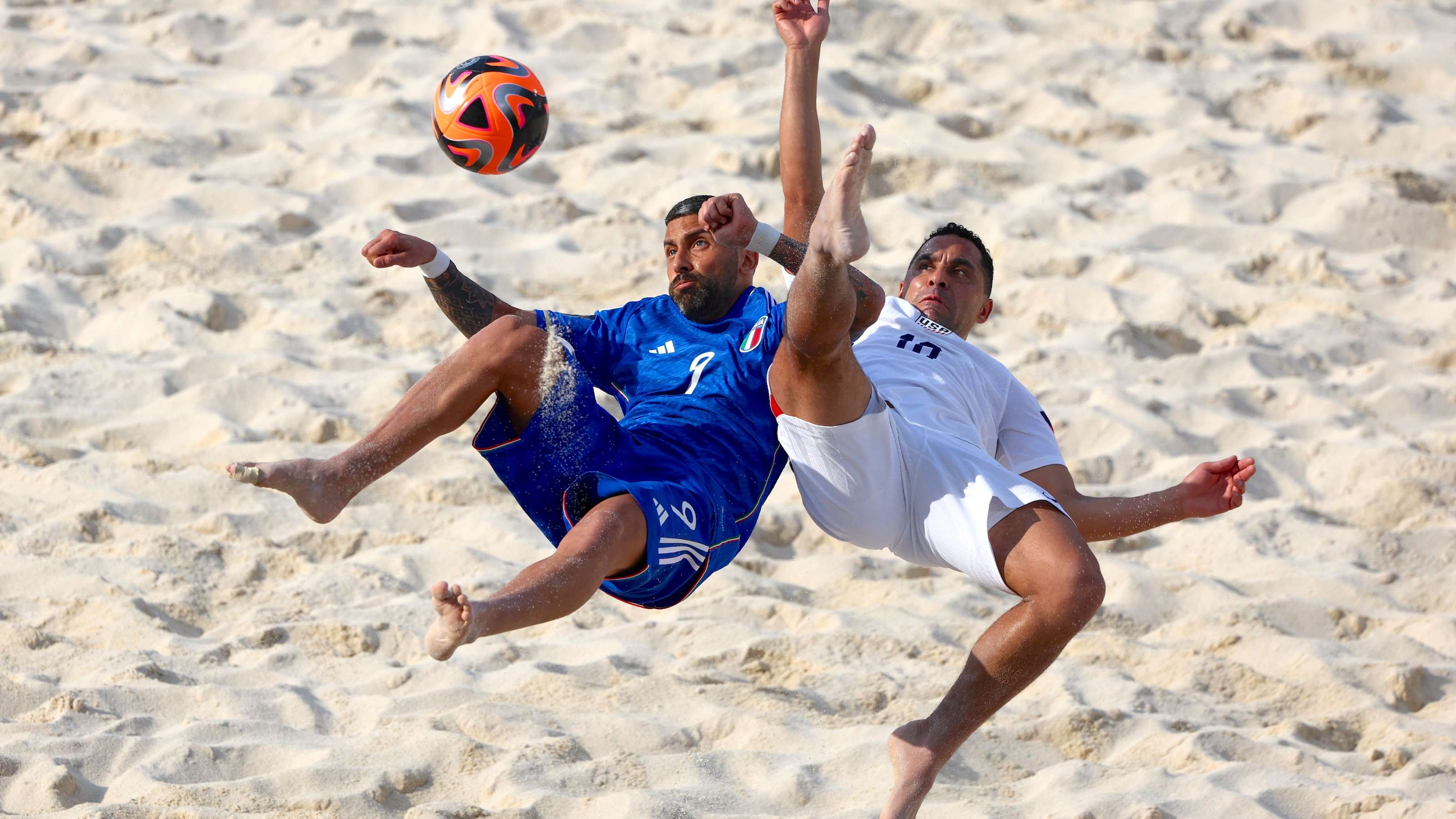
The U.S. team, meanwhile, are ever-improving. The last FIFA rankings had them at No. 15. Part of their challenge is that there is no professional infrastructure for the game in the United States. Perea’s pickup may be a scenic, idealized version of the game, but for a long time, it’s how many learned to play.
But the lack of an official organizing body - outside of the U.S. national setup - has given rise to some wonderful stories, and unique talents. The U.S. national team consists of a group of former USL players, ex-college talents, and futsal stars.
Perea, for one, stumbled across the game when his career had reached a dead end. He was a part of USL Championship side Indy Eleven in 2019, and still looking for a club when the COVID-19 pandemic shuttered sport around the world. With nowhere to play, he moved back to his native Miami. And there, an opportunity arose.
“I was just looking for a team, talking to my agent, trying to feel out the situation. And then the pandemic hit. Everything shut down. As you know, there was not much to do. The league was in a pause, and I was back home in Florida,” Perea said.
He reverted back to all of the things he had done as a kid - running on the beach, training on the sand. He used to go out to the ocean with his father in his youth, practicing headers into the water and working on his touch as the waves broke. A friend introduced him to beach soccer in full. Perea was told there would be a training session on the beach. Perea agreed to attend - without the crucial clarifying detail as to what exact sport he might be playing.
As it turned out, the session was run by the then-beach national coach Francis Farberoff. He was using the games as a quasi-scouting session. There were players from all over the world, Perea said, including Europe, Latin America and the U.S. But the man on the sidelines paid special attention to the Americans. Perea, a commanding center back with an excellent first touch, was swiftly invited to play for the team.
“Once they told me about the opportunities, like, ‘Hey, we travel, we play important competitions, you get to be home,’ I was just like, ‘Let's just try this beach thing out,’” Perea said.
For Canale, things were more complicated. The forward was at a crossroads in his career, soon to transfer from Santa Monica City College to UC San Diego to pursue 11v11 soccer. Upon the recommendation of a friend, he was introduced to Eddie Soto - then the U.S. beach head coach.
Soto told Canale that he needed extra players for a scrimmage in Seal Beach - two hours away from his native Venice. Canale, ever desperate to kick a ball, made the drive on the promise of a couple of hours of fun. This was not, Soto insisted, an official invitation to the camp.
Still, Canale impressed in the first scrimmage, and stayed the night before playing in the second. By his third day with the team, he was wearing a U.S. national team training shirt and in Soto’s plans for the squad.
There were issues, though. College soccer season was approaching. Canale was still enrolled at UCSD and had a winter of 11 a side ball to play. He managed to negotiate around it, and represented the U.S. at the beach World Cup that winter.
“I wasn't really sure if it'd be the best move for me to go,” Canale admitted. “But at the end of the day, like it didn't make sense to not. It was an opportunity that I couldn't pass up.”
Back to front, the whole thing took three months before Canale was kicking a ball in Tahiti.