Are you 24 or older?

Help us verify your age by providing an honest response. This site contains gambling advertising for 24+.

Age-restricted content

You’re not old enough to view betting content. You’ll be redirected to the homepage.

alt
Colo-Colo - 1:1Getty/GOAL

Colo-Colo: How Chile's 'Eternal Champion' became a symbol for something so much more

James Westwood
  • "Colo-Colo is by far the most popular club in Chile. Around 42 percent of the population declares to be a fan of the club," Colo-Colo's chief commercial and marketing officer Samuel Perez told Football Business Inside in 2022. "We have the biggest fanbase in every region across the country, in every socioeconomic and age group and the media coverage of anything related to the club is daily. There are two very famous sayings: 'Colo-Colo is Chile' and 'When Colo-Colo wins, the bread is crunchier and the tea is sweeter the day after'."

    Indeed, Colo-Colo are deeply connected to Chile's working-class population, and the bread and tea nearly always tastes good, because the team has been a winning machine for the best part of its 101-year history. Colo-Colo have won a record 34 Primera Division de Chile titles, way ahead of rivals Universidad de Chile (18) and Universidad Catolica (16), while no one can top their haul of 14 Copa Chile triumphs either.

    They are also the only Chilean club to have won South America's premier club competition and Champions League equivalent, the Copa Libertadores, and the only side in Chile to have competed in every single season of the top-tier division without ever being relegated. All of that explains why Colo-Colo are known as 'Eterno Campeon' ('The Eternal Champion') by their fiercely devoted colocolino supporters, and the club transcends football itself to act as a mirror of Chile's collective joys and struggles.

  • Early beginnings

    Colo-Colo
    Getty Images

    The club enjoyed success almost straight away, but also had to navigate an unprecedented tragedy

    Colo-Colo was formed in 1925, after Chile international David Arellano and 10 other players broke away from Deportes Magallanes, who were one of the country's oldest clubs, initially founded in the late 19th century. They settled on the new team name as a tribute to Colocolo, a legendary indigenous chieftain who led the Mapuche people in the 16th-century Arauco War against Spanish colonisers.

    Colocolo was celebrated as a champion of palin, a traditional indigenous sport similar to hockey, and revered as a brave and clever leader with an indomitable spirit, qualities that Arellano and Co. hoped would transfer to the players competing in his name.

    Tragically, Arellano didn't live to witness Colo-Colo's rise to the number one club in Chile. He died due to peritonitis caused by a severe blow to the abdomen from an opposing Real Valladolid player, as Colo-Colo travelled Europe playing exhibition matches. The news of Arellano's passing rocked Chile and South America as whole, with thousands paying their respects at his funeral, and Colo-Colo placed a black horizontal stripe above their badge as a lasting symbol of grief and gratitude.

    Despite losing their beloved co-founder and team captain, Colo-Colo went from strength to strength. In 1933, they helped create the Chilean professional football league alongside six other clubs from Santiago - the country's capital city. Four years later, Colo-Colo claimed their first national championship without losing a single game, and lifted the trophy four more times over the next ten seasons.

  • Symbol of defiance

    FBL-LIBERTADORES-ATLAS-COLOCOLO
    AFP

    After incorporating the portrait of Colocolo onto the club's badge, it became a symbol of hope in dark times

    The first Colo-Colo badges were made up of a basic shield with the club name written diagonally across it, but only appeared on posters and pennants rather than official jerseys. A new design, however, was created specifically for the jersey in 1950, with a portrait of Colocolo added to the shield.

    His black hair and white headband represented the club's colours, while the shield, drenched in blue and red to incorporate the Chilean flag, was layered behind the Colo-Colo name in a rectangle to complete the badge. This new design solidified the club's famous nickname, 'El Cacique' ('The Chief').

    In the 1970s and '80s, the badge took on even greater meaning. During the military dictatorship of Augusto Pinochet, the Mapuche faced political oppression and cultural erasure. Colo-Colo won10 trophies during this period with a Mapuche warrior proudly displayed on their chest, and become a symbol of defiance for indigenous people in Chile.

    There have been eight different versions of the Colo-Colo crest in total, with a star added in above the black Arellano mourning band in 1992 to mark the club's success in the Copa Libertadores. It is quite simply one of the most distinctive and historically powerful badges in world football, and can be viewed as a love letter to the soul of an entire nation.

  • Iconic home

    FBL-LIBERTADORES-COLOCOLO-CERROPORTEÑO
    AFP

    Colo-Colo's proximity to the Andes makes for an awesome backdrop to their home games

    Colo-Colo initially played at the Estadio El Llano before moving to the Campos de Sports de Nunoa in 1928, and from 1939, they primarily played home matches at Chile's national stadium, the Estadio Nacional. In 1946, meanwhile, they purchased Fortin Mapocho - a ground belonging to Carabineros de Chile that had been closed for security reasons - with the intention to build a 30,000 seat stadium, but they sold up after municipal rules blocked construction.

    In 1956, then-club president Antonio Laban outlined a much bigger blueprint for a 120,000 capacity venue. He acquired a 28-hectare plot in Macul with a view to completing the stadium in time for Chile to host the World Cup in 1962. However, a cruel twist of fate ruined everything.

    With construction 75% complete two years before the tournament kicked-off, an earthquake struck the city of Valdivia in southern Chile, and the government dropped the unfinished site from World Cup plans.

    For the next 15 years, Colo-Colo toiled to secure the funding needed to complete construction. The stadium was partially opened on April 20, 1975, and the team marked the occasion with a 1-0 win over Aviacion, but it lacked too many basic facilities and was deemed unsuitable for use after just four more matches, which forced the club to move back to Estadio Nacional.

    The wait continued through to 1989, when the venue, named the Estadio Monumental David Arellano to honour the club's founder, was finally completed. It was financed primarily through grassroots members and sponsors, along with the massive $1m transfer fee Colo-Colo received from Bologna for forward Hugo Rubio, and featured a concrete bowl design with steep terraces to bring supporters close to the action.

    With so much standing room, the stadium held between 62,5000 and 65,000 spectators at the grand reopening, but progressive installation of individual seating and infrastructure upgrades to comply with modern safety regulations has seen the capacity reduced over the years, and it now stands at around 47,000. Last year, Colo-Colo unveiled renovation plans to bring that number back up to 60,000, with construction slated to begin in late 2027.

    That has generated plenty of excitement, but the Monumental is already very special in its current state. The lower tier sits below ground level, giving it a sunken colosseum feel, and the deep pit traps noise perfectly to create an intimidating atmosphere for opposing teams.

    It also benefits from a breath-taking backdrop. The peaks of the snow-capped Andes Mountains loom behind the eastern stands, and look almost close enough to touch in clear winter skies. During evening matches, the sunset casts an orange glow onto the mountains that transforms the venue into a beautiful visual display known by locals as 'cielo en llama' (sky on fire).

  • The Garra Blanca

    Colo Colo v Union Española - Copa Chile
    Getty Images Sport

    Colo-Colo's ultras group is embedded in the club mythos, for both good and bad reasons

    Colo-Colo's barra brava ultras group 'Garra Blanca' (The White Claw) play a key role in making the Monumental such a unique stadium. The group was officially formed in the Santiago area in 1985 and drew inspiration from British and European culture, incorporating painted faces and bare-chested co-ordinated chanting.

    The Garra Blanca gave young people marginalised by the Pinochet regime an outlet to release their frustration and express identity. In return, they've been fiercely loyal to Colo-Colo, most notably when spearheading the 'Coloton' telethon-style movement after the club went bankrupt in 2002, which helped keep the team afloat before a corporate restructuring took place.

    That undying commitment to the club has also been proven in the stands. There are few more hostile stadiums in South America than the Monumental Arellano when the Garra Blanca are in full voice, and one of their main hallmarks is the use of giant, hand-painted, fabric banners that completely cover the northern terrace, while regular use of flares and smoke bombs generates a wall of fog against the Andes scenery.

    There is a dark side to their story, though. The Garra Blanca have been heavily implicated in wide-scale stadium violence, clashes with military police and street fights with rival groups - specifically Universidad de Chiles's 'Los de Abajo' (The Ones From Below). High security is always needed for Superclasico meetings between the two clubs, though sometimes it is not enough.

    In 2003, a derby clash was abandoned when a Universidad de Chile player was hit by an object thrown by a Colo-Colo fan. Six years later, supporter violence called a halt to to the second leg of their Chilean championship semi-final tie, with Colo-Colo awarded the victory after Los de Abajo hurled stones and plastic seats onto the pitch. In March this year, one fan was killed in a confrontation between the groups miles away from the stadium that escalated into gunfire.

    The violence is not exclusive to the Superclasico, though. There were more fatalities in April 2025 before Colo-Colo's clash with Fortaleza in the Copa Libertadores, as two teenage supporters died in a stampede that tore down one of the protective fences outside the stadium. Colo-Colo fans invaded the pitch in the 72nd minute of the game in protest, which caused it to be abandoned.

    There was also an incident of the Garra Blanca threatening the Colo-Colo squad during a 2021 relegation scare, as they hung a banner at the training centre reading "You win or we kill you". Despite all of this, however, the group is generally seen as the embodiment of the club's working-class ethos.

    They used the stadium to protest against economic equality during the 2018 Chilean social uprising, and frequently organise football tournaments and soup kitchens for families in poverty. The Garra Blanca have also rallied against Colo-Colo's corporate owners Blanco y Negro S.A., accusing them of treating the club purely as a business asset. Their ultimate aim is to facilitate a return to the times when Colo-Colo operated as a democratic member-owned club, and they are not shy about taking the fight directly to the corporate doorstep.

  • Copa glory & Chile's golden generation

    Alexis Sanchez (L) of Chile's Colo Colo
    AFP

    Colo-Colo made a massive splash on the international stage in the early '90s, and enjoyed unprecedented domestic success in the mid-2000s

    In 1973, Colo-Colo became the first Chilean club to reach the final of the Copa Libertadores, only to lose 2-1 to Argentina's Independiente after extra-time in a tie-breaking play-off after the first two legs had ended in draws. They would, however, banish the memory of that heart-breaking defeat when making the final again 18 years later, in 1991.

    After a 0-0 draw away to Paraguayan outfit Olimpia, Colo-Colo stormed to a 3-0 second-leg win to finally bring the hallowed trophy back to Chile, led by a brace from star forward Luis Perez and a goal from substitute Leonel Herrera. Renowned commentator Vladimiro Mimic delivered a spine-tingling line during his live radio broadcast as the final whistle blew: "Go out to the street, grip your flag, and know that Colo-Colo is champion of the Copa Libertadores."

    The weight of the achievement was not lost on Colo-Colo's Croatian manager Mirko Jozic either: "The Copa Libertadores doesn't belong only to those who won it, but to all colocolinos... We proved that Colo-Colo could look face-to-face at any team on the continent."

    Colo-Colo showed that again the following year, beating Brazilian giants Cruzeiro on penalties in the Recopa Sudamericana final in Japan before thrashing Mexico's Club Puebla 7-2 on aggregate to clinch the Copa InterAmericana. With three international titles and nine domestic trophies amassed, the 1990s was the most successful decade in Colo-Colo's storied history.

    They did enjoy another glorious era between 2006 and 2008, though, as Argentine coach Claudio Borghi restored the club's institutional pride after the financial crisis that threatened its existence. Borghi led Colo-Colo to an unprecedented 'Tetracampeonato', winning four consecutive national league titles, with an emotional penalty shootout victory over Universidad de Chile in the Torneo de Apertura final marking the highest point.

    Colo-Colo also reached the 2006 Copa Sudamericana final on his watch, narrowly losing to Pachuca 2-1 on aggregate, and Borghi was deservedly crowned South American Coach of the Year for implementing a daring 3-4-2-1 formation.

    Borghi's most enduring legacy, though, was his ability to nurture talent, as he provided the launchpad for Chile's golden generation, bringing through fearsome midfield enforcer Arturo Vidal (more on him later) and former Barcelona and Manchester City goalkeeper Claudio Bravo, while also giving ex-Arsenal and Manchester United playmaker Alexis Sanchez the platform to shine on loan from Udinese.

  • Club icons

    SOC COLO COLO-U. CATOLICA
    AFP

    Colo-Colo has been home to so many brilliant footballers over the years, and a select few are still celebrated to this day

    As the highest-scoring player in Colo-Colo's history with 208 goals in 374 official matches, Carlos Caszely is widely considered the greatest to ever wear their jersey. He led the team to the 1973 Copa final as the competition's top scorer, and won eight major honours across his two spells at the Monumental, while also earning the nickname 'Rey del metro cuadrado' (King of the square metre) for his close control and ruthless finishing.

    Caszely's off-field impact was even more significant. He aligned himself with the left and was an outspoken critic of Pinochet, famously refusing to shake his hand in the lead up to the 1974 World Cup. To Colo-Colo fans, he's the ultimate standard of what it means to be a rebel, and he was immortalised in a statue outside the Monumental in 2022.

    During the first Colo-Colo's Members' Day at the Monumental in April, Caszely eloquently explained what the club means to him and its' supporters, saying: "It's about always having your heart racing, being supportive, understanding that Colo-Colo is more than just a football team. It is social, it is a heart that stretches from Arica to Punta Arenas. Colo-Colo is everything, it is the greatest thing there is."

    Right next to Caszely's sculpture is one of another Colo-Colo icon, Francisco 'Chamaco' Valdes. The attacking midfielder was the perfect foil for Caszely for both Chile and Colo-Colo, also taking in two separate stints at the club, and led by example as captain. He was a technical genius and master from dead-ball-situations who scored 180 goals for Colo-Colo, many of which fell into the spectacular bracket.

    Valdes died in 2009 at the age of 66, and a memorial event was held at Colo-Colo's Mausoleum earlier this year, with Caszely among those to pay tribute. "In football, I wouldn't have been who I was if it weren't for Chamaco. I've never seen, anywhere in the world, a player with Chamaco's intelligence," he said.

    No one may ever match the legacy of Caszely and Valdes, but one member of Colo-Colo's triumphant 1991 Copa Libertadores side came close. Marcelo Barticciotto (pictured above) scored three vital goals during the team's historic run, and recorded two assists in the final, while he also notched the first goal at the re-inaugurated Monumental in 1989.

    Affectionately known as 'Barti' or 'El 7 del Pueblo' (The People's 7) by fans, the explosive winger was also a leading figure in three Chilean league title successes, and holds the record for the most Colo-Colo appearances in continental competition (86).

    As if all of that wasn't enough to cement his legendary status, Barticciotto showed his devotion to the club while playing for their rivals, Universidad Catolica, on loan from Club America in 1995. He scored in a 2-1 win for Catolica, but refused to celebrate the goal, instead bowing his head in an act of respect for Colo-Colo, whom he re-joined the following year.

    "I hadn't planned not to celebrate it or anything. In that moment, it came from the heart. I couldn't celebrate the goal against those people who had applauded me, who asked me about it in the street and showed me so much affection. I couldn't," Barticciotto recalled to Vamos a Recordar.

    "I realised how much affection the people had for me. It was an ovation I will never forget. That's when I asked myself, 'What am I doing here wearing this shirt?' It was very strange for me, especially when I arrived at the match. On the other side were my team-mates of so many years, so many battles. I never felt anything like it again. I tried to be as professional as possible, but I was always looking the other way, with my heart in Colo-Colo."

    When Barticciotto announced his retirement in 2003, a total of 50,000 fans turned up at the Monumental to say goodbye to their idol, and he returned as a manager five years later, guiding the club to the Clausura trophy to boost his bond with the Garra Blanca even further.

  • Modern heroes

    FBL-LIBERTADORES-COLOCOLO-ATLMINEIRO
    AFP

    Colo-Colo have not wanted for attacking firepower since the turn of the century, or fan favourites

    As far as modern Colo-Colo heroes go, none stand above Luis Mena, a.k.a. 'El Historico'. The reliable centre-half spent almost his entire professional career with Colo-Colo (1996-2014), the last two years of which he served as captain, and won 11 league titles with the club - an all-time record in Chilean football.

    By his own admission, Mena was not the most talented player, but his outstanding work ethic and love for Colo-Colo made up for it. Becoming skipper was an especially great honour for the defender, who told El Cancha: "Being the captain of Colo-Colo represented the dream of a lifetime. It is a heavy responsibility to carry, but when you know how to manage it and channel it, it becomes something incredibly significant."

    Mena was the heart of the squad, and his efforts off the ball allowed others to flourish, particularly when Borghi was in charge. Colo-Colo academy graduate Matias Fernandez scooped the South American Footballer of the Year award in 2006 on the strength of his outstanding displays under Borghi, dazzling with his athleticism, technical flair, and free-kick prowess.

    Fernandez scored 20 goals in 30 domestic appearances from midfield that season, and struck up an unstoppable partnership with Humberto Suazo. The Chilean striker contributed 34 goals of his own across the Apertura and Clausera in 2006, and another 13 in international competitions, bringing his total to 47 in just 49 appearances. Suazo was an unorthodox striker with immense upper-body strength, and seemed to have ice in his veins in on-vs-one situations.

    After he left at the end of the 2007 campaign, Colo-Colo struggled to fill the void. That was, until they signed Esteban Paredes (pictured above) from Santiago Morning for a modest fee of €350,000 in 2009. Paredes hit 50 league goals across his first three seasons at the club, earning the moniker 'El Tanque' (The Tank) because of his skills as a target man and powerful shooting. Fans also rooted for him because he came from a humble background in Santiago and grew up as a die-hard fan of Colo-Colo, often singing alongside the Garra Blanca.

    Paredes left Colo-Colo in 2012, but returned two years later when the team was enduring a long streak of inconsistency, and immediately fired them to their 30th league title. He remained the focal point in the side until 2021, and signed off with 198 goals for Colo-Colo, putting him second on their all-time list behind Caszely, with a record 16 of them coming in Superclasico games against Universidad de Chile.

  • Return of El Rey

    FBL-CHI-COLOCOLO-VIDAL
    AFP

    Arturo Vidal is perhaps the most famous player to represent Colo-Colo, and he's still starring for the team at 39

    Of all the players who rose to prominence under Borghi, Vidal can claim to have left the biggest mark on Colo-Colo. After spending five years learning his trade in the club's youth ranks, he made his debut as an 18-year-old in 2005, and went on to play an instrumental role in their Clausura 2006 and Apertura 2007 victories, with Borghi using him as both a left-sided centre-back and holding midfielder.

    Team-mates took to calling Vidal 'Celia Cruz', after the legendary Cuban singer, because of his eccentric hairstyles and loud personality, while on the pitch, he lived up to the 'Cometierra' (Dirt-eater) nickname that followed him around in the academy, constantly launching into slide tackles without a second thought.

    Vidal's grit was endearing, and he his powers of positioning and anticipation were exceptional for his age. He would often beat much taller opponents to headers purely with superior timing, and showcased relentless stamina that instantly made him a terrace darling. Unfortunately for Colo-Colo, he was far too good to be kept away from Europe's elite.

    Bayer Leverkusen bought Vidal for €10m in 2007, and he spent four years in Germany before joining Juventus, where he became one of the best midfielders of his generation, evolving into a box-to-box No.8, with fans anointing him 'El Rey' (The King). Vidal also enjoyed successful spells at Bayern Munich, Barcelona and Inter, but never forgot his roots, regularly posting his support for Colo-Colo on social media and talking openly about a future homecoming.

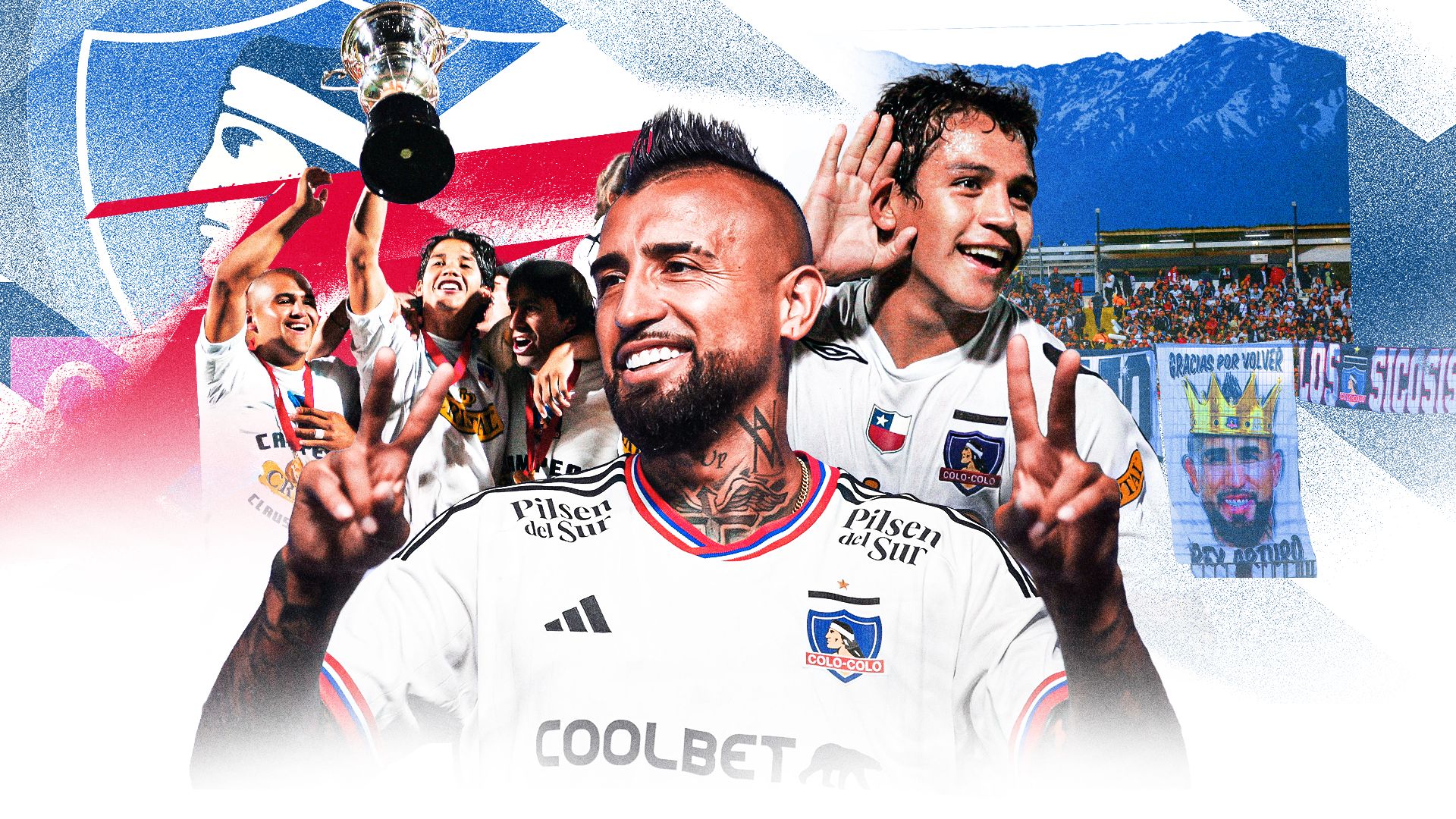
    That eventually came in 2024, when he returned to the Monumental on a free transfer, and Colo-Colo staged an elaborate welcome ceremony that made headlines across the planet. Vidal arrived at the stadium by landing directly on the pitch via a helicopter, dressed in a cape, crown and holding a sword, before mounting a horse and riding around to greet 35,000 adoring supporters.

    "Everywhere I've been, I've always put Colo Colo first. And now everyone will follow Colo Colo," he said in a subsequent press conference. "I want them to know it as one of the strongest teams in South America. There are very good players, a huge fan base. Colo Colo is a country. People will be paying more and more attention. I want the world to know it."

    Vidal has done everything in his power to make that happen. He inspired Colo-Colo to their 34th Chilean league title in his first season back, even scoring the decisive equaliser to clinch the trophy in a final matchday draw against Deportes Copiapo, and they also made it to the Copa Libertadores quarter-finals, their best run in years.

    Fast-forward to the present day, and Colo-Colo sit top of the Chilean top-flight once again, 12 points clear of Catolica, and Vidal has seven goal contributions to his name in all competitions at 39 years old. Not only is he defying Father Time, but also acting as a beacon of professionalism for the club's younger players to learn from.

    "Arturo doesn't just bring history to the pitch; he brings an unmatched authority," current Colo-Colo manager Fernando Ortiz has said. "Having a player who has won at the highest levels in Europe means the younger players have a living blueprint of what a winner looks like. His voice holds a different kind of weight."

  • Human passion

    FBL-CHI-COLOCOLO-UNIONESPANOLA
    AFP

    As well as an attractive footballing project, Colo-Colo can offer players a unique sense of belonging

    The presence of a superstar like Vidal is only a good thing for Colo-Colo's global profile, too, and they're now in a stronger position than ever to attract other top players. Indeed, Colo-Colo proved themselves as a formidable force in the market during the summer window, winning the race for 2026 World Cup sensation Vozihna.

    The veteran goalkeeper was one of the tournament's outstanding performers as Cape Verde defied all expectations to reach the round of 32. He was especially brilliant in a 0-0 group-stage draw against eventual champions Spain, pulling off seven saves - the second-most by a goalkeeper aged 40 or older in a World Cup match since statistics were first recorded in 1966.

    Vozinha reportedly attracted attention from Lionel Messi's Inter Miami, but opted to join Colo-Colo instead upon the expiration of his contract with Portuguese second-division side Chaves. "Deep down, I always told myself I was a 'big club' player," Vozinha said at his official unveiling. "So when Colo-Colo came calling, there was no doubt. I received many offers, but Colo-Colo was always the priority."

    The fact that a Yashin Trophy-nominated goalkeeper was that determined to join speaks volumes about Colo-Colo's level of prestige. They are the only Chilean club to rank in the current top 20 of CONMEBOL's official club standings, sitting ahead of powerhouse Brazilian clubs like Internacional, Fluminense and Corinthians.

    They fight for the biggest domestic trophies pretty much every year, and have a sterling track record in the Libertadores. Vidal vowed to bring continental silverware back to the Monumental when he returned, which is not an unrealistic goal.

    But even more important than all of their footballing credentials is Colo-Colo's unfiltered human passion. Those lucky enough to wear the shirt represent the memory of Colocolo and Arellano, and carry the emotional well-being of millions of working-class families.

    Last year, Chilean media personality Pedro Ruminot shared a quote from Jozic on Zapping TV that quickly went viral on social media, because it encapsulates what makes the club so uniquely special. The former coach said: "For me now, Colo-Colo is something I cannot touch, nor feel, nor see, because I am far away. But it is bigger than love."