
GOALLife after Lionel Messi: American soccer isn't ready for the void he'll leave behind
Kamal Miller didn't even question it when Lionel Messi just showed up at the Inter Miami facility. There had been rumors for weeks on end that the eight-time Ballon d'Or winner might sign for the team. The security at the training ground had gotten tighter. Players were told that the No.10 shirt was unavailable.
But when Miller, a veteran center back, walked into the locker room one day to find Messi sitting there, he was simply starstruck. The rumors were reality. They had secured the biggest signing in MLS history. That was the moment before the moment. Everything shifted then for the players. This guy, who, less than a year before was lifting the World Cup trophy for Argentina, sat there, before them. Miller texted his family hurriedly. But by that time, the internet had already blown up. Messi had arrived, and American soccer would never quite be the same.
Of course, Messi would soon announce himself to the league. It started with an exciting showing off the bench in Leagues Cup, capped off with a classic free kick.
Then there was a Leagues Cup win, a Supporters' Shield victory, and an inevitable capture of MLS Cup in 2025. Three years, three trophies. Job done. And a few months ago, it felt like there may be more to come. Before the season, Messi penned a new contract to keep him at the club through the 2027-28 season. Miami had their guy, in theory, for years to come.
But now, things look remarkably different. Following a gut-wrenching World Cup final loss to Spain, Messi announced his retirement from international soccer earlier this week. And with his personal admission that he finds it hard to capture the drive required to play 90 minutes, it seems that walking away from his club and hanging his boots up for good could happen anytime. Basically, this is the Messi endgame.
That's bad for football. But the global game will go on. For the American soccer scene, though, it could be absolutely catastrophic. Messi has been the lifeblood of this sport for the past three years in the United States - and arguably well before that. If he walks, all levels of the game in North America will suffer, and serve as a test of soccer's strength like never before.
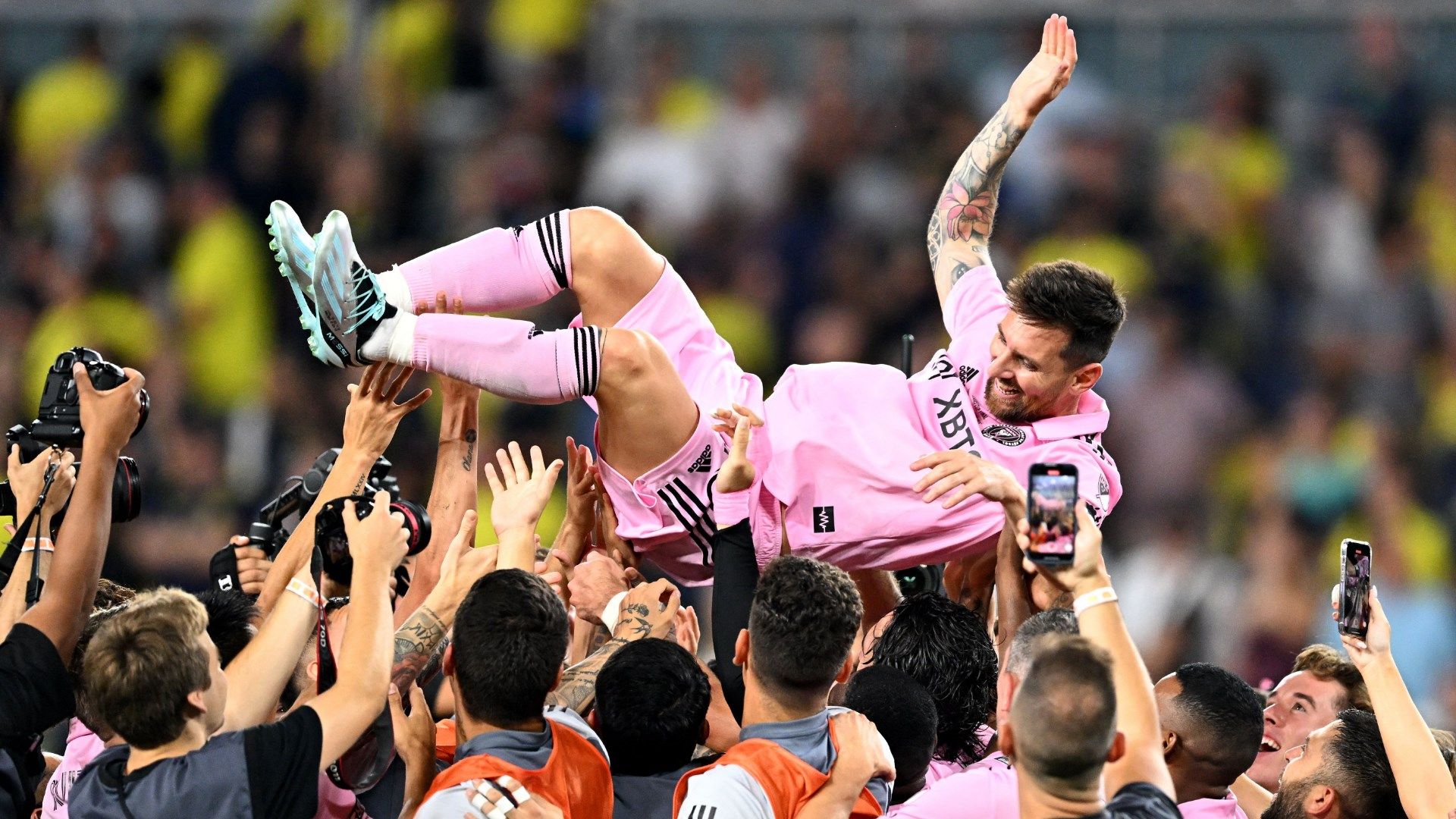
MLS's cash cow
Getty ImagesMessi led Miami to a first trophy in franchise history after signing as a free agent in 2023.
It's hard to overstate how significant Messi's arrival was in 2023. MLS was in a strange spot at the time. Sure, the league's product was always improving. But this thing needed a star, and at the time of Messi's arrival, the landscape was relatively barren. The big-name near-retirees that had once served as the eyeballs of this thing had dried up. MLS, whether it admitted it or not, needed a shot in the arm. And 20,000 fans sold out Chase Stadium to watch his unveiling, braving a Miami thunderstorm to catch a glimpse of Messi shaking David Beckham's hand.
And so arrived the Argentine, seven months removed from his career's crowning achievement. He cared, too, and even if Miami were basically out of playoff contention when he signed, Messi led a charge to Leagues Cup, scoring 10 goals as Miami went undefeated in seven straight to win their first major trophy.
The off-field impact was even more significant. Despite the player himself arriving halfway through the season, Messi's jersey was the bestseller for the whole year. Tickets for every single Inter Miami game - home and away in all competitions - sold out within 24 hours of his arrival. Ticket prices on the secondary market increased by 4.5 times, according to StubHub.In 2024, Miami sold out their season tickets (it didn't matter that the club doubled prices in some sections). In 2021, the club signed a jersey sponsorship agreement that included a clause that if the club acquired a player who had won the Ballon d'Or at least five times, the payout would double. In May, Forbes valued Inter Miami at $1.4B.
The league has benefitted, too. According to Sportico, MLS sponsorship revenue grew by 17 percent in the 12 months after Messi first joined the league. Almost immediately, he was not only Miami's star but also MLS's cash cow.
A brand of his own
GettyMessi has been criticized for his reluctance to help bolster MLS's brand.
Yet all of this has happened amid the persistent feeling that Messi has never fully embraced his role as an ambassador for American soccer.
His media appearances have been minimal, while his involvement in the MLS All-Star Game - a major tentpole for the league - has been virtually nonexistent: injured in 2024, declining to go in 2025 and unavailable again after the 2026 World Cup. Beyond a brief Apple TV interview following his Leagues Cup debut, he has largely avoided the post-match obligations other MLS stars routinely fulfill.
His major American advertising campaigns have also been relatively limited, while Inter Miami have tightly controlled access to both Messi and his teammates. That approach has frustrated local reporters and MLS traditionalists accustomed to a league - and a broader American sports culture - in which stars are expected to be more accessible.
And yet, Messi has remained indispensable to the growth of American soccer. He may not have embraced every ambassadorial expectation that accompanied his arrival, but his impact has never depended upon doing so.
'We have Leo playing in MLS'
GettyMessi was crucial in Miami's run to an MLS Cup win in 2025.
And that's where the real concern for MLS should be. Messi is so big that he is self-sustaining. His influence expands beyond MLS media rules. His notoriety means that he does not need to do press tours or ad campaigns. Perhaps there is mystery in scarcity, but Messi is basically bigger than this sport. He has 516 million Instagram followers, 100 times more than the league itself. There is a compelling argument to be made that Messi is the most famous person in the world. He is perhaps the most famous human ever. That's not a gross overstatement.
There's an effortlessness to this, too. Messi does not need to make an appearance or lift a finger to guarantee that his jersey sells out, or plant hundreds of thousands of Inter Miami shirts in New York, London and pretty much every major city around the world. He has brought notoriety to not only Inter Miami but also the league without really having to try. Those who used to play here recognize this.
"The league is still growing; these big names are coming. Now we have Leo playing in MLS; that's really, really nice. So it's good to see how the league is developing," Brazilian legend Kaka, who played for Orlando City from 2015 to 2017, told GOAL.
'We are so close to the end'
GettyMessi admitted that the death of his father led him to question his longevity in the game.
But what happens when all of that goes away?
The first point worth acknowledging here is that Messi doesn't really owe anyone anything anymore. In a heartbreaking Instagram post following the passing of his father, Messi openly admitted his days in this sport are numbered:
"I don’t know what I’m going to do without you; I don’t know how to go on. I played soccer, but now I have serious doubts about whether I’ll keep doing it for much longer. You were by my side from the very beginning, and we were so close to the end. Why couldn’t you hold on just a little longer so we could finish this journey together?" he wrote last month.
He is under contract until 2028, and Inter Miami co-owner Jorge Mas has said Messi earns between $70 million and $80 million annually across his salary and various commercial arrangements. That would be a lot of money to walk away from alone - never mind the sponsorship he has with Adidas. The counterargument, of course, is that Messi doesn't really need the cash. His net worth is $1.1 billion. His career earnings, pre-tax, are approaching $2 billion. Whether Messi "needs" the money or not is pretty much irrelevant, though. This is now about drive, desire, and, as cliché as it sounds, the love of the game. Basically, the only thing preventing Messi from walking away is the man himself.
How to replace him?
(C)Getty ImagesNeymar has been touted as a potential replacement for Messi in Miami.
And it looks increasingly likely that he will. The shockwave of that would be immense. In an instant, MLS stands to lose its top jersey seller, its best player, and its selling point to the rest of the world. For many casual fans outside North America, Messi remains MLS’s clearest and most compelling selling point. When he no longer does, it's hard to vouch for the league as a product alone.
There are three major responses there. The first is one that MLS has always counted on - that the Messi effect will have raised the quality of the league enough and brought in new faces. Certainly, there is a line to be drawn from Messi's success domestically and globally in an MLS shirt to the arrivals of players such as Son Heung-Min, Antoine Griezmann and Robert Lewandowski. There is no Rodrigo De Paul, Casemiro or Luis Suarez without Messi. But has the average league quality risen enough in the three years since he has played in the league?
And that's another solution. MLS has been flirting with new salary structures for a while. The idea, roughly, is that allowing teams to spend more money on an "average" player will allow clubs to seek out better talent. Teams will improve over time, and the product, writ large, gets better. Timing that around Messi's retirement - or, even better, as soon as possible - will no doubt help MLS capitalize on some momentum.
The third is to play the hits, return to the playbook and find another star. Messi can be recreated in the aggregate, Moneyball style. Cristiano Ronaldo is certainly off limits as an acquisition. But the world is pretty open otherwise. Neymar would seem to be an ideal fit, both in name and for the Brazilian flair he would bring to an already South American-heavy Miami fanbase.
There is, in fact, no like-for-like solution. Messi accelerated the growth of MLS and expanded its international relevance in a way no other player could. The league cannot replace him with one signing; it will have to recreate his impact in the aggregate through deeper investment, more recognizable stars and a stronger week-to-week product.
Whether that will be enough to sustain the momentum he created remains American soccer’s looming billion-dollar question.
