Legacy England 2002 GFXGetty/GOAL

LEGACY: How England’s ‘egotistical losers’ blew their biggest chance for a second World Cup crown in 2002 - and the lessons Thomas Tuchel must learn

England have endured nothing but heartbreak at the World Cup since their historic success on home soil back in 1966. The Three Lions succumbed to Argentina and Diego Maradona's 'Hand of God' in the 1986 quarter-finals, before being sent packing in the semis four years later by Germany after a gruelling extra-time battle. Those same two teams inflicted round-of-16 defeats in 1998 and 2010, respectively, while Portugal got the better of England in the 2006 quarters.

A sense of real belief finally returned in 2018 under Sir Gareth Southgate as England exceeded expectations by reaching the final four, but they disappointed again in 2022 after being upgraded to one of the tournament favourites, falling to a 2-1 quarter-final loss to France that was defined by the worst penalty of Harry Kane's career.

England have had 11 chances to lift the famous gold trophy again, only failing to qualify for the tournament in 1974, 1978 and 1994, with an embarrassing group-stage exit in 2014 marking their worst performance at a modern World Cup finals. Bad fortune has undeniably played a part, but each generation of players has let themselves down in some way, whether by freezing up in the most important moments or failing to transfer their club performances to the international stage.

In 2002, it was an unforgivable combination of both. That should have been the year that football 'came home' for the second time. Those were certainly the sentiments of head coach Sven-Goran Eriksson after his squad had returned home from South Korea and Japan bruised and beaten.

"The one thing that we always said to the players was that with the team that we have, we should not be afraid of anyone and, if we are a little bit lucky, we could go all the way," he said. "I still think we could have done it."

But they were afraid. In fact, it was perhaps one of the worst cases of fear crippling an elite team in the history of international football. And if Thomas Tuchel's current group are to succeed where Eriksson's came up short 24 years ago, the lessons from that failed foray in the Far East must be heeded.

  • England v Greece 2002 World Cup QualifierHulton Archive

    Dramatic qualification

    Eriksson initially took the managerial reins at a time when the England team was in complete disarray. The Three Lions crashed out of Euro 2000 in the group stage before opening their 2002 World Cup qualifying campaign with a 1-0 defeat to Germany in the last game ever played at the old Wembley. After the final whistle, then-Football Association (FA) director David Davies, dragged manager Kevin Keegan into a toilet cubicle to try and convince him not to resign, but his pleas fell on deaf ears. 

    "You can’t change my mind," Keegan is reported to have said. "I’m out of here. I’m not up to it. I’m going out to the press to tell them I’m not up to it. I can’t motivate the players. I can’t get the extra bit out of these players that I need." True to his word, the beloved Liverpool icon stepped down, later terming his 20-month tenure with the national team as "soulless".

    In the eyes of many, England had hit rock bottom, and the FA decided a serial winner was needed to turn the tide. Enter Eriksson, who was seen as one of Europe's finest coaches after guiding Lazio to the 1999-2000 Serie A title. There was still plenty of public scepticism when the serene Swede was appointed as the first foreign manager in England's history, but he won most of them over by winning his first five games, a mixture of friendlies and qualifiers against Spain, Finland, Albania, Mexico and Greece.

    Eriksson then masterminded an all-time great performance in a 5-1 victory over Germany at the Olympiastadion in Munich, with Michael Owen blasting an unforgettable hat-trick. It was a result that sent shockwaves through the international game, and England followed it up by breezing to a 2-0 home win against Albania four days later that left them only needing to match Germany's result in the final round of qualifiers to finish top of their group.

    They accomplished that mission, but it was an agonisingly dramatic process rather than the straightforward one it should have been. Greece stunned the Three Lions to establish and hold a 2-1 lead at Old Trafford right up until the third minute of stoppage time, when Manchester United's own David Beckham stepped up to equalise with a sensational 30-yard free-kick. With Finland holding Germany to a 0-0 draw, that magical strike proved to be enough to secure England's automatic ticket to the first-ever World Cup finals in Asia.

  • Advertisement
  • David BeckhamGetty Images Sport

    Injuries bite

    The euphoria generated by the rout of Germany and Beckham's instantly-iconic goal against Greece soon, however, gave way to apprehension, as England were drawn into the dreaded 'Group of Death' for the 2002 tournament, alongside old enemies Argentina, Eriksson's native Sweden and potential bogey team Nigeria.

    To make matters worse, Beckham, Gary Neville and Steven Gerrard all pulled up with serious injuries at the end of the club season, and Eriksson found himself plastered all over the front and back pages of UK newspapers for cheating on his long-term girlfriend Nancy Dell'Olio with television presenter Ulrika Jonsson.

    It was feared that Eriksson's private life would distract from England's preparations, and his final squad selection drew plenty of criticism. He opted for Wes Brown and Danny Mills over Jamie Carragher and Phil Neville in defence, omitted Steve McManaman and Frank Lampard from the midfield and only picked five forwards, with Andy Cole announcing his retirement from international football after being overlooked.

    "There's a major concern as to where the goals are going to come from," former Sky Sports pundit and Scotland international Andy Gray said on BBC Radio Five Live. "If Michael Owen is not on form, then where's his back-up? Who is going to do it if Michael doesn't?"

    Eriksson was deemed to be playing it too safe with eight defenders, but did take one big risk by including Beckham, who was given a six-to-eight-week recovery timeline after suffering a broken foot in United's Champions League win over Deportivo La Coruna in early April.

    The captain's rehabilitation, and the meaning of the word metatarsal, was pored over by fans and the media up right up until the big kick-off, and beyond. Gary Neville and Gerrard were not able to play through the pain barrier, though, and the latter's replacement, Danny Murphy, also fractured his foot just eight days before England's opening game, with West Ham's Trevor Sinclair called up to fill his spot. Kieron Dyer and Nicky Butt were dealing with knocks, too, leaving some experts to claim the campaign was doomed before it had even begun.

  • Michael Owen of EnglandGetty Images Sport

    Lucky escape

    Still, Eriksson was not short of quality. David Seaman, Martin Keown, Sol Campbell, Paul Scholes, Owen Hargreaves and Teddy Sheringham completed the list of household names alongside Beckham and Gary Neville, while Owen, Rio Ferdinand and Ashley Cole led England's crop of younger talents.

    The first match, a meeting with a bang-average Sweden team, offered an opportunity for the Three Lions to flex their underrated muscles. Alas, they did not grab it. A half-fit Beckham, sporting a distinctive blonde mohawk, justified his inclusion from the start with a pinpoint corner delivery for Campbell to head Eriksson's side in front inside the first 25 minutes. But instead of pushing on thereafter, England sat back and invited pressure.

    Niclas Alexandersson capitalised on an awful clearance from Mills to drive home the equaliser, and Sweden dominated for the remainder of the second half, with Teddy Lucic and Henrik Larsson both going close to finding a winner. England held on for a 1-1 draw, but it was a lucky escape and the mood in the dressing room was sombre, not least because Argentina had won their opener against Nigeria 1-0 earlier in the day.

    Eriksson was not disheartened, though: "When you lead 1-0 and then draw, it feels like you've lost. You shouldn't feel like that but that was the feeling in the dressing room after the game so I told them we are not at a funeral. We have just started the World Cup and of course we can still get through. Everything is still possible as it's very tight."

  • ENJOYED THIS STORY?

    Add GOAL.com as a preferred source on Google to see more of our reporting

  • English midfielder David Beckham (L) and his teammAFP

    Revenge

    Sure enough, England issued a strong response in their second game against Argentina, but Eriksson's rallying cry had little to do with it. Four years on from their painful penalty shootout to Argentina in France, a desire for revenge fuelled the squad - and most notably Beckham, who was sent off early in the second half with the scoreline at 2-2 for kicking out at Diego Simeone.

    Right from the off at the Sapporo Dome in Japan, there was a ferocity to England's play that was, regrettably, never replicated again in the Eriksson era. The Three Lions out-battled and out-played Argentina in a pulsating first half, and got their noses in front when Owen cleverly drew a foul from Mauricio Pochettino just inside the box.

    Beckham grabbed the ball and confronted all of his demons in the most pressurised situation imaginable. It would have been easy to buckle, but just as he did in the qualifier against Greece, the resilient midfielder took a deep breath and focused purely on nailing his technique, powering a low shot into the centre of the net that was so fast that Argentina goalkeeper Pablo Cavallero seemed to blink and miss it.

    It was a moment of great catharsis for Beckham and signalled England's arrival as a force at this World Cup. Argentina threw the kitchen sink at their rivals in the second half but found no way through, with Ferdinand and Campbell epitomising the unbreakable spirit in the group with a series of crucial blocks, interceptions and tackles. England got the win and the vengeance they craved, and when news filtered in of Sweden's 2-1 win over Nigeria, they knew that a draw in their final group fixture would ensure progress to the last 16.

  • English players defender Trevor Sinclair (L) and fAFP

    Stalemate followed by masterclass

    England got the point they needed as they played out a 0-0 stalemate with Nigeria, but missed out on top spot in the group after Sweden drew 1-1 with Argentina. Even more concerning was the players' lethargic performance in the energy-sapping heat and lack of cutting edge in the final third.

    Instead of a more favourable draw (on paper) against Senegal, Denmark now stood in England's way of a place in the quarter-finals. The Danes had topped Group A ahead of Senegal and pulled off massive upset wins over Uruguay and dethroned champions France, scoring five goals in total.

    A difficult night was expected in Niigata's Big Swan Stadium and fans were on edge. But they needn't have worried. England hurtled out of the blocks and breached the Denmark defence just five minutes in, with Beckham claiming another corner assist as Ferdinand nodded in at the back-post (aided by the calamitous handling of opposition goalkeeper Thomas Sorensen).

    Owen made it two with a trademark poacher's finish before Emile Heskey rifled home England's third just before the break after more good work from Beckham. It was a near-flawless first-half display characterised by slick passing interchanges and aggressive pressing.

    Eriksson's men cruised to a 3-0 victory in the second 45 minutes to set up a blockbuster quarter-final meeting with a Brazil side that were far less impressive in their own last 16 tie. Belgium went down 2-0 against the Selecao, but created enough chances to win the game and controlled the midfield for much of the contest. The Three Lions had the tools to make the four-time winners pay if they repeated those mistakes, with even Brazil legend Pele admitting toBBC Sport that, "If England can keep their cool and their discipline they will win the game."

  • Sven Goran Eriksson of EnglandGetty Images Sport

    Schoolboy errors

    England's clash with Brazil kicked-off in the middle of the afternoon with scorching 28°C temperatures and humidity inside the Yokohama Stadium at 57 per cent. Those conditions favoured Luis Felipe Scolari's team, and it was clear in Brazil's play at the start of the game as they largely pinned England in and knocked the ball around confidently.

    However, with the colossal Campbell setting the tone at the back, England managed to stifle the Selecao's illustrious attack and looked dangerous on the counter. In the 23rd minute, one such breakaway led to Heskey playing a searching ball through towards Owen. It was slightly wayward and should have been dealt with by Lucio, but the Brazil centre-half's poor first touch fell straight into the path of Owen, who took a touch before expertly dinking the ball into the far corner.

    Brazil were stunned and, suddenly, Pele's pre-match prediction sounded realistic. But England needed to kick on rather than retreat, as they did against Sweden on matchday one. The South Americans were wounded and there for the taking.

    Sadly, though, that was just never the Eriksson way. He instructed his side to sit deep and protect the lead through to half-time, which allowed Brazil to quickly regain confidence. With only seconds to go before the whistle, the inevitable happened.

    A sequence of schoolboy mistakes for the equaliser began when Beckham, clearly conscious of taking a blow to his weak foot, jumped out of a tackle with Roberto Carlos. Roque Junior then played a loose pass into midfield that Scholes should have picked up, but it was taken off his foot by Kleberson, and the ball broke for Ronaldinho to charge.

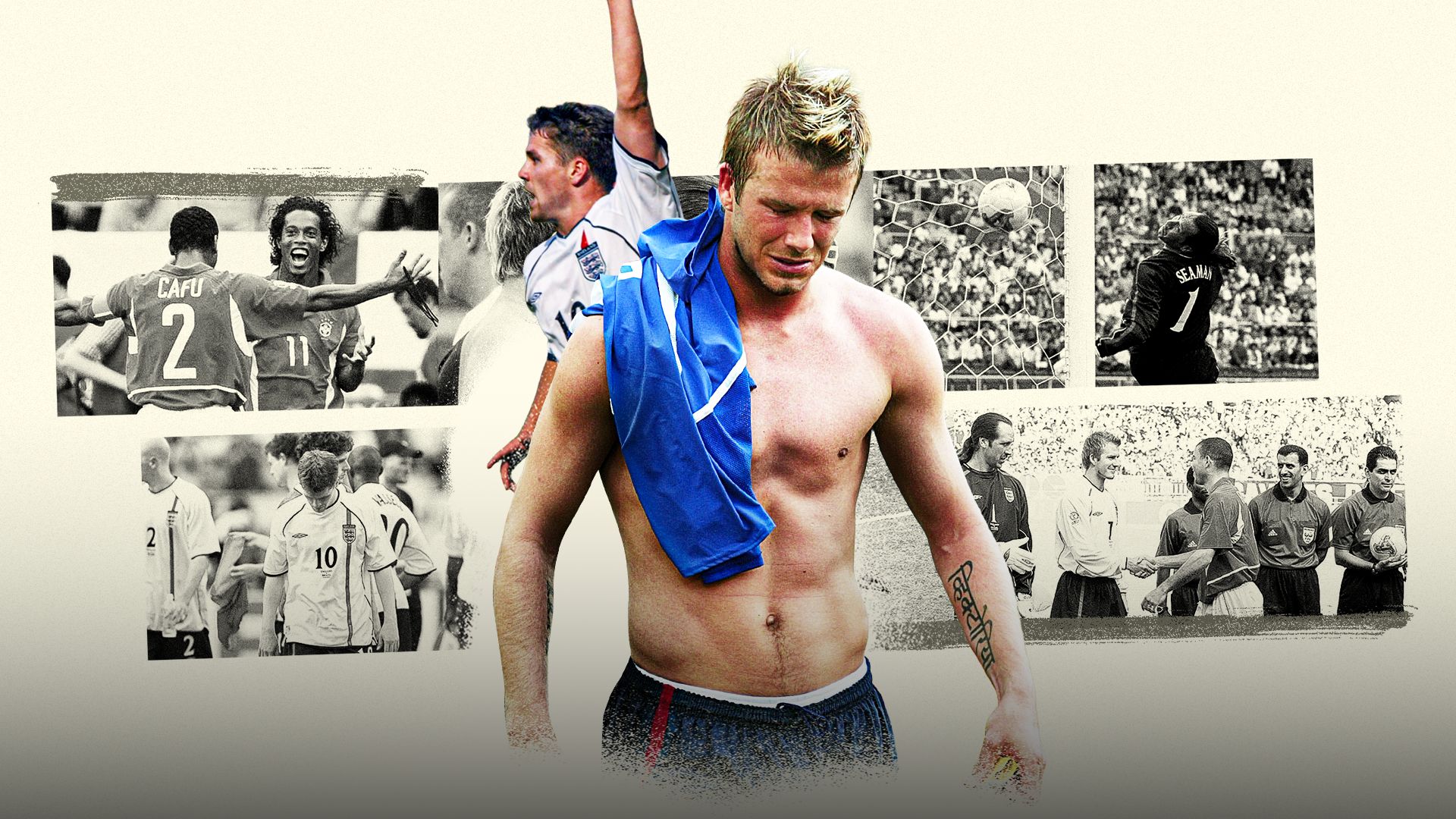
    The toothy-grinned maestro then produced a quick stepover to bypass Cole, who had been drawn out of position and left Campbell exposed, before laying the ball off for Rivaldo to sweep in a lovely first-time shot that Seaman was too slow to get down to. England inexplicably gifted Brazil a way back into the game and, as it turned out, Eriksson had no Plan B.

  • TOPSHOT-WC2002-ENG-BRA-SEAMAN-BECKHAMAFP

    Humiliated

    According to Southgate, the Swedish coach also failed to galvanise the players with his half-time team-talk. The defender, who did not make it off the bench, said when looking back on the game years later: “We were expecting Winston Churchill and instead got Iain Duncan Smith.”

    Indeed, Eriksson made no half-time personnel changes and stuck with his pragmatic 4-4-2 system. England came back out with no extra urgency and Brazil took full command of proceedings. Within five minutes of the restart, they were ahead.

    This time, only one man was responsible for the concession. When Brazil won a free-kick some 42 yards from goal wide on the right, there didn't appear to be much danger. But as soon as the ball left Ronaldinho's foot, Seaman was in panic mode.

    It turned out to be a shot rather than a lob into the box, and the England No.1 completely misjudged its flight path. The ball had looped over his head and into the inside netting before he could even flap out an arm, and Ronaldinho had already sprinted over to the athletics track circling the pitch to dance with his team-mates when Seaman finally retrieved it.

    "Cafu had pointed out to me that Seaman plays off his line and there is often space between him and the goal," Ronaldinho later said while referring to Brazil's veteran captain. "I took his advice and was looking for that space to surprise him and score. I tried to put it over his head, and got lucky."

    Seaman was completely humiliated and England allowed their heads to drop. There was still 40 minutes left, but Brazil had already won the mental battle. Even after Ronaldinho was shown a straight red card for a high challenge on Mills on the hour mark, there was no real change in momentum, as the Selecao continued to boss possession and England resorted to a desperate long-ball strategy that was easily dealt with.

    The final whistle didn't halt any late siege on the Brazil goal; it simply put England out of their misery.

  • A dejected David Beckham of EnglandGetty Images Sport

    Lack of belief

    While it's true that England were hampered by the heat and injuries, a lack of ambition is what ultimately led to their downfall in South Korea and Japan. Eriksson was far too cautious and too many star names went missing when the going got tough.

    Brazil didn't have to do anything special, they simply wanted it more. That huge difference in mindset was perhaps best summed up with Owen's shrug-of-the-shoulders reaction to the final result: "Brazil are a decent side, so it is not that difficult to take in terms of who knocked us out."

    The Selecao went on to lift the trophy by dispatching surprise package Turkey and an underwhelming Germany outfit that picked up three successive 1-0 wins to reach the final. England could well have gone all the way if they'd got past Brazil, but the players didn't truly believe they could do it. That became a running theme under Eriksson, who would go on to suffer two more quarter-final defeats to Scolari after the Brazilian moved on to coach Portugal.

    England blew an early lead in a quarter-final clash against Portugal at Euro 2004, eventually drawing 2-2 after extra-time before losing on penalties. Scolari's team repeated the trick at the World Cup in Germany two years later, which haunted Eriksson long after his departure.

    "We should have made the final," the late Swede said in 2018. "I don't think any team, at that time, were better than us. And I still don't think there was any team better. No one."

  • England v Japan - International FriendlyGetty Images Sport

    Clear task ahead

    It has long been suggested that Eriksson wasted England's 'Golden Generation', but several of his former players have debunked that myth. Gerrard was the latest, as he admitted in an interview on theRio Ferdinand Presents podcast at the start of October: "We were all egotistical losers. It was down to the culture within England. We weren't friendly or connected. We weren't a team. We never at any stage became a real good, strong team."

    The squad mentality issues continued after Eriksson's departure, with Steve McClaren, Fabio Capello and Roy Hodgson all unable to fix that toxic culture. Southgate was the first man to make England a proper unit, by fostering a club-like atmosphere that focused on building team chemistry and continuity.

    But for all the progress Southgate made between 2018 and 2024, England still had nothing to show for it by the end, and there were plenty of similarities to be drawn between their performances in the biggest games and the 2002 World Cup defeat to Brazil.

    Croatia and Italy both came from behind to conquer England in the 2018 World Cup semis and 2020 European Championship final, respectively. And in 2024's Euros showpiece, the Three Lions pulled level with Spain through a 73rd-minute Cole Palmer strike, only to capitulate again and lose 2-1.

    In the absence of genuine self-confidence, England will continue to fail. It was especially hard to take in South Korea and Japan, because Eriksson had a winning ticket. Tuchel's main job next summer with a similarly gifted squad is to ensure his players know that they belong on the biggest stage and let their inhibitions go for good. Only then will England finally deliver.