
Legacy Canada GFXGetty/GOAL

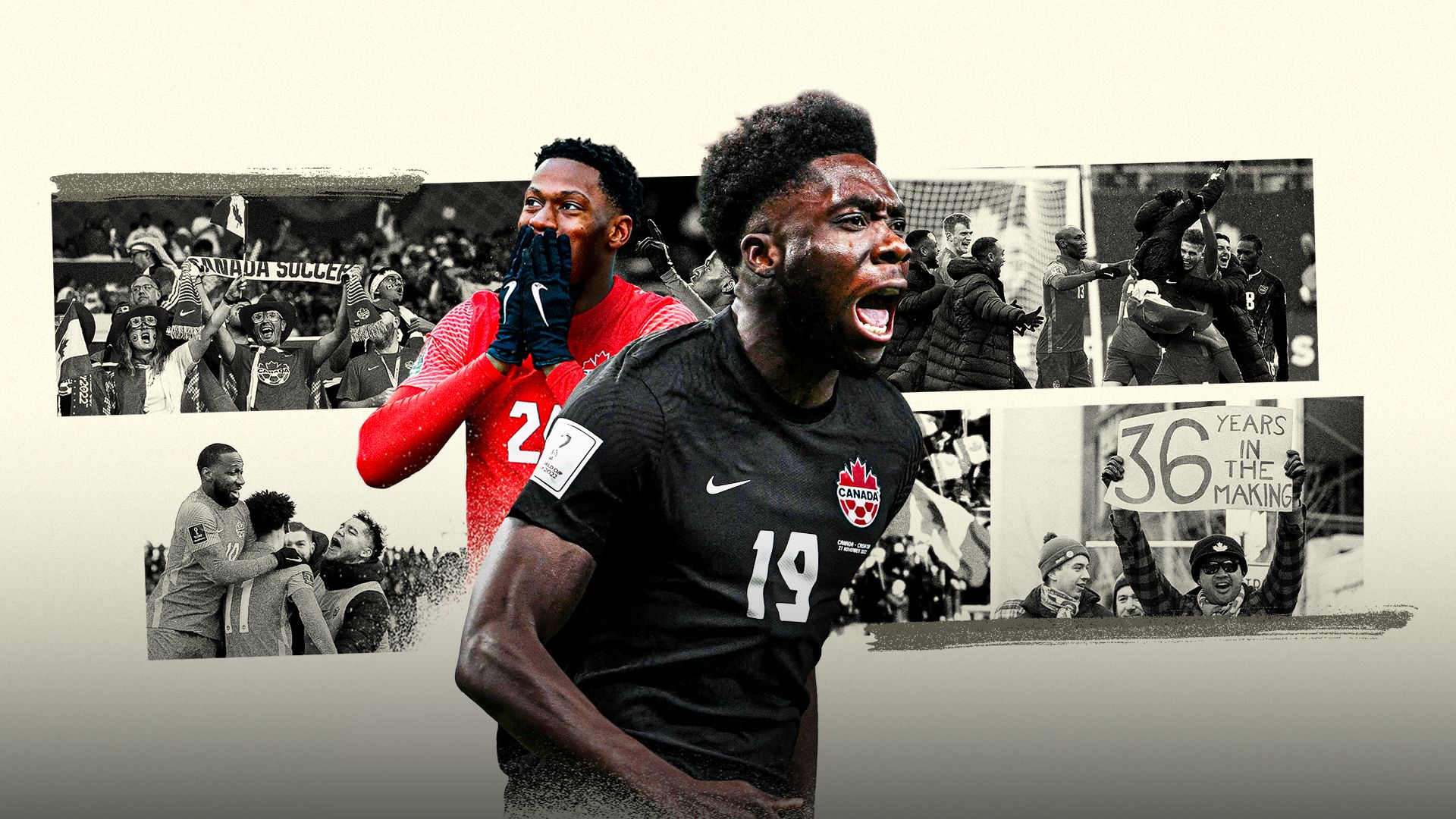
LEGACY: How 2026 co-hosts Canada enjoyed a World Cup rebirth in Qatar

It started in 2019, when Canada beat the United States for the first time in 34 years. Instead of leading the team in celebration, then-manager John Herdman showed Les Rouges a compilation of a series of "sacrificial acts" from the team.

First, it was Jonathan David chasing down Michael Bradley as he tried to dictate the game. Then, it was the Canada bench reacting to a hard foul. Herdman argued, at the time, that it was those kinds of moments - that kind of intent - that would carry Canada to their first World Cup since 1986. Three years later, he was proven right.

Canada hosted Jamaica at BMO Field in frigid conditions, and proceeded to absolutely batter the Reggae Boyz. Cyle Larin, Tajon Buchanan and Junior Hoilett were among the goals in front of a sell-out crowd in sub-zero weather.

Canada, top of CONCACAF qualifying, were clear favourites. Many arrived believing merely that the inevitable would finally become a reality, yet they had to win it all the same. And in the Toronto snow, Les Rouges went wild.

This, of course, was what all of Herdman's videos were for. There was no victory, in full, until his country had qualified for a World Cup.

Herdman, who was so against declaring any sort of win at any point in his tutelage, finally let his emotions go in a post-match interview: "I think if we all get behind each other... This is the time for everyone to get behind football and unite. Because we can be a powerhouse. And it's time."

That game, played on March 27, 2022, remains the most famous fixture in Canadian national team history. Sure, they had been to a shrunken World Cup before, but 1986 was prehistoric relic when compared to modern soccer. This was a true moment, the day Canada became a soccer nation again. And they haven't looked back since.

  • USSR v Canada 1986 FIFA World CupHulton Archive

    Failure followed by hurt

    Canada really shouldn't have qualified in 1986. If 2022 was an achievement, then their participation 36 years earlier was a miracle. Not everyone on that team played professional soccer, and those who did were coming out of the NASL - a league that had suspended operations in 1985.

    Only two CONCACAF nations qualified for the World Cup at the time, and with Mexico already in as hosts, Canada were left to battle the rest of a region where the U.S. weren’t yet a force.

    Canada cruised through the first round, then found themselves in a round-robin with Honduras and Costa Rica - two countries with far more established soccer cultures. Les Rouges stole a valuable point in Costa Rica and followed it with a 1-0 win in Honduras, courtesy of a goal scored by a full-time gas worker, George Pakos. That set up a win-and-you’re-in home finale against Honduras.

    Canada sold out a 13,000-seat temporary stadium in St. John’s, Newfoundland, and scraped a 2-1 victory to clinch their first World Cup berth. That squad, even with a core of NASL veterans and a few players who had impressed at the 1984 Olympics, was still painfully inexperienced. They struggled to even schedule warm-up matches.

    As head coach Tony Waiters recalled: "So what we did was we formed more or less a team-in-being, and we’d go pretty well anywhere that would pay for us to come in and pay us when we got there. So we had a tour of North Africa. We went into Asia as well. Any opportunity to get a game where there’d be money coming in so we could turn some of that money around into players’ pockets."

    The bookies believed Canada had little chance of even finding the back of the net, and they were proven right as Les Rouges crashed out of the group without scoring a goal. That is where most nations are supposed to kick on, with the old generation inspiring a new one to go one better. Instead, Canada languished.

    They failed to qualify in 1990 after losing a home-and-away series to Guatemala, while campaigns in 1994 and 1998 were similarly unsuccessful. An unexpected Gold Cup win in 2000, meanwhile, turned out to be little more than a false dawn.

  • Advertisement
  • FBL-CONCACAF-GOLDCUP-CAN-PRESSERAFP

    Herdman's dream

    Then, in the late 2010s, something changed via a significant coaching hire. Octavio Zambrano had done an agreeable job at the 2017 Gold Cup by getting Canada out of the groups for the first time since 2009, but when Herdman became available, the Canadian Soccer Federation struck.

    The highly-regarded Englishman had done well with the Canada women's side, building them into a genuine force on the global stage, and was linked with a number of top jobs at the time - not least the England women's position. Canada Soccer were, however, eager to keep hold of Herdman, and appointed him head of the men's national team in January 2018 on an eye-watering eight-year contract.

    His remit was simple: Rebuild Canadian soccer. And it was quite the task. Les Rouges had the talent, but were a mess.

    Herdman had overseen a rebuild before with the women's side, and thus knew exactly how to go about replicating his success on the men's side. Within a year of taking the role, he claimed that Canada would be at the 2022 World Cup. Many, including those of an American persuasion, snickered. Surely, this guy couldn't be serious? Yet the results started arriving.

    When it became clear that Canada would be co-hosting the 2026 World Cup alongside the U.S. and Mexico, the dream became more realistic. It helped, too, that Canada had a good side, led by young Bayern Munich star Alphonso Davies and plenty of experience around him.

    Herdman was also an excellent man-manager, who could inspire a team. "I think every minute of the day, he has a motivational speech," said Lucas Cavallini after a win in 2019. "That's why we're here. That's why we're doing important things."

  • Jamaica v Canada: 2022 World Cup QualifyingGetty Images Sport

    Qualifying in style

    Qualification was, in the end, made to look rather easy. Herdman built a solid squad around Davies, gave real minutes to a young striker in Jonathan David and persuaded a number of dual-nationals to commit to Canada.

    The team’s identity thus changed drastically. In the past, Canada had been defensive, even timid. And though Herdman wasn’t trying to outplay everyone, he knew tactical flexibility would be vital, while in Davies, he had the best left-back in world football at his disposal.

    Because of their low FIFA ranking, Canada had to navigate a preliminary round just to reach the eight-team group that would decide World Cup places. They made quick work of it, battering Haiti 4-0 on aggregate to cruise into a final phase that, on paper, looked tricky, even with three automatic spots up for grabs. The U.S. were out for revenge after missing out on qualification for 2018 and looked renewed under Gregg Berhalter, while Mexico were always likely to qualify. The third place seemed up for grabs, though Costa Rica were favourites after their memorable 2014 World Cup run to the quarter-finals.

    Canada opened with two draws, a frustrating point at home to Honduras followed by a more acceptable result in the U.S.. They then made light work of El Salvador, picked up a point at the Azteca against Mexico and stumbled to a scoreless draw against Jamaica. After five matchdays, the performances were good - and Canada were undefeated - but they needed to start turning draws into victories.

    What followed was an emphatic, six-game winning streak, highlighted by home triumphs over first Mexico and then, crucially, the U.S.. The former came in heavy snow in Edmonton, leading to fans on  social media dubbing the Commonwealth Stadium the 'Ice-teca'.

    Those results realistically secured automatic qualification, and by the time that Jamaica game came around, Canada not just qualifying, but finishing top of the group felt like a formality.

    "Now people believe. And it's incredible how much people believe. And it's only going to get better. Now we want to go to a World Cup and really make a statement," midfielder Jonathan Osorio said.

  • ENJOYED THIS STORY?

    Add GOAL.com as a preferred source on Google to see more of our reporting

  • 2017 MLS Cup - Seattle Sounders v Toronto FCGetty Images Sport

    MLS' impact

    It is worth noting the impact Major League Soccer had on Canadian soccer's improvement under Herdman. Yes, the manager was born in England cut his teeth in New Zealand, and yes, Canada certainly had a soccer scene by the time he took over. But their journey to the World Cup would not have been possible without contributions from MLS.

    Of course, MLS has three franchises in the country - including Toronto FC, who completed a treble in 2017. But Canada's player pool was immensely MLS-heavy. While Berhalter moved away from domestic talent in favour of European names for his U.S. side, Herdman looked to MLS for answers.

    He called on 16 MLS players over the course of Canada's lengthy qualifying campaign, and 10 for their final duo of fixtures, with four more in that squad who had developed in MLS before moving to Europe.

    Herdman was able to benefit from a player pipeline that hadn't previously existed. Canadian talent, for years, had to move to colleges in America to even have a shot of making it as a professional. But by 2007, when Toronto FC entered the league as an expansion franchise, there were real options - and a more accessible pipeline. And while even now it hasn't yet yielded any outright Canadian-born stars - Davies only reached worldwide prominence once he became a regular at Bayern Munich - those teams have given rise to valuable depth.

  • Canada v Morocco: Group F - FIFA World Cup Qatar 2022Getty Images Sport

    Falling short

    Not that it proved to be enough in Qatar. The draw was brutal for Canada, who were paired with highly-rated Belgium, vastly experienced Croatia and the team who emerged as the tournament's surprise package, Morocco.

    Herdman backed his team for success prior to the tournament: "We’re going to come up against giants in world football, there’s no doubt about that, and we’re a David here. But David was always meant to beat Goliath, based on him fully understanding what his strengths were."

    A narrow loss to Belgium offered hope, and after Davies bagged the country's first goal at a World Cup two minutes into their game with Croatia, there was hope abound. Except it was short-lived. Croatia rattled off four goals, and Morocco then hammered Canada in the final group game. They once again failed to pick up a single point, and, after all of the excitement of qualification, saw everything fall apart. 

    From there, things began to spiral. Herdman led Canada to the 2023 CONCACAF Nations League finals, but there was no magic against the U.S. once there, and then they were eliminated in the semis. Herdman subsequently left his post in October 2023 and took over at Toronto FC, where he struggled immensely before being forced to resign in 2024 after it became clear that he was knowingly involved in the massive scandal around Canada Soccer and them being caught using drones to spy on opponents' training sessions. Herdman was mentioned in the report, and received a "written admonishment" for his knowledge of the situation, although it isn't clear if he orchestrated the process.

    Jesse Marsch, Herdman's successor, later claimed that he "didn't know a lot about what was going on", with his cultural reset already under way.

  • Wales v Canada - International FriendlyGetty Images Sport

    Bright future?

    Marsch arrived with a chip on his shoulder like no other. The American was rumoured to be frontrunner for the vacant U.S. head coaching position before Mauricio Pochettino was hired, leading to the ex Leeds United boss mounting a furious PR campaign during which he detailed just how poorly he had been misled by U.S. Soccer, whom he had once worked for as an assistant coach.

    He took the Canada job in May 2024, with less than one month to go before the Copa America, and despite the talent within his squad, Canada looked likely to be outmatched by some of South America's best. Instead, he guided Les Rouges to an unlikely semi-final appearance, where they were beaten by eventual winners Argentina.

    Since then, Canada have only gone from strength to strength. The 2025 Gold Cup was a disappointment, but in their pre-2026 World Cup friendlies, Les Rouges have looked a tough side to beat. Davies is struggling with injuries, but the hope is that he should be fit and firing by the time the summer rolls around, while Marsch continues to benefit from MLS, albeit in a slightly different way.

    It’s no secret that Canada Soccer is strapped for cash, and the federation eased the burden by having the country’s three MLS clubs contribute toward Marsch's salary. The coach insists that there is no obligation to use MLS talent in return, though the arrangement still underscores a sense of alignment across the country, buoyed by the three major clubs that call it home.

    Marsch has shown himself to be a successful coach, but has been handed the unenviable task of following a Canadian soccer legend. He believes, however, that he can deliver where Herdman failed. If 2022 was the best day in Canadian soccer history, perhaps, under Marsch, there might be even better ones on the horizon.