Are you 24 or older?

Help us verify your age by providing an honest response. This site contains gambling advertising for 24+.

Age-restricted content

You’re not old enough to view betting content. You’ll be redirected to the homepage.

alt
FBL-EUR-C1-REAL MADRID-TRAININGAFP

Translated by

La Liga hat-trick: can Mourinho kill Barcelona's dream?

Barcelona have begun the 2026-2027 season by making a third straight La Liga title look almost inevitable.

Hansi Flick's side opened the campaign with four consecutive league wins, scoring 17 goals and conceding just two. Then came a resounding 5-1 demolition of Feyenoord in the Champions League.

Real Madrid, by contrast, have already tasted defeat in La Liga under Jose Mourinho, beaten 1-0 by Real Betis.

Tribuna argued in a lengthy report that Real turned to Mourinho because they believe Barcelona have built a dominance that needs someone to break it. 

His particular strengths may be unusually well suited to turning the title race into a fiercer, tougher contest.

A feat achieved this century only by Pep Guardiola now sits within Barcelona's reach: three La Liga titles in a row. Mourinho, meanwhile, has returned to the club he once led to the title with a tally of 100 points. He has inherited a squad assembled for enormous sums, and he made one thing clear from the off. Winning is non-negotiable.

You can discuss the topics and news in greater depth in the Kooora forums

  • mourinho(C)Getty Images

    Will Mourinho's tried-and-tested recipe work against Barcelona?

    The first reason the title race is so intriguing is that Barcelona have strengthened the side that won the league last season.

    Rodri stands out as one of the most significant additions. Barcelona have spent around 174 million euros this summer, bringing in Rodri from Manchester City alongside Anthony Gordon, Karim Adeyemi, Gabriel Jesus and others. It is an exceptional luxury for Flick. Last season, Barcelona's greatest advantage over Real Madrid lay precisely in their ability to overwhelm opponents with attacking pressure and a high volume of offensive movement. Now they have added one of the world's best players at controlling the tempo of play in midfield.

    Rodri is likely to free Pedri to push further up the pitch with greater licence, while giving Barcelona another player who can control the rhythm of matches once the team's initial intensity fades. We have already seen the signs. Barcelona's start to the season was the best of the Flick era, and Raphinha began superbly, but more importantly he has suddenly become the answer to the striker problem Barcelona were expected to face after Lewandowski and Ferran Torres departed.

    Raphinha scored 8 goals in his first 5 matches this season, including six in his first four La Liga games. At 19, Yamal has already become one of Barcelona's leaders after his team-mates handed him that responsibility. He has also stated clearly that the Champions League is his main objective, a sign that Barcelona's ambitions now stretch beyond mere dominance in Spain.

    Barcelona's greatest potential weakness lies in sustaining this exceptional intensity across a season in which the Champions League has become such a clear priority. This is where Mourinho comes in. Real Madrid may have to overcome Barcelona by turning the title race into a test of endurance.

    Mourinho has already shown signs of grasping the importance of controlling matches rather than simply imposing dominance on them. His Real Madrid side looks, in these early stages, more complex than the usual stereotype about him. Against Malaga, he was happy to let Real Madrid rely on counter-attacks rather than insisting on possession, yet the team created nine clear chances and won 4-0.

    The Inter Milan match provided the opposite example. Real Madrid once again attacked with force in offensive transitions and created nine clear chances to Inter's four, but they also allowed the opponent 21 shots and had to rely on seven saves from Thibaut Courtois.

    Mourinho admitted afterwards that he did not like the chaos, and said he would prefer his team to score five or six goals while keeping absolute control of the match. This is the clearest picture of what he is trying to build. He is happy for Real Madrid to punish opponents on the counter, but he does not want those transitions to turn into open matches that resemble an exchange of goals.

    Against Barcelona, this balance could prove decisive. Real Madrid have the speed to hurt Barcelona on the counter-attack, but giving Yamal, Raphinha and Pedri that same freedom would be asking for trouble. Mourinho made a point of praising his side's cohesion and explained how the organisation contributed to Valverde's goal. That may be the most important point about the current Real Madrid.

  • Advertisement
  • Vinicius Junior Lamine Yamal Real Madrid BarcelonaGetty

    Real Madrid have something that Barcelona do not possess to the same degree

    Barcelona's current philosophy is built on overwhelming their opponents with pressure, movement and technical superiority. Yet whenever Real Madrid drag matches into tactical battles rather than open contests, Mourinho's experience becomes all the more important.

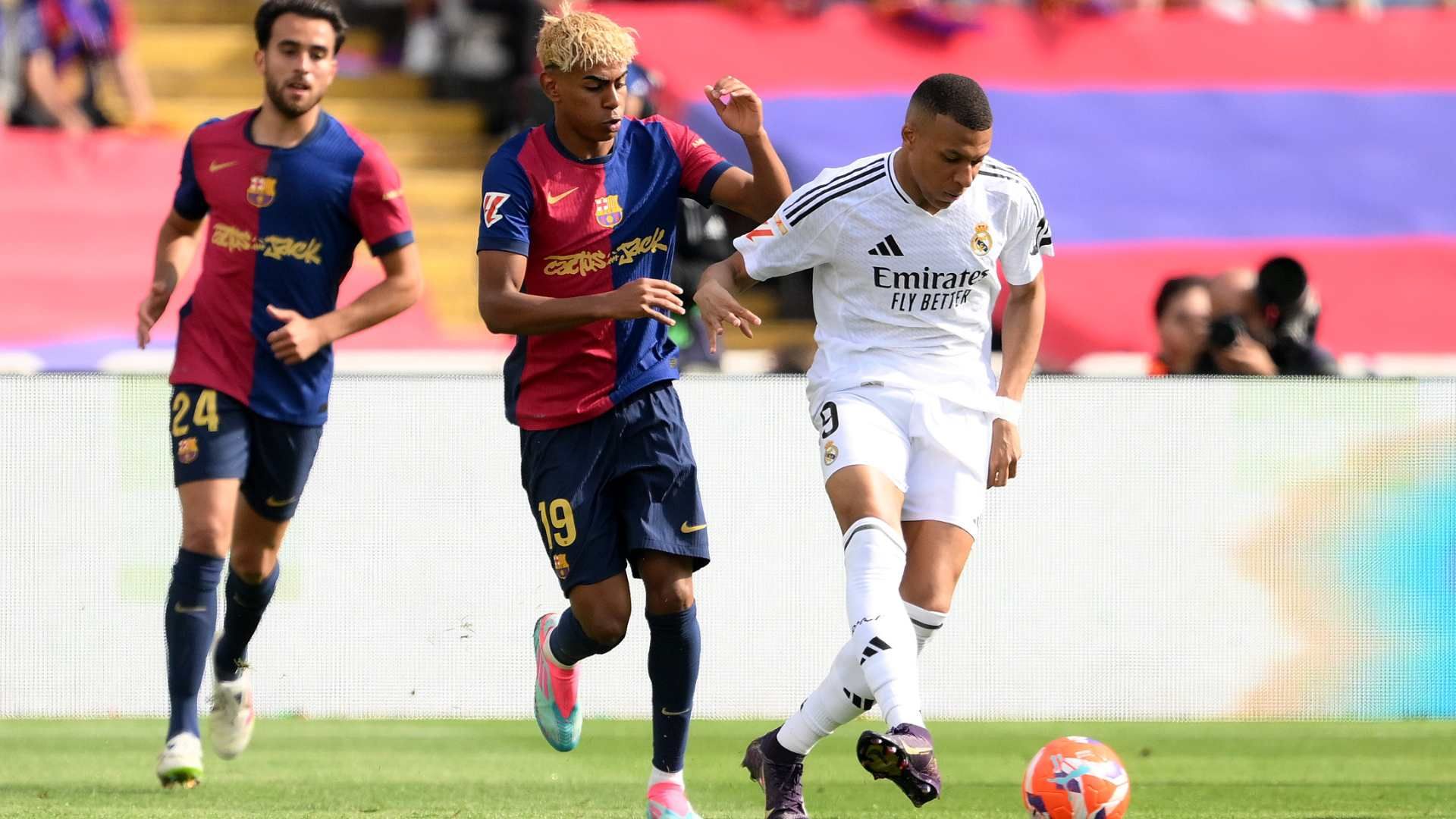
    History offers another reason not to rule it out. Barcelona have dominated the recent Clasicos, winning three of the last four league meetings since Flick's arrival. That run includes the 2-0 victory last season that effectively sealed the title and left Real Madrid trophyless once again.

    Mourinho's first major task, then, will be to shift the psychological relationship between the two teams. The opening Clasico comes on 25 October at the Camp Nou. Barcelona carry greater momentum for now, but Mourinho knows a single win can rewrite the entire narrative around the title race.

    Real Madrid possess something Barcelona lack to the same degree: a squad packed with players who can settle matches on their own. Kylian Mbappe remains a top-class goalscorer. Vinicius Junior can destroy any defence single-handedly, Jude Bellingham gives Real Madrid another route into the box, and Fede Valverde offers physical power and tactical flexibility. Mourinho's job is to make these individual abilities work collectively. That is the gamble.

  • Mourinho's biggest battles inside the Real Madrid dressing room

    If Barcelona are a polished machine, then Real Madrid under Mourinho remain a project under construction.

    The summer signings tell us exactly what the club wanted to do. Marc Cucurella, Ibrahima Konaté, Denzel Dumfries, Bernardo Silva and Yan Diomandé were among the most notable additions, while Endrick and Carlos Espí returned from their respective loan spells.

    Real Madrid's final squad contains 26 players, though Mourinho prefers a tighter group of around 22.

    That hands him something extremely valuable across a 38-match league season: the luxury of available options.

    He has built a much stronger foundation in several key positions. Cucurella is not just another left-back rotating with Mendy. Given Mendy's physical problems, the Spaniard represents a clear upgrade, and Mourinho specifically insisted on signing him. His ability to defend robustly and contribute to possession also gives Real Madrid a more convincing option down the left.

    Konaté, meanwhile, is the most interesting gamble. He was by no means perfect during his last season with Liverpool, and his level became a subject of debate, but Mourinho is betting on the physical attributes that made him so effective alongside Virgil van Dijk.

    The Frenchman gives Real Madrid a strong central defender on the right side, with pace in recovery and the ability to defend large spaces. That could prove crucial if Mourinho wants to push the full-backs forward. He started 36 matches in the Premier League last season, despite the inconsistency in his level.

    Dumfries, meanwhile, is perhaps the signing with the greatest attacking potential. He scored five goals and provided two assists in Serie A and the Champions League last season, but his 2024-2025 campaign was far more productive: 11 goals and five assists across the two competitions. His arrival gives Mourinho a physically strong player in the wide position, capable of creating danger from the right.

    One clear problem remains. Real Madrid did not sign Rodri.

    This could become one of the decisive details of the season. Barcelona have strengthened the very position that Real Madrid perhaps most needed to reinforce.

    Rodri's arrival gives Flick a top-class defensive midfielder and an exceptional organiser of possession, whereas Real Madrid rely on Valverde, Tchouaméni and their other options in midfield.

    Mourinho may need to compensate for this tactically, which explains the focus on organisation in Real Madrid's performances during the early part of the season.

    Against Inter, he was particularly interested in what happens when his side loses its defensive edge. He praised the moments in which Real Madrid maintained their cohesion, and acknowledged that the match became more difficult when the team stopped controlling the spaces.

    Here lies the biggest point of intersection between Mourinho and Flick. Flick wants Barcelona to play with intensity and ferocity. Mourinho wants Real Madrid to determine when that ferocity is necessary.

    The latter approach could prove extremely effective across a title race, and it could also protect Real Madrid from their own attacking stars.

    One obvious question surrounds Mourinho's team: how can he get Mbappé, Vinícius and Bellingham to coexist without sacrificing the defensive balance?

    Mourinho has already begun to protect his stars publicly. He later defended Vinícius and Mbappé, insisting that players who score goals and work for the team should not automatically become scapegoats when the level of performance drops.
  • ENJOYED THIS STORY?

    Add GOAL.com as a preferred source on Google to see more of our reporting

    Add as preferred source on Google
  • RCD Espanyol de Barcelona v Real Madrid - LaLiga EA Sports 2026/27Getty Images Sport

    Early warnings for Mourinho

    Real Madrid began the Spanish league with three victories before losing to Betis. They beat Espanyol 2-1, Real Sociedad 4-1 and Malaga 4-0, scoring ten goals in their first four league matches while conceding three.

    Against Betis, Real Madrid created enough chances to win but failed to take them. Mbappé struck the crossbar, then missed a penalty in stoppage time. Troy Parrott scored for Betis. Mourinho insisted afterwards that his team put in a good collective performance, while acknowledging that deserving to win does not guarantee the points.

    This is exactly the kind of match Real Madrid cannot afford to repeat too often. Barcelona have already shown what ruthless efficiency looks like.

    They crushed Elche 5-0, beat Athletic Bilbao 2-0, defeated Rayo Vallecano 5-2, then swept aside Valencia 5-0. Their first four league matches produced 17 goals scored and only two conceded.

    Real Madrid, then, cannot simply lean on Mourinho's football as defensive cover. They need to become more effective in front of goal, which is why the win over Inter Milan in the Champions League mattered, despite the defensive concerns. Mourinho's side found a way to win a chaotic match against a strong opponent.

    Mourinho reckoned Real Madrid were capable of scoring five or six goals but also capable of conceding five or six. His assessment laid bare both the ceiling of the team's attack and its defensive frailties.

    Cut the second number without lowering the first, and Barcelona will face a genuine title rival. Fail, and Barcelona may once again simply outscore them.

  • Hansi Flick (C)Getty Images

    Barcelona have more to lose than Real Madrid

    A consecutive treble is now within Barcelona's reach, but October could change everything.

    The strongest argument against Mourinho stopping Barcelona is simple: Barcelona look better right now.

    They have won every league match and scored 17 goals. Flick now has two years of institutional experience with this group, and most importantly, he has already proven he can win the league in charge of them.

    Four points clear in 2024-2025, eight clear in 2025-2026. Barcelona also outscored Real Madrid by significant margins across both seasons.

    History raises the stakes further. Win it and Barcelona become the first Spanish club to take three consecutive league titles since Pep Guardiola's side between 2008 and 2011.

    That gives Flick the chance to place his name alongside one of the most dominant coaching eras in Spanish football. But there are reasons to believe the race could tighten considerably.

    Start with the attacking transformation. The team faces a significant void after losing two guaranteed sources of goals in Robert Lewandowski and Ferran Torres.

    Gabriel Jesus is the obvious replacement, yet his recent numbers offer no guarantee of another season rich in goals. He managed just 3 goals in the Premier League and no assists for Arsenal last season, plus two goals in the Champions League, after only returning from a serious knee injury in December.

    That leaves Flick leaning more heavily on Yamal, Raphinha and his new attacking options. Should they collectively make up those forty goals, Barcelona become harder to read. If they don't, Mourinho has a clear weak point to target.

    Jesus has already opened his Barcelona account against Feyenoord, an encouraging start. But replacing the output of players accustomed to scoring across 38 league matches is an entirely different challenge.

    Flick must also manage a group built not only to win La Liga, but to finally win the Champions League.

    Yamal has made clear that Europe's biggest prize is his main objective, after Barcelona's recent failures in the competition. Flick's team lost to Inter in the semi-final last season, having already suffered another painful European exit before that.

    Here lies Mourinho's opening. If Barcelona are forced to prioritise Europe, Real Madrid must make every domestic match exhausting, dragging their rivals into a grind. Sometimes that means winning ugly, and cutting the points dropped against smaller sides.

    It also means turning away matches into tactical traps. Above all, it means ensuring the October Clasico is not treated as just another game.

    Barcelona host the fixture at the Camp Nou on 25 October, days after both teams play in the Champions League. Barcelona face Paris Saint-Germain on 20 October, while Real Madrid meet Leipzig on 21 October.

    Mourinho understands better than anyone that the Clasico is often decided by finding the opponent's physical and psychological weak points. Barcelona's high-intensity style gives him something to attack.

  • vinicius mourinho(C)Getty Images

    What is Mourinho doing to stop Barcelona's playmakers?

    To stop Barcelona, Mourinho must identify the individual duels he can win, and whether winning those duels can disrupt Barcelona's attacking system.

    Start with Yamal against Cucurella. It may seem obvious, but Cucurella handed Yamal one of the most uncomfortable nights of his career during Chelsea's 3-0 win over Barcelona in the Champions League. He did it by repeatedly showing the youngster towards his weaker right foot while protecting the inside space.

    Refusing to lunge in, Cucurella waited for Yamal to make his move and used the cover behind him to stop the winger cutting onto his left foot. This may be the model Mourinho leans on. Then comes Raphinha, who could pose the biggest problem of all. He has scored seven goals in his last five Clasico matches, including two in Barcelona's 3-2 win over Real Madrid in the Spanish Super Cup. More importantly, his role has evolved.

    Flick is pushing him into areas closer to goal and letting him drift centrally, which means a traditional duel between right-back and left winger may not exist at all.

    Now Mourinho must decide whether Konate follows Raphinha when he drops into midfield, or leaves him to one of the midfielders. That small call may determine whether Barcelona can create a numerical advantage around the penalty area.

    Midfield offers another intriguing duel, between Pedri and Bernardo Silva. Real Madrid simply cannot allow Pedri to dictate the tempo between the lines, yet marking him tightly could open up the very spaces Barcelona want.

    Bernardo's value may lie in making it a two-way battle. Can Real Madrid's new player disrupt Pedri's rhythm without being dragged too far from the spaces Barcelona want to attack?

    Finally, watch what happens when Barcelona's high defensive line meets the pace of Mbappe and Vinicius. In the previous Clasico, Real Madrid's disciplined man-marking and intelligent pressing forced Barcelona into 37 losses of possession in their own defensive third. Mbappe, meanwhile, repeatedly attacked the spaces that appeared whenever Barcelona's defensive line lost its cohesion.

  • real madrid barcelonaGetty Images

    Turning El Clásico into a series of tactical problems

    Here lies Mourinho's real opportunity: turning the Clasico into a series of specific tactical problems that Barcelona cannot solve all at once.

    Real Madrid have the individual quality to punish Barcelona when those moments arrive.

    So can Real Madrid end Barcelona's dominance? For now, Barcelona deserve to be clear favourites. Their level is higher, their squad looks more balanced, and Real Madrid have already dropped points while still searching for a new tactical identity.

    Title races, in the end, can be swung by a coach who knows how to turn football into a psychological battle. There is already evidence that Jose is building exactly this kind of environment.

    Rather than fuelling the criticism aimed at his stars, he has defended them and stressed unity in the dressing room. More importantly, he appears ready to make changes based on performance and energy, not simply field the big names every week. For that very reason, Barcelona are not yet certain of a third straight title.

    The decisive question may be whether Mourinho can carry Real Madrid to 25 October without falling too far behind. Manage that, and the first Clasico at the Camp Nou this season could turn the race from a coronation lap for Barcelona into a genuine title battle.

    Mourinho's biggest challenge is transforming a formidable group of talent, one that sometimes descends into chaos, into a team capable of controlling the very matches Barcelona want to drag into chaos. Win at the Camp Nou on 25 October, and the entire narrative changes.