
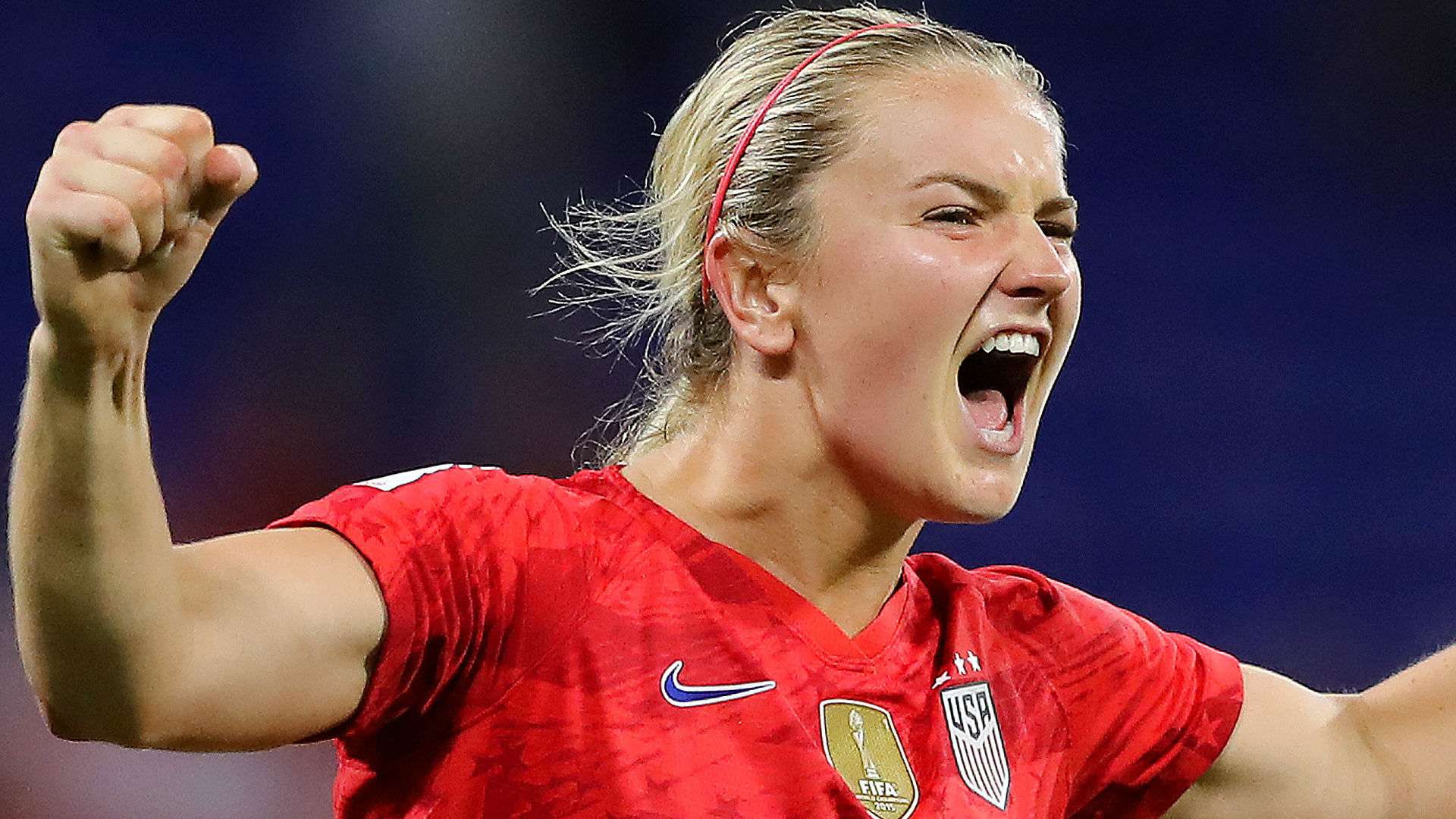
The U.S. women’s national team is in the spotlight. As they get set to play their third straight World Cup final on Sunday, the nation’s attention will be squarely focused on Lyon.
When that game against the Netherlands ends, win or lose, all 23 American players will eventually return back to where they came from: the National Women’s Soccer League.
Now in its seventh season, the fact that the NWSL still exists is a win for the women’s game in the United States, with past leagues having folded much sooner. But for the future of the U.S. national team, and American women’s soccer in general, the league needs to strengthen.
“As much as we love being in this environment,” USWNT defender Tierna Davidson says, “it is the NWSL environment that we’re in most of the time, and if that didn’t exist we wouldn’t be able to be where we are today.”
There is always optimism that an increased focus on the U.S. national team will translate to more attention on the domestic league where all of its players ply their trade.
“Hopefully it brings more exposure to the league and people will be more excited and willing to come out to the games,” U.S. midfielder Rose Lavelle said.
But initial bumps usually fade, and there are doubts as to whether the NWSL is in the right place to take advantage of the increased attention on the women’s game in the United States.
The league has only has one sponsor committed beyond the current season, Nike. It has recently lost multiple key front-office employees, saw two teams fold prior to the 2018 season (one of those teams, FC Kansas City, did have its players transferred to the expansion Utah Royals) and until this week, it had been playing the 2019 season without a national television deal.
“I was pretty annoyed that we didn’t have a deal at the beginning of the year,” U.S. midfielder Lindsey Horan said. “It almost felt like we were going backwards.”
Thankfully, that situation was remedied by ESPN’s announcement on Thursday that it would be televising 14 matches through the rest of the 2019 season. Beyond this season, though, everything is up in the air.
“I think this should have come a while ago,” Horan said of the TV deal, “but I’m very happy that it did.”
Horan, the league’s 2018 MVP, plays for the NWSL’s model franchise, the Portland Thorns, who averaged 16,959 fans per game in 2018, dwarfing the league average of 6,017.
Still, NWSL saw the highest average attendance in its history in 2018, in part due to the expansion Utah Royals averaging 9,466 fans per game.
With only nine teams in the league and potentially fruitful markets like Los Angeles, Minneapolis, Atlanta and others reportedly interested in joining the league, expansion may be the key to NWSL success in the future.
“We have nine teams now and I hope we have expansion in the next year or so,” Horan said. “I think that will help so much.”
 ISI Photos
The league will need a boost as competition from Europe increases. Seven of the eight World Cup quarterfinalists were from Europe this year, as more clubs and federations continue to invest in the women’s game.
Should the NWSL not find more deep-pocketed owners willing to invest, the league, and by extension the U.S. national team, will start to fall behind.
“To have more publicity and more funding for [NWSL] is just so incredibly important,” Davidson said. “To think that this team is completely separate from the NWSL is not realistic. We are very much a product of the environment that we’re in.”
In the meantime, though, the return of USWNT stars, along with 35 other players from 10 different countries who also participated in the World Cup, should provide a temporary boost at least.
“It’s our job to get back in there and do what we do and continue to inspire the next generation, to continue to help the league grow, and that’s what we’ll be doing,” U.S. forward Carli Lloyd said.
The increased interest will be there at first. Whether the league can capitalize over the long term is another question entirely.