
.jpg?auto=webp&format=pjpg&width=3840&quality=60)
This LaLiga encounter was a fascinating study in contrasting philosophies of control. Jose Mourinho, true to his historical blueprint, sought to weaponise defensive stability and clinical verticality. Real Madrid were happy to surrender the lion's share of possession, focusing instead on structural integrity and explosive transitions. The objective was clear: limit high-quality chances and rely on the individual brilliance of a star-studded frontline to capitalise on the few moments Villarreal left themselves exposed.
On the opposite bench, I. Perez implemented a brave, possession-heavy 4-2-3-1 that aimed to pull Madrid's double-pivot out of position. Villarreal dominated the ball with 53% possession, attempting to use the width provided by Ilias Akhomach and Alberto Moleiro to stretch the pitch. However, they lacked the final-third incision required to puncture a Mourinho-drilled low block, ultimately falling victim to a single lapse in defensive concentration during a set-piece or transitional phase.
Real Madrid's tactical setup
Jose Mourinho deployed a 4-2-3-1 formation that frequently morphed into a disciplined 4-4-2 mid-block. The defensive line, anchored by Antonio Ruediger and Ibrahima Konate, maintained a remarkably narrow horizontal distance, forcing Villarreal into wide areas where Madrid felt comfortable defending crosses. The double-pivot of Aurelien Tchouameni and Federico Valverde acted as a screen, rarely venturing beyond the halfway line during sustained periods of opposition possession.
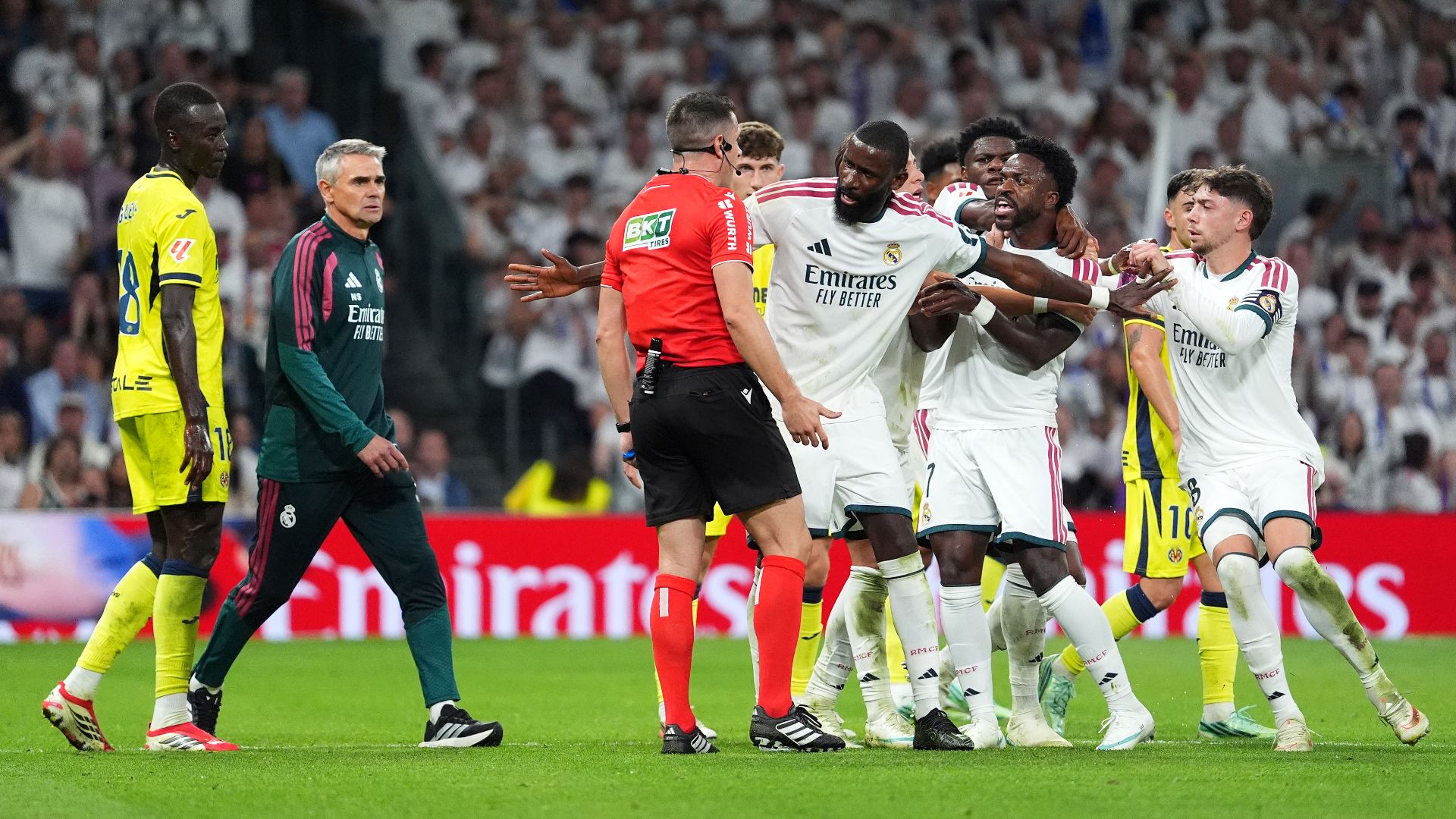
In the build-up, Madrid were conservative. Trent Alexander-Arnold was not given his usual license to roam into the central corridors, instead focusing on deep-lying distribution to find the runs of Kylian Mbappe. The pressing triggers were specific; Madrid did not engage in a high press, instead waiting for the ball to enter the middle third before Tchouameni or Jude Bellingham initiated contact. This "contain and counter" strategy aimed to leave space behind the Villarreal high line for Arda Guler and Vinicius Junior to exploit. The breakthrough eventually came from an unlikely source, with Yan Diomande finding the net in the 62nd minute following a period of increased set-piece pressure. The defensive resolve was tested in the final twenty minutes after Vinicius Junior received a straight red card in the 73rd minute, forcing a shift to a 4-4-1 deep block that prioritised clearance over ball retention.
Villarreal's tactical setup
Villarreal mirrored Madrid's 4-2-3-1 but used it to achieve far more expansive ends. Under I. Perez, the Yellow Submarine focused on building through the thirds, with Santi Comesana and Pape Gueye dropping deep to form a back three with the central defenders during the initial phase of play. This allowed the full-backs, particularly Juan Foyth, to push high and offer passing outlets in advanced wide positions. Their tactical plan revolved around isolating Madrid’s full-backs in one-on-one situations, hoping Moleiro’s trickery could create numerical advantages.


Defensively, Villarreal utilised a high defensive line and an aggressive counter-press to win the ball back immediately after a turnover. This was largely successful in the first half, as they limited Madrid to just 0.905 Expected Goals (xG) over the 90 minutes. However, the high line carried inherent risks against the pace of Mbappe. While they managed 14 total shots, the quality of their chances remained low, as they were often forced into speculative efforts from distance by Madrid’s packed penalty area. The failure to convert possession into high-value chances was their undoing; despite having more of the ball, they rarely tested Thibaut Courtois with anything other than routine saves.
The tactical chess match
The defining tactical battle took place in the half-spaces. Perez wanted his playmakers to drift inside to occupy the space between Madrid’s full-backs and centre-backs. Mourinho anticipated this, instructing Valverde to drop almost into a third centre-back role when the ball was on the flank. This tactical flexibility effectively nullified Villarreal's creative engine. The game was won by Mourinho’s ability to accept sustained pressure without his team losing their shape. Even when Villarreal rotated the ball quickly, Madrid’s lateral shifting was near-perfect, ensuring that the visitors had plenty of the ball but no way through the "eye of the needle."
The decisive moment in the 62nd minute, finished by Yan Diomande, was a direct result of Madrid's increased verticality following the introduction of Vinicius Junior earlier in the half. By stretching the Villarreal backline, Madrid created the chaotic second-ball situation that led to the goal. Perez tried to respond by introducing Goncalo Guedes and Georges Mikautadze, but they ran into a wall of white shirts that only grew sturdier after the red card.
In-game adjustments
The match was shaped by reactive coaching from both sides. Mourinho made a significant change at half-time, bringing on Marc Cucurella for Alvaro Carreras to shore up the left flank against Ilias Akhomach. Shortly after, the introduction of Vinicius Junior for Trent Alexander-Arnold signaled a shift in intent. With Vinicius on, Madrid abandoned the cautious approach on the left and began to attack the space behind Juan Foyth with more aggression. This pressure eventually forced the corner and the sequence that led to Diomande's goal.
Perez responded in the 56th and 67th minutes with a flurry of substitutions, bringing on Nicolas Saliba and later Gerard Moreno to provide more physical presence in the box. After Vinicius Junior was sent off in the 73rd minute for a moment of madness, Mourinho immediately withdrew Arda Guler for Eduardo Camavinga and later brought on Denzel Dumfries for the goalscorer Diomande. These changes shifted Madrid into a pure 5-3-1 / 4-4-1 defensive hybrid. The adjustment worked perfectly; despite being a man down, Madrid’s shape remained so compact that Villarreal’s extra man was largely irrelevant, as they continued to circulate the ball around the perimeter without penetrating the low block.
Ultimately, the match was decided by Real Madrid's superior structural discipline. While Villarreal played the more attractive, ball-dominant football, they lacked the tactical variety to break down a world-class low block. Mourinho’s decision to prioritise the defensive shape over possession proved the correct one, especially after the red card forced his side into survival mode. Yan Diomande’s clinical finish from a Valverde assist was the slim margin required in a game where defensive transitions and set-piece efficiency outweighed aesthetic dominance.