
AB WilliamsburgJoe Gordon

‘It’s changed my view of sports’ - Why a Brooklyn bar fell in love with a Danish third-division team

Joe Gordon put a hat on the moose’s head that peered over the musty back room of a Williamsburg bar. It was the centerpiece of a crowded space, and Gordon knew, for some reason, that the trophy screwed onto the wall needed dressing up. He could neither confirm nor deny whether placing that headwear - branded with the badge of the Danish club he owns, Akademisk Boldklub (AB) - had any impact. But his team was down 1-0, and he was feeling superstitious.

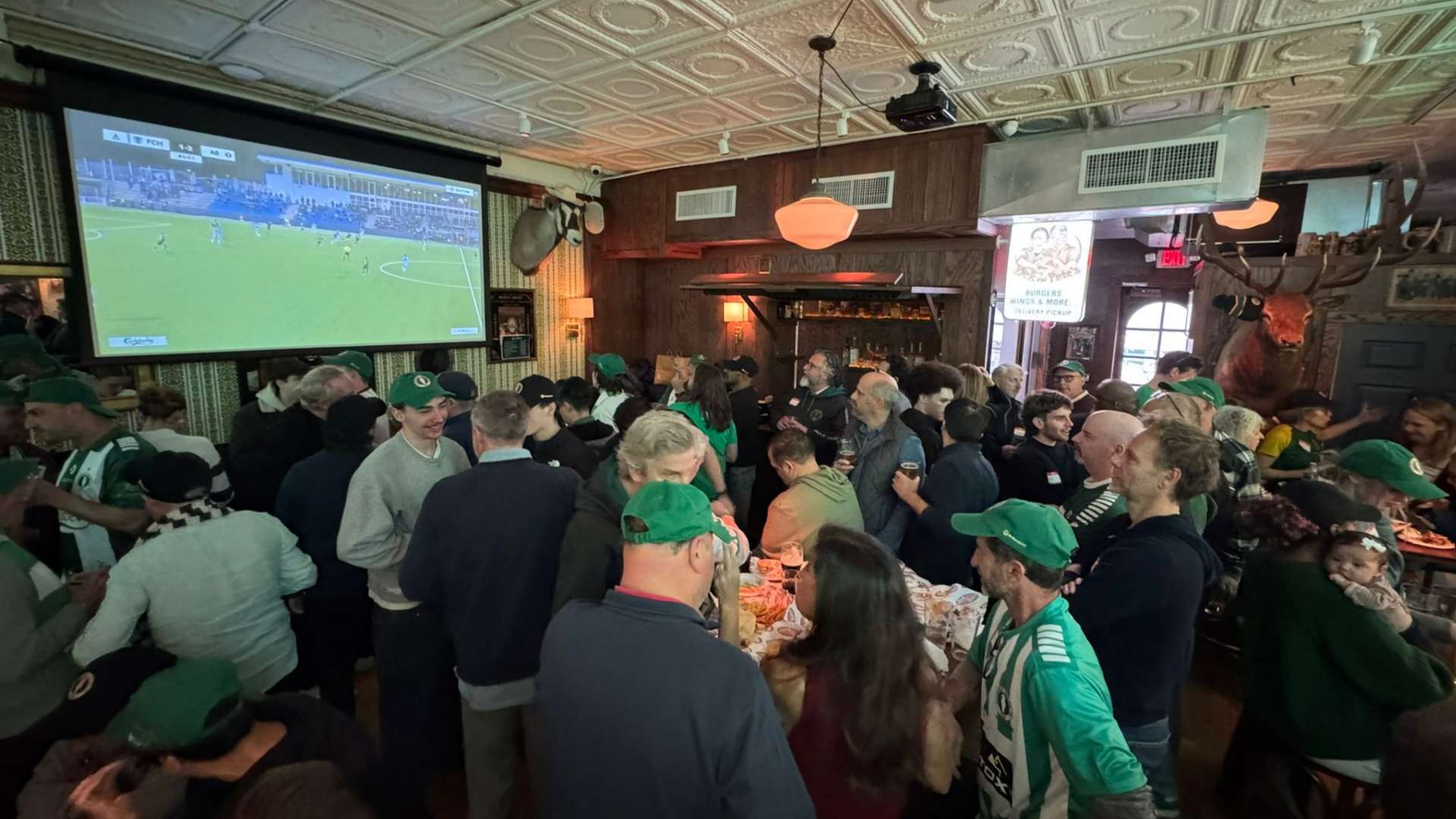
Ten minutes later, they scored. Gordon glanced across the room, shrugged, and pointed at the cadaver that loomed over Mugs Bar - a cramped back room tucked inside an otherwise unremarkable watering hole on one of Williamsburg’s busiest streets. Seventy-five people were there that day, standing shoulder to shoulder. Most matchdays, they are wedged into that space, chanting in a room that barely contains them.

But on that Friday at noon, for the final game of the regular season before the Danish league takes a winter break, they spilled out of their usual corner and onto the main floor. The whole bar was devoted to Danish soccer. It was a scene typical of Mugs, which routinely hosts an ever-expanding group of New Yorkers who watch and, in 2022, invested in AB, a struggling third-division club at the time.

What started with five industry veterans and a few friends has become fully fledged American ownership in Danish soccer. At first, it was a tiny group. Now, there are more than 150 owners, all bought in at various price points. As sports ownership goes, it’s cheap. It’s fun. And for the dozens that routinely show up at an otherwise unremarkable bar, it’s a joyful way to interact with the beautiful game.

“It’s changed my view of sports,” Chairman Brian Grieco, a business lawyer based in New York, said. “I have more excitement now for the team that I’m involved in than any of the other teams ever before.”

There are hundreds of bars in New York. Many show soccer these days. Almost every English club has an affiliation somewhere. Spike Lee owns an Arsenal pub called Gooners. There are at least two dedicated solely to Liverpool. There are bars for teams in Italy, Spain, Portugal, France, Argentina, and Brazil. Walk anywhere in New York, and the odds are there’s a screen showing soccer from somewhere in the world.

But Mugs is almost certainly the only bar dedicated to showing Danish third-division soccer. And it’s without question the only one where the people watching actually own the team. It’s not just about ownership - it’s about belonging, identity, and finding community through soccer.

  • AB crowd AB

    ‘The best opportunity for us’

    The attendance was “above average,” Gordon remarked as he walked around the bar, exchanging greetings and smiles with every other person. Those gathered in the space took in quite the scene. In the corner, there were two kegs of beer. On the right, there were multiple television screens. And on the left, a massive projector displayed a remarkably high-quality stream of a midseason clash between AB and FC Helsingor - set up, very much legally, thanks to club ownership.

    This is a fairly average scene at Mugs when AB play, never mind the fact that it was a Friday afternoon kick off. In 2022, Five Castles Football Group LLC - named as such because two of the five founding members lived somewhat close to some real-life castles - started a hunt for a football club. They had some spare cash, time for investment, and a desire to expand their portfolios. And as they peered around Europe, it quickly became clear that Denmark was the right place to look.

    “When we looked at different countries there, you're looking at price point, you're looking at the affordability, you're looking at some of the rules in terms of contracts, work permits, that type of stuff. We just evaluated that we thought that this was, all in all, the best opportunity for us,” Andy Glockner, an original investor, told GOAL.

    AB, too, made perfect sense. The Danish third division was a unique place, especially at the time. Back then, it was a step above amateur soccer, but slow to professionalize. With shrewd investment, any club could be lifted up the standings. And AB were a fine one to go for. They had all of the right pieces: a stadium that seats just under 8,000 - and can fit another 5,000 standing - proximity to Copenhagen and a loyal fanbase that has supported the club since its inception in the late 1800s. But crucially, they also had a fine history. They have won nine first division titles, the fourth most ever.

    This was a team that had been mistreated, cast aside, and fallen on hard times. For fans, that was a point of frustration. For soccer nerds looking to get involved, it represented an immense opportunity. Still, they couldn’t do it alone. The original five decided, then, to reach out to friends. Gordon, of the moose and the hat, was one of them. He had some spare cash kicking around, and joined forces with dozens of others - all of whom put in stakes of various sizes - to become part owners of the club. In the winter of 2022, their takeover was finalized.

    This was community football, de facto fan investment, done from thousands of miles away.

  • Advertisement
  • AB crowd Joe Gordon

    A wide-ranging crowd

    And they gather a few times per year at Mugs. On the Friday GOAL attended, the atmosphere was jovial. AB were hosting Helsingor, a struggling side who seemed on that unfortunate march towards relegation.

    The room was packed and full of green and white stripes. Kits were dotted throughout the crowd. Pints flowed from before kick-off. The youngest in the room were still infants, brought by their parents. Some were well into their 70s, part owners of the club in retirement. There were kids - let off early after a half day at school. Some owners and shirt sponsors were huddled nervously around a screen. A woman stood in the corner with a newborn. Her husband is an owner, but she still wanted to support.

    Some were there for the first time. Others haven’t missed a single game. Every single attendee wore a label with their name. They were encouraged to mingle. You could buy exclusive merch for a decent enough price (business, the sellers said, was pretty good).

    European football is known for its hardcore ultra culture, the sort of do-or-die, verging on intense fan who will give anything for their club. And certainly, there are some in the AB ownership collective who treat the team that way.

    “I’m pretty chill. I get excited, but if we win or lose. It's actually like it doesn't make my day, good or bad. I like it when we win, trust me, but I don't cry. There are some people you don't want to talk to,” Zach Smith, a board member who works primarily in sponsorship deals.

    But on Nov. 14, it was a family thing. Gordon played the main man, working the room. Yet there were loads of other familiar faces - young and old. And newcomers were welcome, too. The beer was free and provided by Carlsberg, which the club brought on as a front-of-shirt sponsor. The Danish beer brewer has been famously on the front of Liverpool kits for three decades, from 1992 to 2010.

    “It just goes to show that people are sort of in on this, you know what I'm saying? Like, Carlsberg is not putting their name on a club that they can't trust, that they think is going to be bad partners, that is going to be bad product,” Glockner added.

  • Gladsaxe StadionAB

    'I grew up a 10-minute bike ride from the stadium'

    Troels Gadegaard Frølich’s tale is one of those magical stories that only football can bring.

    Two years ago, he moved to New York to work for the Danish Consulate General. There, he was introduced to Gordon, a quick hello between soccer fans. Gadegaard Frølich was unlikely to have heard of the club, Gordon assumed. After all, theirs was a third-tier team, which played outside of the city, in the suburbs. The stadium sat less than 10,000. In all likelihood, Gadegaard Frølich would support a Superliga club - likely FC Copenhagen.

    But Gadegaard Frølich knew it well. AB were, in fact, his boyhood club.

    “In Denmark, we measure distances in bike rides,” he said. “I grew up a 10-minute bike ride from the stadium.”

    He hadn’t engaged with the team in a while. They had fallen on hard times, slipping from the top division. He has a couple of Football Manager video game saves and follows from afar. But he couldn't watch the team in Denmark, where the games aren't streamed. And besides, there were other priorities.

    But after meeting the owners, he’s a regular at Mugs. He also now invests, too.

    “I'm pretty sure I'm, like, the smallest investor. I mean, I'm not sure if my money would buy me even, like, a couple of blades of grass, but it was like, when do I get the chance? If not now?” he said.

  • AB playersAB

    ‘Club of Nerds’

    Sponsors were a big focus on the day. Smith affectionately refers to AB as a “club of nerds.”

    And he has a point.

    AB were founded when two students studying in Copenhagen wanted to merge academics and sports. For a few years, in the late 1800s, AB only played cricket. But when English Football Association rules proliferated throughout Europe, the youngsters insisted on starting a team. They joined up with students from the Technical University of Denmark to form what is now AB in its footballing form.

    That academic heritage makes for a nice story. And it’s also something the club has leaned into.

    “AB stands for the academics. And it's really a nerd club. It started out of the university, like many clubs did in the late 1800s, and we've had this kind of history of entrepreneurs and scientists and whatnot related to our club. And so we were like, ‘Hey, let's figure out if we can build a nerd theme,’” Smith said.

    Smith has no real soccer background. He is a self-professed “soccer Dad” who has grown into the game through his kids. But he is also immensely successful in the tech space. He works for Datum, a tech startup that does networking for artificial intelligence. It was a fine excuse for him to get involved in soccer in a more official capacity. He kicked in some cash and brought his tech nous, and also utilized his industry connections to bring in sponsorship revenue.

    “Technology kind of permeates the world. It goes everywhere, but so do sports. And so it's been really fun to add this kind of nerd appeal,” Smith said.

    These days, the club has three tech sponsors on its jerseys. Those patches, along with the Carlsberg front of shirt sponsor, make for a unique vibe - but a strangely appropriate one. Beer and science? This is, after all, a university club.

  • Commentating from an apartment in Queens

    You can’t watch Danish third division soccer in Denmark. At least, not in normal broadcasts. What it requires, instead, is a stream, usually without commentary. But AB’s owners have found their way around that problem.

    That came from another chance meeting. Smith was at a soccer tournament for his kids, where he met a Colombian American who was interested in commentating on soccer. The man lived in Queens and fancied doing some announcing in his free time. Smith offered him a good rate, and they sorted the setup. Their commentator worked hard on his pronunciation - Danish isn’t easy - but these days, they roll off the tongue.

    The bar, then, had perfect English commentary booming around on the speakers.

    Grieco watched nervously from a separate room. He’s a New York sports fan first, but got into soccer in the early 2000s. Milan were his first club, but since investing in AB, his loyalties have, naturally, shifted. He waxed lyrical about club ownership, how the team has embraced his ideas about expanding the matchday experience, and how nice Copenhagen was to visit with his family - especially compared to the hustle and bustle of New York City.

    And then, he paused. “I don’t mean to be rude, but we’ve got a penalty kick right now,” he said.

    He celebrated, partially out of relief, when Noah Engell slotted home.

  • AB crowd Joe Gordon

    'A very clear vision of what we want to be'

    AB were performing poorly on the day. They are, by some distance, the best side in the 2. Division (an admittedly confusing name for the third tier of Danish soccer). The stats make for good reading: 16 played, 12 won, 43 goals scored, 19 conceded. They press high, swarm their opponents, and try to run up the score as much as possible.

    “It’s just the way they play,” Glockner said.

    But lowly Helsingor grabbed a foothold in the game early and took the lead in the 18th minute from a well-worked counterattack. The AB response felt inevitable, though. First, it was Engell from the penalty spot after 30 minutes. They added a second shortly before the break. And by the time youngster Marcus Immersen made it three, the rout was on. The game finished 5-1. Routine stuff.

    They are well placed to kick on now. The Danish league takes a break for a few months, which allows the ownership group to get into the commercial side of things.

    “We're building this club in so many ways,” Greico said.

    It’s also a decent excuse for a training camp. AB also have a new coach to bed in after former boss Jóhannes Karl Guðjónsson had to leave due to personal reasons. They have promoted his assistant, and the vibes, so far, are good.

    Of course, the owners have to play it cool with the promotion talk. But AB have a four-point lead atop the table before it splits into round-robin style play. There is a very good chance that they will be playing second division soccer in 12 months.

    There are other plans: watch parties, more investment, community activities. They have not played top division soccer in over 20 years. Get promoted, invest well, and that might not be too far off.

    “We have a very clear vision of what we want to be, but I don't want to self-limit in terms of saying what we will be,” Glockner said.

    But most importantly, as AB piled on in that game, the lucky moose still had its hat on. And those Americans, rooting for a Danish team in the middle of Brooklyn, kept the Carlsberg flowing.