
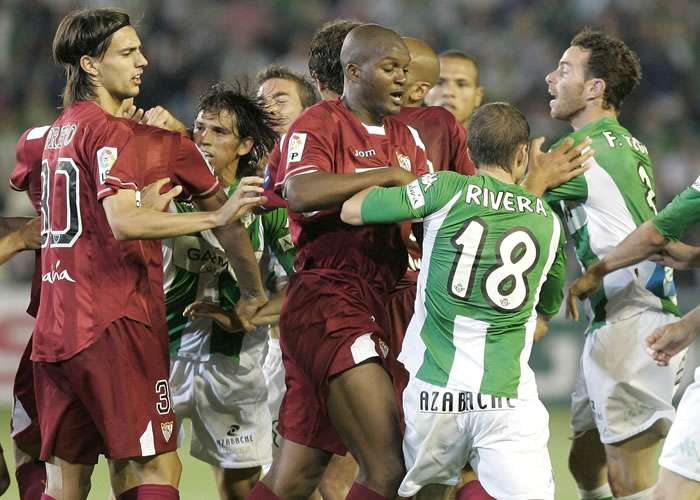
Around the rest of the world, this weekend marks another typically exciting round of Primera Division football, but this Saturday, in Spain, the atmosphere is distinctly charged. The bars are getting ready. Extra bottles of Rioja will be uncorked for another round of Calimochos, a Spanish drink consisting of 50 per cent red wine and 50 per cent Coca Cola (after a few tentative sips, it becomes much better than it sounds), and a few more links of chorizo will come up from the cellar. Saturday night will be packed to the hilt for a match few in Spain miss. Ask any Spaniard to choose between Barca and Real Madrid and, without a moment’s hesitation, you will have an answer. The same is the case for Sevilla Futbol Club and Real Betis Balompie.
Behind El Clasico, the Seville derby is the most anticipated in Spain. The Andalusian capital is inevitably consumed by one of the most rabid and violent rivalries in sport - riots are not uncommon. In Spain, as this column has explicitly discussed, football is married to the country’s politics and culture, but unlike the well-known historical background and bad blood between Real Madrid and Barcelona, the root of the civil unrest among the citizens of Seville remains relatively enigmatic. It is, however, no less venomous.
“¡Sevilla arriba, comiendo palomitas! ¡Betis abajo, comiendo escarabajos!” —Sevilla above, eating popcorn! Betis below, eating beetles!— The chant rises up over the din of schoolchildren playing a pickup match of football at recess. From an early age, when children across the whole of Spain divide themselves into teams, the sides often split into Sevilla and Betis. In Seville, the rivalry starts at an even younger age, as some particularly zealous fans will register their yet-unborn children for club membership, either as Sevillistas or Beticos. As these children grow to become adolescents, the relatively innocuous playground chants become far more vulgar with certain words emphasised by gestures that effectively drive the point home a bit further.
The rivalry continues to be just as pervasive in the adult world, to the point that it taints trade and commerce. It is not uncommon for taxi drivers who are hinchas (fans) of one team to refuse to drive to the other club’s stadium. The workweek after the match is marred by bouts as the winning team’s fans heckle their unfortunate counterparts in the office; some ardent supporters do not even bother to go to work on the following Monday. In 1999, the city of Seville built a brand new 50,000-seat stadium for the World Track and Field Championships, intending that Sevilla and Betis could eventually come to share the same pitch, but both clubs refused, remaining true to their traditions and staying in their own relatively outdated stadiums on opposite sides of the city. More recently, in the year 2000, Betis President Manuel Ruiz de Lopera, who single-handedly brought the club out of a financial tailspin in the early 90s, opted to build a new stadium over the old one (the structure just so happens to be named after the local businessman).
Unlike the well-hashed-out underpinnings of the Madrid - Barca rivalry, the roots of the deep-seated derision in Seville are far more obscure. Sevilla Futbol Club was founded in 1905 by Spanish aristocracy, but all was not well in the fledgling club’s boardroom. Two years later, in a row over the refusal to sign a player who came from a poor socioeconomic background, two directors of the club decided to break away and founded Betis Futbol Club. Naturally, Betis FC attracted the working classes and took on a left-wing reputation (a liberal reputation it retains to this day), but curiously enough, the club also gained the support of the then King of Spain, Alfonso XIII. Thus, when Betis FC merged with another club, Sevilla Balompie, in 1914, the club adopted the prefix ‘Real’ (royal) to become Real Betis Balompie. For much of the 20th century, Sevilla was the much wealthier and established club, but such economic disparities do not adhere to modern times.
Like Real Madrid and Barcelona, Sevilla and Betis seem to have an inverse relationship - that is to say, when one side experiences success, the other finds itself in the footballing doldrums. This only tends to add fuel to the already sweltering inferno, as the team doing well in a given year is always eager to rub salt in the unsuccessful team’s wounds, while the underachiever is given extra motivation to rain on the successful team’s parade. A win for either side is tantamount to winning La Liga. In terms of actually winning La Liga, Betis have only won La Primera once in their history, in 1935, just as civil war began to grip Spain. Similarly, Sevilla’s only La Liga title came 11 years later in 1946. Sevilla have faced abject humiliation from their southern counterparts by being demoted to the second flight twice in the late 90s, but in 2000, both Betis and Sevilla were forced to swallow the bitter pill of relegation, only to earn promotion to the top flight the following year.
In recent years, Sevilla’s success in the Copa del Rey and on the European stage in the UEFA Cup has taken the rivalry to new heights and, regrettably, violence has stained the derby. Few have forgotten the brutal botellazo - the glass bottle that was thrown by a Betis fan that struck then-Sevilla coach Juande Ramos in the head, knocking him unconscious. Some joke that Ramos sustained a bump so severe, he was concussed into believing he could manage a Premier League team. A ‘healthy’ rivalry, indeed.
But the unfortunate (although admittedly, too frequent) outbreaks of violence aside, the Seville derby is a uniquely spirited rivalry in Spain. During the 10-months of La Liga, football becomes a lifestyle and the passion becomes palpable. In a strange way, the Sevilla-Betis duality creates a unified sense of community as fans that share the same city share an equally ardent love for the game. Beneath all the heckling, lies an underlying sense of respect as supporters of both teams cordially tolerate each other’s presence, rubbing shoulders on the buses and, as Seville’s subterranean mass transit system becomes operational, packed together on the metro. In a truly beautiful instance of irony, the people are pulled together around a common and fervent sense of identity - a balanced yin and yang, each unable to exist without other. However, readers take heed; for the peaceful metaphor, as this columnist quickly learned, football does not make for a good topic of conversation to strike up with the barbers of Seville.
Cyrus C. Malek, Goal.com
Behind El Clasico, the Seville derby is the most anticipated in Spain. The Andalusian capital is inevitably consumed by one of the most rabid and violent rivalries in sport - riots are not uncommon. In Spain, as this column has explicitly discussed, football is married to the country’s politics and culture, but unlike the well-known historical background and bad blood between Real Madrid and Barcelona, the root of the civil unrest among the citizens of Seville remains relatively enigmatic. It is, however, no less venomous.
“¡Sevilla arriba, comiendo palomitas! ¡Betis abajo, comiendo escarabajos!” —Sevilla above, eating popcorn! Betis below, eating beetles!— The chant rises up over the din of schoolchildren playing a pickup match of football at recess. From an early age, when children across the whole of Spain divide themselves into teams, the sides often split into Sevilla and Betis. In Seville, the rivalry starts at an even younger age, as some particularly zealous fans will register their yet-unborn children for club membership, either as Sevillistas or Beticos. As these children grow to become adolescents, the relatively innocuous playground chants become far more vulgar with certain words emphasised by gestures that effectively drive the point home a bit further.
The rivalry continues to be just as pervasive in the adult world, to the point that it taints trade and commerce. It is not uncommon for taxi drivers who are hinchas (fans) of one team to refuse to drive to the other club’s stadium. The workweek after the match is marred by bouts as the winning team’s fans heckle their unfortunate counterparts in the office; some ardent supporters do not even bother to go to work on the following Monday. In 1999, the city of Seville built a brand new 50,000-seat stadium for the World Track and Field Championships, intending that Sevilla and Betis could eventually come to share the same pitch, but both clubs refused, remaining true to their traditions and staying in their own relatively outdated stadiums on opposite sides of the city. More recently, in the year 2000, Betis President Manuel Ruiz de Lopera, who single-handedly brought the club out of a financial tailspin in the early 90s, opted to build a new stadium over the old one (the structure just so happens to be named after the local businessman).
Unlike the well-hashed-out underpinnings of the Madrid - Barca rivalry, the roots of the deep-seated derision in Seville are far more obscure. Sevilla Futbol Club was founded in 1905 by Spanish aristocracy, but all was not well in the fledgling club’s boardroom. Two years later, in a row over the refusal to sign a player who came from a poor socioeconomic background, two directors of the club decided to break away and founded Betis Futbol Club. Naturally, Betis FC attracted the working classes and took on a left-wing reputation (a liberal reputation it retains to this day), but curiously enough, the club also gained the support of the then King of Spain, Alfonso XIII. Thus, when Betis FC merged with another club, Sevilla Balompie, in 1914, the club adopted the prefix ‘Real’ (royal) to become Real Betis Balompie. For much of the 20th century, Sevilla was the much wealthier and established club, but such economic disparities do not adhere to modern times.
Like Real Madrid and Barcelona, Sevilla and Betis seem to have an inverse relationship - that is to say, when one side experiences success, the other finds itself in the footballing doldrums. This only tends to add fuel to the already sweltering inferno, as the team doing well in a given year is always eager to rub salt in the unsuccessful team’s wounds, while the underachiever is given extra motivation to rain on the successful team’s parade. A win for either side is tantamount to winning La Liga. In terms of actually winning La Liga, Betis have only won La Primera once in their history, in 1935, just as civil war began to grip Spain. Similarly, Sevilla’s only La Liga title came 11 years later in 1946. Sevilla have faced abject humiliation from their southern counterparts by being demoted to the second flight twice in the late 90s, but in 2000, both Betis and Sevilla were forced to swallow the bitter pill of relegation, only to earn promotion to the top flight the following year.
In recent years, Sevilla’s success in the Copa del Rey and on the European stage in the UEFA Cup has taken the rivalry to new heights and, regrettably, violence has stained the derby. Few have forgotten the brutal botellazo - the glass bottle that was thrown by a Betis fan that struck then-Sevilla coach Juande Ramos in the head, knocking him unconscious. Some joke that Ramos sustained a bump so severe, he was concussed into believing he could manage a Premier League team. A ‘healthy’ rivalry, indeed.
But the unfortunate (although admittedly, too frequent) outbreaks of violence aside, the Seville derby is a uniquely spirited rivalry in Spain. During the 10-months of La Liga, football becomes a lifestyle and the passion becomes palpable. In a strange way, the Sevilla-Betis duality creates a unified sense of community as fans that share the same city share an equally ardent love for the game. Beneath all the heckling, lies an underlying sense of respect as supporters of both teams cordially tolerate each other’s presence, rubbing shoulders on the buses and, as Seville’s subterranean mass transit system becomes operational, packed together on the metro. In a truly beautiful instance of irony, the people are pulled together around a common and fervent sense of identity - a balanced yin and yang, each unable to exist without other. However, readers take heed; for the peaceful metaphor, as this columnist quickly learned, football does not make for a good topic of conversation to strike up with the barbers of Seville.
Cyrus C. Malek, Goal.com