+18 | Play Responsibly | T&C's Apply | Commercial Content | Publishing Principles
Christian Pulisic, Antonee Robinson, Tanner Tessmann, Mauricio Pochettino USMNTGetty Images

Talking tactics: By empowering Christian Pulisic, stresssing spacing and movement, something meaningful is forming for Mauricio Pochettino and the USMNT

Not so long ago, there was a man in the U.S. men's national team dugout that had fans divided. He seemed like a nice guy, wore cool Nike shoes, and his players liked him. He was, by most measures, a perfectly fine soccer coach. But when it came to tactics, the real minutia of setting up a team to win, that man fell short.

And so Gregg Berhalter was replaced by Mauricio Pochettino, one of the game's finest tacticians. Here was a groovy Argentine, with fresh ideas, and a player pool, he believed, could execute them in full. In three short games in charge of the USMNT, Pochettino is starting to be proven right in his summation. He hasn't reinvented this side as much as refined it, and implemented some rather basic, but simultaneously significant, changes. In effect, in the areas in which his predecessor fell just short, Pochettino excels.

Through three games - merely three games, it must be emphasized, friendlies against Panama and Mexico and a Nation's League quarterfinal against Jamaica - something is taking place tactically. The USMNT are starting to do smart things with and without the ball.

Build up structures are present. Players are moving at the right times, to the right spaces. Christian Pulisic, a virtuoso of an attacking player, is at the center of it all - but in a controlled way. In short, this is, in the smallest of sample sizes, looking like the kind of impact tactical setup that was promised. Following a 1-0 win against Jamaica in Kingston Thursday night - a game that was truly dire in the final minutes - one thing is clear: the USMNT have a system again. And it might just work.

  • Ricardo Pepi USMNT vs Jamaica HICGetty Images

    A recognizable build up structure

    First, the technical bit.

    None of the tactical ideas that Pochettino have instituted here are particularly novel, or overtly advanced. But they are the kind of basics that form the base of any successful soccer team. The way the USMNT set up in possession is the perfect example. When they have the ball, the U.S. play, roughly, in a 3-2-5 formation. One of the full backs - usually Joe Scally - drops deep alongside the two center backs to give the U.S. three men as a defensive base. Two midfielders - on Thursday night, Tanner Tessman and Johnny Cardoso - offer passing options in midfield.

    Everyone else pushed up to the attacking line. This defies the kind of expectations associated with starting positions. Antonee Robinson, a left back, plays as a left winger. Pulisic occupies an inside left space. Ricardo Pepi stays central. Weston McKennie drifts into the inside right. Yunus Musah plays as a right winger.

    Piece this all together, and the U.S. have a defined system through which to work the ball. If executed properly - spoiler, teams have systems to counter this thing - then every guy on the pitch should have at least two passing options. This is not a new thought in this sport. And it's constantly being tweaked. But it is, for this U.S. side, a standardized setup.

    And it's also how everything gets a bit more fun after.

  • Advertisement
  • Christian Pulisic, USMNTGetty

    Empowering Pulisic

    It is every manager's job to get the best out of his players. That seems obvious, but it's really not that simple. This is especially true in international management, as coaches cannot simply acquire players as they wish (Jurgen Klinsmann, famously, tried to challenge that accepted norm.) Pochettino, like any shrewd manager really should, has set up this team perfectly to let Christian Pulisic be Christian Pulisic. Pulisic is the best player on this USMNT in all of these areas:

    • Running
    • Dribbling
    • Passing
    • Creating
    • Finishing
    • Beating players out wide
    • Beating players in the middle
    • Finding space between the lines

    Asking him to do all of those things at once would seem impossible. But Pochettino, rather shrewdly, has already tried. This team has been assembled around Pulisic, with the Milan man given license to roam. Despite starting as an attacking midfielder, at various points on Thursday night, Pulisic played as a touchline winger, No. 10, false nine and inside forward.

    In other words, Pulisic is being told to go where he wants. This is only made possible, though, by the smarts and coordination with everyone around him. A look at the UMSNT's opening goal explains it all rather well.

    Pulisic drops from the last man down into the space between the defensive and midfield lines. To allow for his movement, McKennie pushes out to the right. Scally, a typically defensive full back, stays high and wide. Pepi, noticing the space opening due to Pulisic's run, makes a beeline for goal.

    And this is where Pulisic being good at football really helps. He receives a pass on the half turn, accelerates between two defenders, and rolls the ball into Pepi. All the striker has to do is finish (which he does wonderfully.) Or, as Pepi put it quite simply, "I saw Christian in between the lines and I started my run and I just finished it side net."

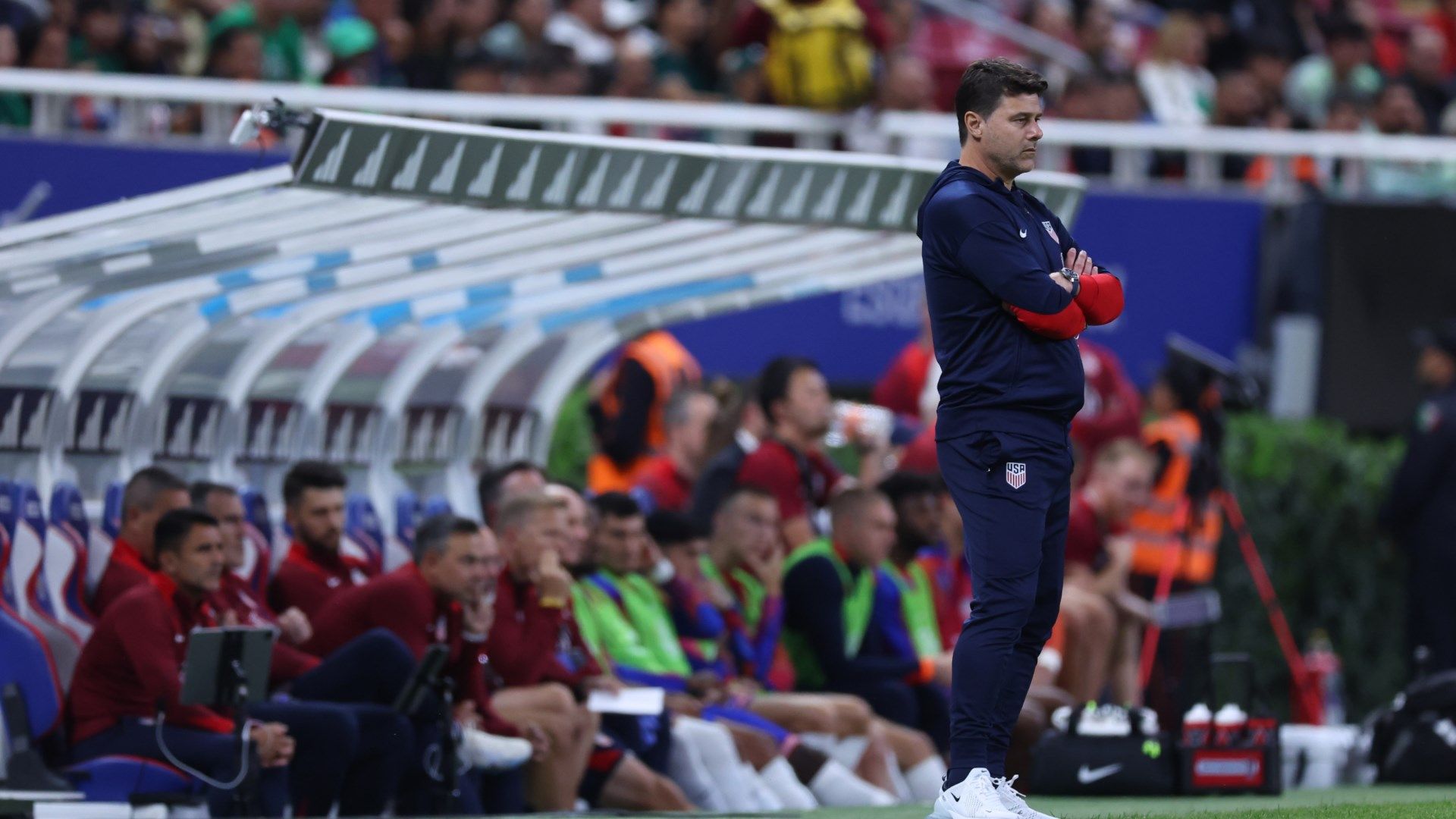
  • Mauricio Pochettino USMNT MexicoImagn

    Spacing and how it works

    Pepi's goal is a perfect example of how this can all be executed. But to understand it fully, it's worth noticing the way that the players move around each other. Possession-based teams aren't rigid these days. And when they have one virtuoso - in this case, the U.S. with Pulisic - everyone has to constantly move, and create passing options at all times.

    In other words, this is where a structure becomes a guideline - not a rule. Players here are encouraged to interpret their roles in different ways, but simultaneously ensure that there is ample room for the ball to be moved. That's why Scally, a right back, spent periods of the second half in the right half space of the front line. It's why McKennie started as a No. 10, but moved into all sorts of areas (he is perhaps better used in a deeper role, but his movement high up the pitch was invaluable.)

    Tessman, too, was valuable in that sense. The Lyon midfielder plugged holes when Antonee Robinson burst forward, dropping deep. His ball progression - an ability to pass forward - also helped at times. He wasn't a midfield maestro - none of the center mids Pochettino used were. But, in a different way, he was clever and aware.

    Sometimes, of course, you end up with the wrong player, in the wrong spot, at the wrong time. Scally playing as a forward for brief spells is not really where he should be. Pochettino was probably thankful that a good chance didn't fall to his right foot. But his mere presence there ensures that everyone has an option. This is not Ajax's total football. But the echoes of it are here.

  • Yunus Musah, USMNTGetty

    Musah, Musah, Musah

    There are, outside of Pulisic, a couple of individuals worth highlighting here. The first is Musah. He has always been a versatile presence, able to play either as a center midfielder, wide midfielder, or full back. It was, in fact, his efforts at the Santiago Bernabeu for Milan in the Champions League that helped keep Vinicius Jr quiet.

    Pochettino has embraced that versatility in every possible way. Against Panama, in Pochettino's first game in charge, Musah played as a right wing back, and scored his first USMNT goal by cleverly darting into the box (remember that whole bit about being able to switch positions?)

    Musah admitted, after that game, that a wide midfield spot might be his best:

    "I can see [Pochettino] knows a lot about my background. He knows about my academy days, playing at Valencia - everything," Musah said. "That's why today I played wide because he knows I used to play wide as well so it's nice that a coach knows about me, has a lot of faith in me."

    Against Mexico, in an admittedly less successful endeavor, he played as a center midfielder. And against Jamaica, Thursday night, he was used as a right winger. His material contributions weren't quite there - he managed just 37 touches. But his movement was constant, and he showed that, once again, he can always fill a space.

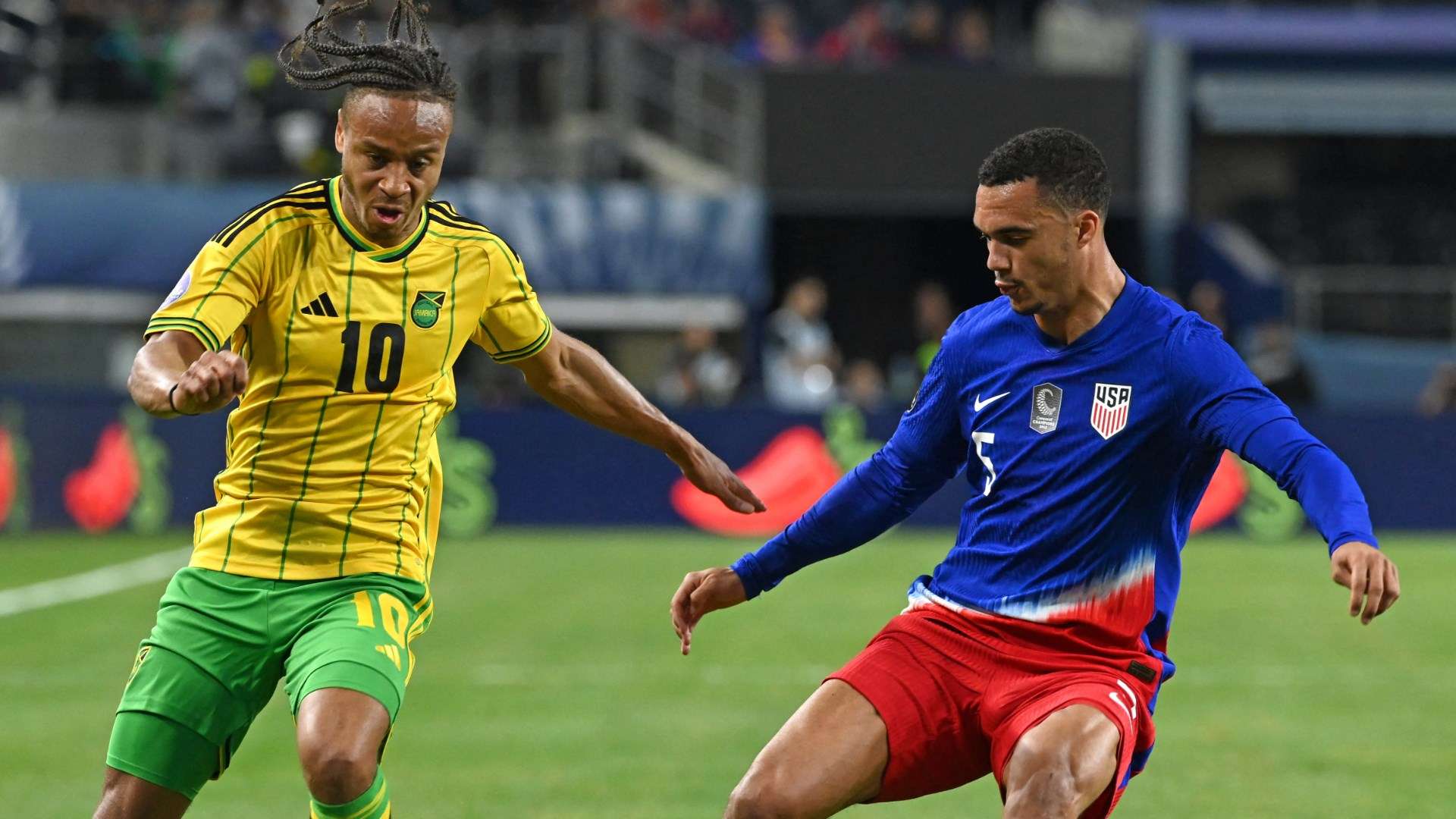
  • Antonee Robinson USMNT Nations League 2024Getty Images

    Antonee Robinson going for an adventure

    Also, a word on Robinson. It has been clear, for quite some time, that Robinson has immense potential as an attacking full back. The skill set is there: pace, dribbling ability, an ever-improving final ball. At Fulham, that's his remit: run up and down the left touchline. Receive the ball, cross the ball, and sprint back when you don't have it. This is hardly a new concept in football - Real Madrid great Roberto Carlos, who mastered this thing in the late 90s, would like a word. But Robinson does it very well.

    Under Pochettino, though, he is encouraged to do a bit more. There are the standard Robinson-at-Fulham things to be found. He is often used as a de-facto left winger - consistently the highest player up the pitch (seriously, he made a sprint to the corner flag in the 85th minute when the U.S. were trying to hold onto a lead against Jamaica.)

    But there are other things happening here. At times, when Scally pushed up on the other wing, Robinson dropped deeper down the pitch, and got involved in midfield areas. And at the start of the second half, when Pulisic started to have some joy against the leggy Jamaican right back Dexter Lembikisa, Robinson played further inside - effectively replacing the U.S. star man's starting position.

  • Matt Turner USMNT vs JamaicaGetty Images

    Mid block off the ball

    Much was known about Pochettino when he took this job. You could piece together a playing style by looking at his managerial career to date - especially with the ball. The U.S. were always going to try to play quickly, be fluid in attack, and rely on the kind of unpredictable movement required to unsettle an opposing defense. These things were expected, and so far they have been implemented.

    What has been less predictable, though, was the setup without the ball. Pochettino was acclaimed around world football for his signature pressing style - the way in which he would encourage his team to hunt down the opponent, with the goal of winning possession as close to the opposing goal as possible.

    Thus far, for the U.S., he has scrapped that. Without the ball, his team are organized and compact, switching into a 4-4-2 formation. The two forwards prevent the opponent from passing to the middle. Wide midfielders cut lanes to the wings. And instead of pressing high, they occupy, roughly, the middle third of the pitch. The nerds call that a "mid-block."

    There are some nuances. Pochettino likes his team to be close together, and compact, employing a high defensive line. At its best, it prevents counter attacks. When it fails, it leaves the U.S. susceptible to the long ball - and creates chaos. Jamaica exploited the tactic once or twice. It's how they won the penalty that Matt Turner saved. Perfect? Not yet. But it got the job done against Jamaica.

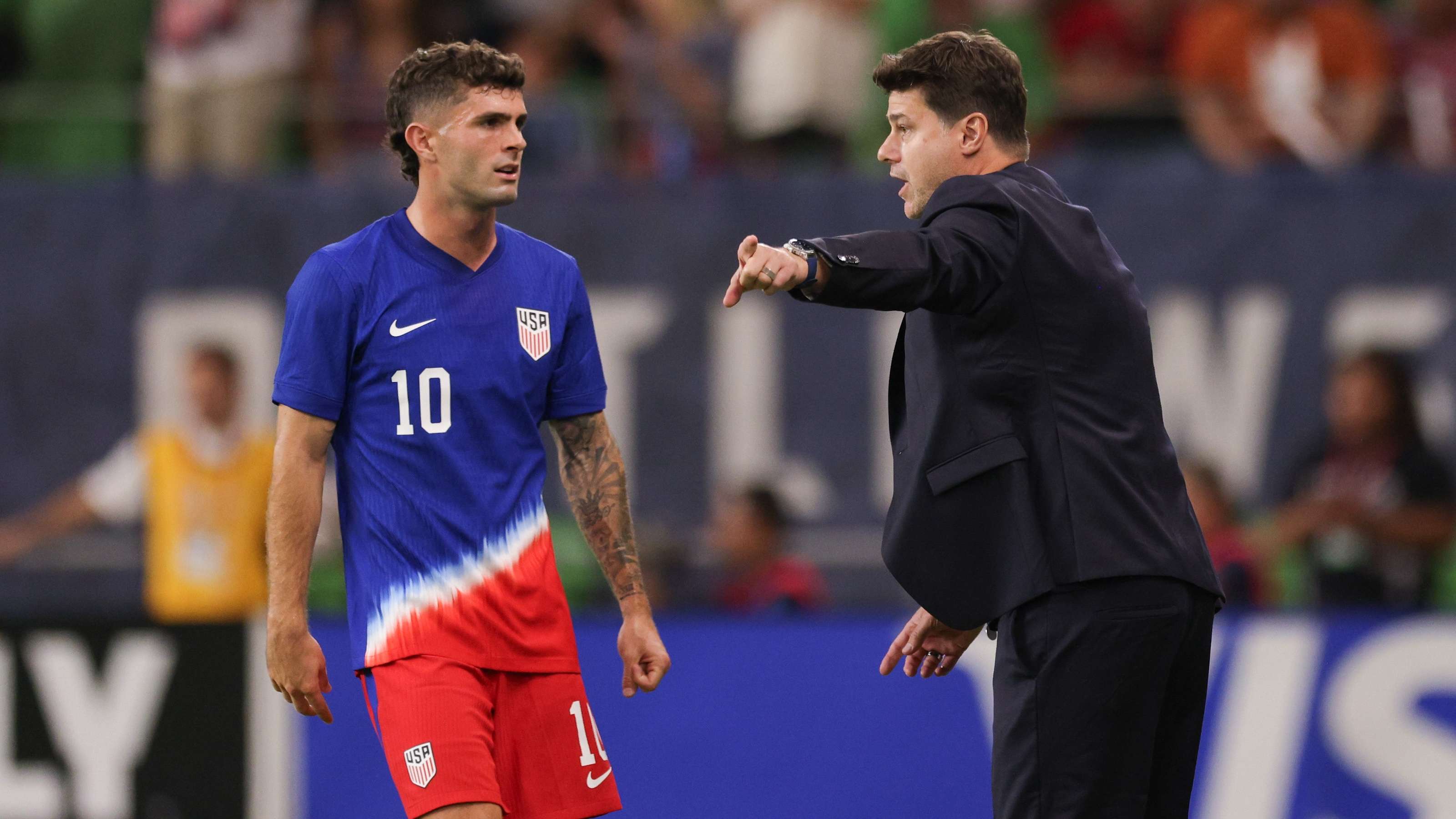
  • Mauricio Pochettino Christian Pulisic USMNTGetty Images

    Still experimenting

    Perhaps the most crucial thing to note here is that it's all subject to change. Pochettino has a playing style, a group that he trusts, and two good results to show for it. Win the second leg against Jamaica on Monday night, and his start as USMNT can be considered nothing short of a roaring success. This is all a build up to the 2026 World Cup, of course, so the building blocks matter.

    But things could happen in the coming months. Pochettino himself admitted that things can always be switched around - promising a wholesale review in January.

    "The most important thing is to have a review after this camp," he said in announcing the squad for this camp on Sunday. "To talk with the federation, with the sporting director... to translate our ideas, about what our view is about the organization, about what we need to improve. We have an idea, but we want to be really, really clear."

    Furthermore, there will be new faces to integrate. Tim Weah, presumably a nailed down starter going forward, will be available for the second leg after missing Thursday's match due to a red card in the Copa America. Due to injury, illness and recovery, players such as Folarin Balogun, Tyler Adams, Sergino Dest, Josh Sargent, Gio Reyna and Brenden Aaronson were all missing from Thursday's squad.

    If the World Cup were to start today, Pochettino would be without nearly half of his best XI. Their availability can and will change things. New faces need integrating. But, for now at least, there's a vision. Something meaningful is forming. Pochettino's ideas are starting -just starting - to come to fruition. Now where can they go from here?